



Welcome to ChinaVoice, a new podcast series from the ChinaAffairsplus team. Hosted by Chenghao Sun, we will invite scholars and experts to discuss major international issues from great power relations and global governance to emerging security and diplomatic challenges. Through these conversations, we hope to share diverse perspectives on China’s foreign policy and the evolving international landscape.
Artificial intelligence is advancing at an extraordinary pace globally, and the core debate has shifted from who owns more powerful models and advanced chips to how to carry out effective global AI governance. This year’s World Artificial Intelligence Conference (WAIC) provides a key window to observe this issue, as the conference has gradually transformed from a technical and industrial event to a high-level international platform focusing on global AI governance, and made new progress in promoting the establishment of the World AI Cooperation Organization (WAICO).
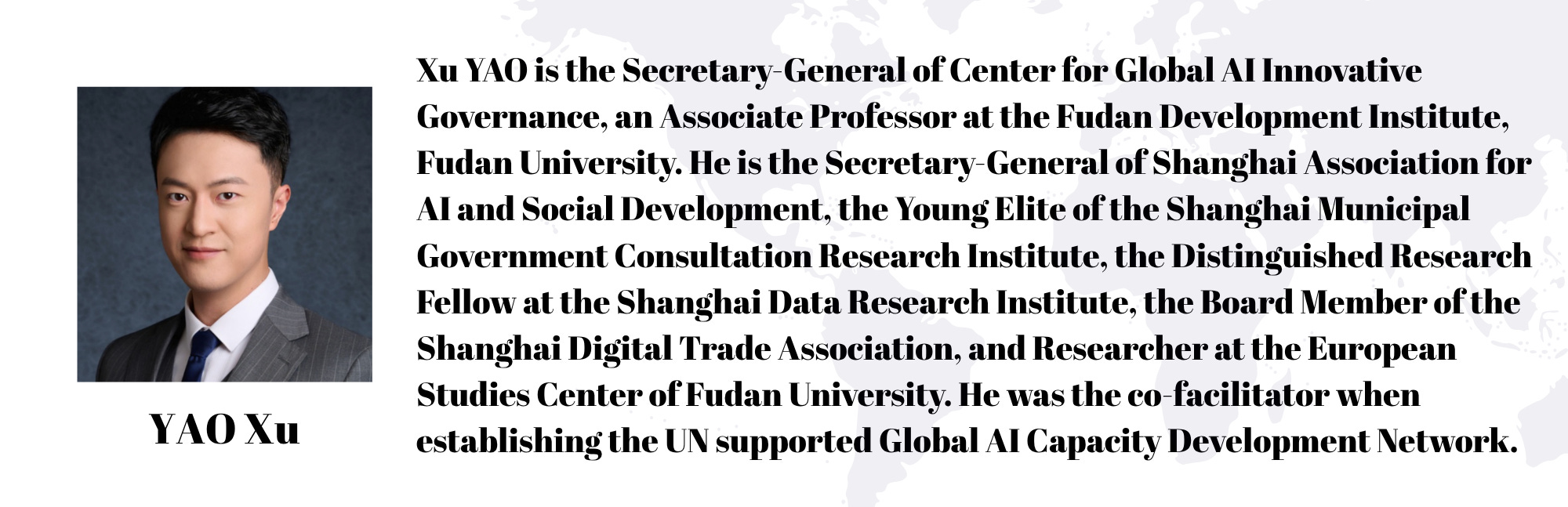
What are the new changes of WAIC 2026? What is the positioning of WAICO, how should we understand the different international reactions to this initiative? How to evaluate the current advantages and bottlenecks of China’s AI development? How will AI competition between China and the United States evolve, and what is the space for practical cooperation between the two sides? In this episode of ChinaVoice, we are honored to invite Yao Xu, Associate Professor, Secretary-General of Center for Global AI from Fudan University, who has been deeply involved in related work, to analyze the transformation of WAIC, the development of WAICO, the current situation of China’s AI development, the prospect of China-US AI relations, and China’s contribution to global AI governance.
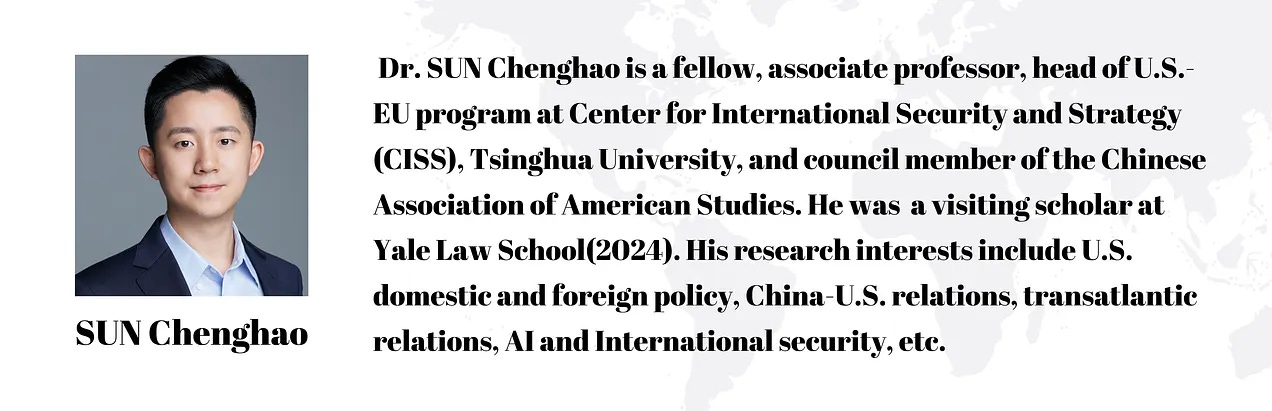
Experts in Today’s Dialogue:
Timestamps:
Key Points:
World Artificial Intelligence Conference (WAIC) is gradually evolving from a technology- and industry-focused event into a more international platform connecting technological innovation with global AI governance.
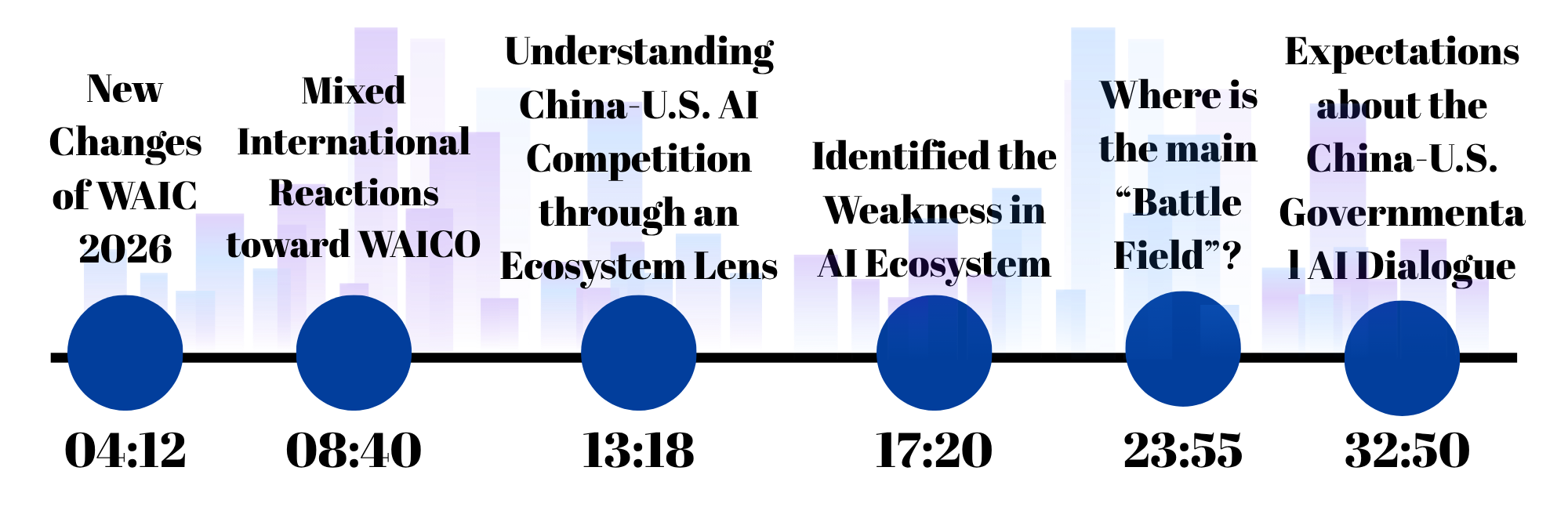
From SUN Chenghao’s perspective, WAIC 2026 made this shift particularly visible through broader international participation, a stronger emphasis on governance, and the agreement-signing process related to the World AI Cooperation Organization, or WAICO. Yao Xu agreed that this reflects a longer-term evolution rather than a sudden change. He explained that WAIC initially focused largely on showcasing the development of Shanghai and China’s AI industry, but since around 2024 it has increasingly become a high-level platform bringing together governments, industry leaders, academics, and international organizations. He also stressed that WAICO should be understood more precisely as an initiative still in the process of institutional development, with the 2026 conference marking the signing of an intergovernmental agreement rather than the formal launch of the organization.
Sun Chenghao observed that international reactions to WAICO have been mixed. While many countries in the Global South appear interested in an additional platform for AI capacity building and governance, some observers have questioned whether China is attempting to build an alternative AI governance architecture. He suggested that this reflects a broader tendency in international politics for even global governance initiatives to be interpreted through the lens of geopolitical competition.
Yao Xu argued that such skepticism is understandable, but that the more important question is whether international institutions can actually provide the global public goods that developing countries need. Drawing on his engagement with Global South scholars and practitioners, he emphasized their demand for high-quality datasets, computing resources, technical expertise, training programs, and other forms of capacity building. He argued that WAICO’s significance will ultimately depend on whether it remains open and inclusive and whether it can provide practical assistance rather than become a closed geopolitical bloc.
About China’s AI capabilities, Sun argued that it should not be measured simply by comparing frontier models. While the rapid development of models such as Kimi K3 reflects China’s technological progress, he suggested that a country’s overall AI competitiveness also depends on semiconductors, computing infrastructure, energy, talent, applications, safety, and the ability of society to absorb technological change.
Yao agreed and cautioned against placing too much emphasis on individual “moments” such as a “DeepSeek moment” or “Kimi moment.” In his view, these breakthroughs are usually the visible outcome of much longer processes of technological accumulation. He identified China’s emerging AI ecosystem as one of its major strengths, particularly the increasingly close interaction among universities, research institutes, frontier laboratories, start-ups, and large technology companies. At the same time, he regarded advanced semiconductors and computing resources as China’s clearest structural weakness, noting that the United States still maintains a substantial advantage in chips, data-center capacity, and aggregate compute.
Sun placed infrastructure and social adaptation within the broader definition of national AI capacity, emphasizing that energy, data centers, supply chains, and the ability of society to absorb technological disruption are becoming increasingly important.
Yao added that China and the U.S. face somewhat different political and social environments in expanding AI infrastructure. He noted that public opposition to data centers has become more visible in the U.S. because of concerns over electricity consumption, water use, environmental pressure, and local infrastructure, whereas China may have greater capacity to coordinate large-scale infrastructure through national and local planning. At the same time, he stressed that China also faces serious social challenges from AI, particularly concerns about automation, employment displacement, autonomous driving, creative industries, and the rapid transformation of existing occupations. In his view, these are not uniquely Chinese problems but common challenges that all major economies will increasingly have to address.
On China–U.S. AI competition, Sun argued that the rivalry is increasingly shifting beyond individual models toward competition between entire technological ecosystems. Given that technological competition is likely to remain a persistent feature of China–U.S. relations, cooperation will need to coexist with competition rather than replace it.
Yao cautioned against describing this as a direct or symmetrical “battle.” He suggested that the two countries currently occupy different positions, with the United States still maintaining clear advantages in frontier models, advanced semiconductors, computing resources, cloud infrastructure, and global talent concentration, while China is catching up rapidly. He therefore described the relationship more as two runners at different stages of the race than as two equal competitors confronting one another across every dimension of AI.
Technological competition does not remove the need for cooperation on shared risks. Sun identified military applications of AI, AI–nuclear risks, misuse by non-state actors, critical infrastructure, and frontier AI safety as areas in which neither China nor the United States can fully manage the consequences alone.
Yao agreed and argued that emerging risks associated with advanced AI, especially in combination with nuclear technology, biotechnology, and other high-consequence scientific capabilities, could provide a practical foundation for bilateral cooperation. About the upcoming China–U.S. dialogue, Yao believed that it should treat AI safety itself as a global public good. Under this approach, China and the U.S. could cooperate in providing regulatory sandboxes, safety toolkits, evaluation mechanisms, technical assistance, and capacity-building programs to Global South countries. This would make safety governance more closely connected to development and reduce the risk that developing countries see AI safety rules simply as new barriers to technological participation.
At the same time, Sun argued that an official China–U.S. AI dialogue should pursue relatively modest and realistic objectives. It should not attempt to resolve the broader technological competition between the two countries, which would be unrealistic, but instead identify areas where both sides have a shared interest in preventing unintended outcomes. In his view, a realistic success would involve creating channels for risk reduction, practical cooperation, basic common understandings, and continued communication.
Yao broadly agreed but placed stronger emphasis on openness. He argued that the experience of both China and the U.S. shows that scientific progress benefits from cross-border exchange, talent mobility and interaction among researchers. He therefore urged both sides to keep genuinely sensitive competition within a limited range and prevent security concerns from overwhelming the broader relationship between their scientific and technological communities.
Follow ChinaVoice Now
Apple Podcast
Spotify
RSS Feed
https://rss.com/podcasts/chinavoice/3106349/(You can also copy this address from your browser’s address bar and paste it into any podcast app that supports RSS.)
Team
Executive Producer: Chenghao Sun
Producer: Yining Li, Yinuo Wang
Content Editor: Xueyu Zhang, Yijie Li, Yexu (Jasmine) Wang
Graphics Designer: Xueyu Zhang


