



Welcome to the 10th edition of Ask China! I’m SUN Chenghao, a fellow with the Center for International Security and Strategy (CISS) at Tsinghua University, Council Member of The Chinese Association of American Studies, a visiting scholar at Paul Tsai China Center of Yale Law School in 2024 and Munich Young Leaders 2025.
ChinAffairsplus is a newsletter that shares articles by Chinese academics on topics such as China’s foreign policy, China-U.S. relations, China-Europe relations, and more. This newsletter was co-founded by my research assistant, ZHANG Xueyu, and me. Through carefully selected Chinese academic articles, we aim to provide you with key insights into the issues that China’s academic and strategic communities are focused on. We will highlight why each article matters and the most important takeaways. Questions and feedback can be addressed to sch0625@gmail.com.
In this newsletter, we address concerns about China’s positions through a Q&A format, while also presenting key points of leading Chinese scholars’ commentaries. Through this series, we aim to provide policymakers, think tanks, and strategic communities overseas with access to Chinese scholars’ views, accompanied by curated academic perspectives that help readers better understand the considerations underlying China’s foreign policy choices.
Background
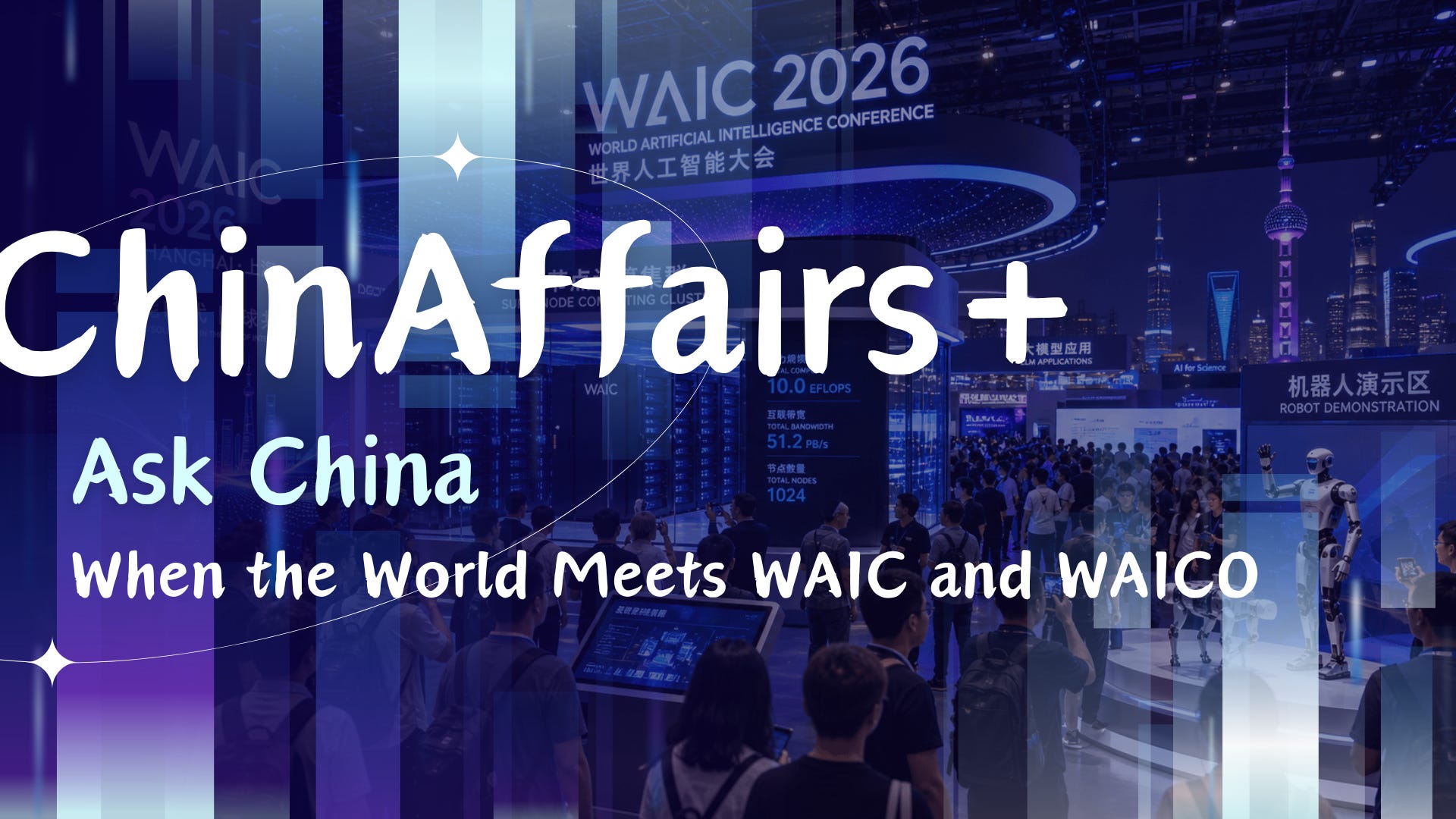
On July 17, the 2026 World Artificial Intelligence Conference and High-Level Meeting on Global AI Governance opened in Shanghai. Chinese President Xi attended the opening ceremony and delivered a keynote address titled “Joining Hands to Build a Just and Equitable System For Global AI Governance.” The World AI Cooperation Organization was also established in Shanghai. What solutions does China propose for global AI governance, and how will these proposals be translated into practice? Against this broader backdrop, how does China view its competition with the United States in shaping the future of global AI governance? In this episode of Ask China, we bring together the perspectives of Chinese scholars to offer readers a closer look at these questions.

The outcomes of the 2026 World Artificial Intelligence Conference (WAIC) indicate that China has gradually developed a coherent approach that connects normative principles, institutional arrangements and practical cooperation. President Xi Jinping’s keynote address presented China’s proposal through four dimensions—development, security, civilization and governance. The establishment of the World Artificial Intelligence Cooperation Organization (WAICO) at the Conference further translated these principles into concrete actions.
From the development dimension, it regards governance as an enabler of technological progress rather than merely as a means of mitigating risks. The Chair’s Statement advocates an innovation ecosystem that is enterprise-led, market-driven, application-oriented, research-grounded and talent-based. It also calls for the promotion of the AI Plus model, the responsible development of open-source ecosystems, and the application of AI in science, education, agriculture, health and so forth. These commitments show that China does not place governance in opposition to innovation. Instead, it seeks to use appropriate rules, infrastructure, open-source cooperation and scenario-based applications to unleash the potential of AI, facilitate industrial upgrading and improve the accessibility of AI technologies and services.
From the security dimension, China is committed to a controllable path of AI. The Conference called for the establishment of laws and regulations, technological monitoring, risk-warning and emergency-response systems, while also advocating tiered and category-based management according to the characteristics and risk levels of different AI systems. Large language models should be equipped with necessary guardrails, while AI agents should operate within clearly defined decision-making authority and behavioral boundaries, supported by mechanisms for behavior tracing and risk alerts. The scope of governance extends from data security, personal information protection and algorithmic ethics to critical infrastructure and the malicious use of AI by terrorist, extremist and transnational criminal groups. At the same time, China opposes overstretching the concept of national security and using security concerns to justify technological blockades or decoupling. The objective is to ensure that AI remains a trusted tool for humanity and is always under human control without suppressing technological innovation.
From the civilization dimension, China promotes a culturally inclusive approach that places human dignity, social well-being and mutual learning between civilizations above technological efficiency alone. The Conference emphasized that AI development should respect differences in national histories, cultures, social systems and forms of civilization, rather than imposing a single cultural or ideological model on the world. It also called for systematic responses to the impact of AI on employment, including AI education, skills training, job creation and the protection of workers’ rights and dignity. China’s commitment to enable 30 countries to use MAZU, an AI-powered meteorological warning system, further transformed the principle of AI for good into a practical international public good serving disaster prevention, public safety and the protection of livelihoods.
From the governance dimension, a major institutional outcome of the Conference was the establishment of WAICO in Shanghai. The organization is intended to promote policy dialogue, technical cooperation, governance coordination and capacity building, with particular attention to the needs of Global South countries. China also announced that, over the next five years, it would provide developing countries with 5,000 opportunities in AI training and seminar programs and establish international AI application cooperation centers with major regional organizations. These measures show that China also seeks to strengthen the capacity of developing countries to innovate, apply and govern AI, thereby bridging the AI and digital divides.

For many countries across the Global South, the question is no longer whether to adopt artificial intelligence, but how to do so without becoming dependent on a single technology ecosystem. As AI capabilities become increasingly concentrated in a handful of countries and companies, governments in Asia, Africa and Latin America are looking for partnerships that strengthen domestic capabilities rather than lock them into proprietary platforms. The 2026 World Artificial Intelligence Conference (WAIC) presented China’s answer to this demand: a collaboration model that prioritises capacity building, open ecosystems and multilateral governance over technology dependence.
While advanced economies tend to focus on frontier innovation, AI safety and regulation, many developing countries remain constrained by an emerging “intelligence divide”. Computing power, foundation models and high-end AI talent remain heavily concentrated in a small number of countries and leading technology firms, leaving many Global South countries at a structural disadvantage. Representatives from developing countries consistently raised the same concern: they wanted greater opportunities to participate in the AI revolution, but feared that unequal access to infrastructure, talent and data would create a new form of global inequality. From this perspective, AI governance is not only about managing risks, it must also ensure that more countries can develop and use AI on their own terms.
WAIC therefore framed international cooperation less as technology transfer than as capability building. For instance, China pledged to provide 5,000 AI training places for developing countries and to establish International AI Application Cooperation Centres serving regional organisations including ASEAN, the African Union, the Arab League, CELAC, BRICS and the Shanghai Cooperation Organisation. Beyond training, cooperation extends to joint research, governance exchanges and long-term technical support. In this model, universities and research institutions become long-term partners in knowledge production and talent cultivation rather than simply channels for technology transfer.
Another feature of WAIC’s collaboration model is its emphasis on open and adaptable AI ecosystems instead of exclusive platforms. Throughout the conference, Chinese companies showcased open-source foundation models alongside lightweight AI applications designed for deployment in resource-constrained environments. Visitors from Southeast Asia, Africa and Latin America showed particular interest in the low-cost weather early-warning systems, rural digital education platforms and compact industrial AI solutions that require relatively limited computing infrastructure. These demonstrations reflected that future cooperation aims to help countries build their own AI ecosystems.
WAIC also sought to redefine AI governance as an enabler of development. During the conference, 29 countries signed the agreement establishing the World AI Cooperation Organisation (WAICO) in Shanghai. Rather than allowing governance rules to be determined primarily by technologically advanced countries, these new institutions aim to expand developing countries’ participation in setting standards, building regulatory capacity and shaping the future architecture of global AI governance.
Taken together, these initiatives suggest that instead of promoting closed technology platforms, WAIC seeks to promote the conditions for technological development itself: skilled talent, institutional capacity, open-source ecosystems, local adaptation and multilateral governance. Whether this model can be implemented at scale remains to be seen. But for many Global South countries seeking greater technological autonomy without technological isolation, WAIC offered a vision of AI cooperation that is alternative to both technological dependence and geopolitical alignment.

Yes—but only if WAICO continues to uphold the United Nations as the main channel for global AI governance and positions itself as a complement to, and a connector within, the existing global governance architecture, rather than as a parallel system created outside it. Whether a new international mechanism contributes to governance fragmentation depends less on who initiated it than on whether it can effectively align itself with existing international institutions. WAICO’s founding agreement affirms the purposes and principles of the UN Charter; its purpose is to strengthen international AI cooperation within the broader UN-centered framework.
At the same time, WAICO addresses a long-standing weakness in global AI governance: insufficient representation. Existing international rules are often shaped primarily by a small number of technologically advanced countries, while developing countries have limited opportunities to participate. This creates an imbalance between the production of rules and the representation of interests. WAICO’s founding members span Asia, Africa, Latin America, and Europe. By following the principle of extensive consultation, joint contribution, and shared benefits, it expands opportunities for Global South countries to participate in rulemaking and capacity building, helping move AI governance from an “exclusive club” toward an open platform for all countries to participate, strengthening the representation and voice of Global South countries in AI governance.
More importantly, WAICO seeks to address another major weakness in the current system: the gap between principles and action. The international community does not lack broad principles concerning AI ethics, safety and development. What it lacks are durable mechanisms that can translate those principles into sustained cooperation and tangible international public goods. Through the AI Capacity-Building Action Plan for Good and for All, WAICO can promote capacity building through professional training, joint application centers and technological cooperation, thereby integrating governance rules with development cooperation. Hu Yi describes this function through three important transitions: “turning consensus on principles into coordination mechanisms, technological capabilities into public goods, and development needs into governance issues.”

To turn principles such as “AI for Good,” “inclusive development,” and “multilateralism” into international governance mechanisms that countries can monitor, assess, and implement, the international community needs to build a coherent institutional chain from shared values to practical action.
First, states should translate broad principles into common standards and concrete requirements. Within multilateral frameworks such as the United Nations, states should build consensus around the core principles of AI governance. They should define “AI for Good” through clear requirements concerning safety, effective human oversight, transparency and explainability, fairness and non-discrimination, and accountability. International institutions and technical bodies should also develop common standards for model training, data governance, safety assessment, and the allocation of responsibility.
Second, regulators should adopt a risk-based and adaptive approach to monitoring and assessment. Because AI systems vary significantly in their purposes and potential risks, regulators should tailor governance requirements to different risk levels and application contexts. They can apply relatively flexible rules to lower-risk applications while requiring high-risk applications to meet stricter testing, certification, accountability, and withdrawal requirements. Regulators should also move beyond one-time, pre-deployment reviews. Through a recurring process of monitoring, assessment, adjustment, and regulatory revision, they can update standards and regulatory measures in response to technological developments and real-world impacts.
Third, international institutions, governments, companies, and social actors should share responsibility for implementation. At the international level, the United Nations and other multilateral institutions should coordinate different governance arrangements and promote cooperation on AI safety standards, assessment methods, and certification procedures. At the national level, governments should incorporate these standards into laws and regulations, clarify the responsibilities of developers, platforms, and users, and establish testing, certification, market-access, and withdrawal requirements. Companies should take responsibility for managing the risks associated with the technologies they develop and deploy, while civil society, academic institutions, and other stakeholders should provide oversight and feedback.
Fourth, the international community should strengthen capacity building to advance inclusive development. Many countries in the Global South still lack sufficient capacity to develop and govern AI. International cooperation should therefore do more than establish common rules; it should also help developing countries implement them. International AI capacity-building centers, global capacity-development networks, training and exchange programs, and the provision of global public goods can strengthen these countries’ technological capabilities, risk-identification capacity, and governance institutions while narrowing the global AI divide.

Over the past year, global AI governance has been characterized by two parallel trends: the rapid acceleration of technological innovation alongside rising governance risks, and intensifying strategic competition alongside expanding international cooperation. AI infrastructure, computing power, frontier foundation models, and high-end talent remain concentrated in a small number of countries and leading technology firms, leaving many developing countries facing a widening “AI divide.” At the same time, significant differences remain over AI regulation, data governance, and technical standards, while a broadly accepted global governance framework has yet to emerge.
Against this backdrop, the United States has continued to frame AI primarily through the lens of strategic competition. On the one hand, it has strengthened export controls, investment restrictions, semiconductor regulations, and other technology-related legislation to constrain China’s technological advancement. On the other hand, it has sought to build an AI ecosystem centered on the U.S. technology stack and allied partners in order to preserve its leadership in both technological innovation and global rule-making. In contrast, this year’s World Artificial Intelligence Conference (WAIC) placed greater emphasis on AI governance, global technological risks, and inclusive development. Rather than viewing AI through a zero-sum geopolitical lens, the conference approached AI as a global public good and highlighted the need for international cooperation. This reflects China’s broader understanding of long-term China-U.S. AI competition.
First, China believes that long-term AI competition should not evolve into uncontrolled technological confrontation. Escalating rivalry could increase the risks of AI safety failures, fuel an AI-driven arms race, fragment the global technology ecosystem, and ultimately force third countries to choose between competing technological systems, thereby undermining global innovation.
Second, China views AI competition as extending beyond technological breakthroughs alone. Competition is not simply about achieving marginal advantages in frontier models or computing power, but also about building resilient innovation ecosystems, strengthening governance capacity, and promoting responsible development. In this sense, governance capability itself constitutes an important dimension of national AI competitiveness. China argues that countries able to promote more open, inclusive, and responsible AI governance—and uphold the principle of AI for Good—will possess greater long-term strategic influence.
Third, China recognizes that strategic competition with the United States is likely to remain a long-term reality. While China does not regard confrontation as its preferred choice, it acknowledges the need to respond to sustained U.S. competitive pressure by strengthening its own technological capabilities and maintaining long-term strategic resilience.
The priorities highlighted at this year’s WAIC illustrate how China intends to prepare for this long-term competition. The first priority is to further strengthen indigenous innovation. China remains confident about its progress in large language models, industrial applications, and AI ecosystem development, while recognizing that gaps remain with the world’s leading frontier models, particularly in fundamental research and original innovation. Strengthening basic research and core technologies therefore remains a strategic priority.
The second priority is to expand international partnerships. China continues to advocate openness and inclusiveness by deepening cooperation with developing countries and other international partners in areas such as infrastructure, talent development, and capacity building. This reflects both China’s aspiration to contribute to global AI governance and its effort to prevent further fragmentation of the global AI ecosystem.
The third priority is to strengthen talent development and long-term innovation capacity. Beyond cultivating more AI specialists, China emphasizes developing a workforce capable of effectively using AI tools while retaining uniquely human capabilities, including independent thinking, creativity, and lifelong learning. Ultimately, China sees long-term AI competitiveness as depending not only on technological advances themselves, but also on the quality of human capital and the capacity to harness technology responsibly.


