



Welcome to the 79th edition of our weekly newsletter! I’m SUN Chenghao, a fellow with the Center for International Security and Strategy (CISS) at Tsinghua University, Council Member of The Chinese Association of American Studies and a visiting scholar at the Paul Tsai China Center of Yale Law School (fall 2024).
ChinAffairsplus is a newsletter that shares articles by Chinese academics on topics such as China’s foreign policy, China-U.S. relations, China-Europe relations, and more. This newsletter was co-founded by my research assistant, ZHANG Xueyu, and me.
Through carefully selected Chinese academic articles, we aim to provide you with key insights into the issues that China’s academic and strategic communities are focused on. We will highlight why each article matters and the most important takeaways. Questions and feedback can be addressed to sch0625@gmail.com
Today, we have selected an article written by ZHANG Shuyan and CHEN Zhimin The Rise of “Sovereign AI” in the Global South and China’s Cooperative Responses on how China’s pursuit of sovereign artificial intelligence has become closely tied to its broader vision for the Global South, technological autonomy, and a more inclusive global governance order.

Summary
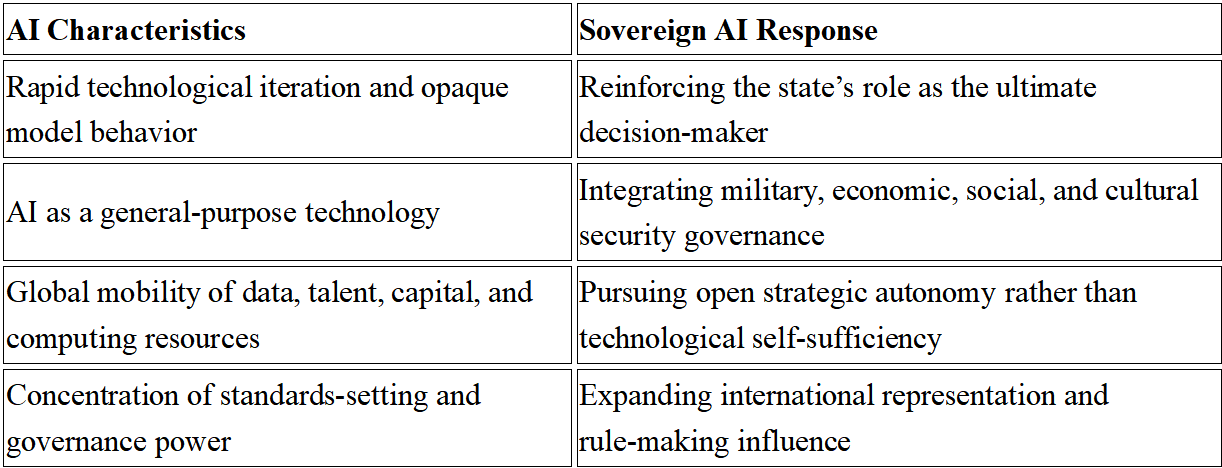
“Sovereign AI” refers to the governance of Artificial Intelligence (AI) led by sovereign states: domestically, it relies on the “supremacy” of sovereignty to strike a balance between industrial development and security risks; externally, it leverages the “independence” of sovereignty to pursue strategic autonomy and international influence. The theoretical implication of this concept derives from the technological characteristics of AI. The rapid iteration and inherent uncontrollable nature of AI compels states to assert their agency in technology governance. The broad, general-purpose nature of AI requires state powers to coordinate efforts across multiple security domains. The cross-border mobility of technological factors of AI necessitates that “sovereign AI” pursue strategic autonomy while remaining open.
To counter the monopolization of technical standards and governance rules, “sovereign AI” must assert its voice in international rulemaking, thereby upholding the value of diversity in the global order. As a natural member of the Global South, China adopts a cooperative response towards “sovereign AI,” featuring a spirit of cooperation based on equality and mutual benefit, a capacity-building model integrating open-source strategies with localized deployment, and a solidarity approach to enhance global AI governance engagement.
Why It Matters
The article conceptualizes “Sovereign AI” as a strategic choice through which states seek to shape the development and governance of artificial intelligence according to their own national priorities. Rather than viewing AI governance solely through the lenses of regulation or technological competition, it argues that sovereign AI has increasingly become a strategy adopted by countries in the Global South to strengthen technological autonomy, safeguard national security, and expand their voice in global AI governance.
Against this backdrop, the 2026 World Artificial Intelligence Conference (WAIC) provides an important practical context through which the article’s arguments can be understood. At the opening ceremony, President Xi stated that artificial intelligence “should not be the solo performance of one country, but a symphony of global cooperation.” This vision reflects China’s long-standing emphasis on AI for good, openness and inclusiveness, and the belief that AI development should contribute to more equitable global development.
More importantly, China announced a series of concrete initiatives aimed at strengthening AI capacity in developing countries, including providing 5,000 AI training opportunities over the next five years, establishing AI application cooperation centers with organizations such as ASEAN, the African Union, the Arab League, CELAC, the Shanghai Cooperation Organization, and BRICS, and expanding AI-enabled meteorological early-warning systems to thirty countries. These initiatives suggest that China’s understanding of sovereign AI extends beyond technological self-reliance to include capacity building and the diffusion of technological capabilities across the Global South.
The establishment of the World AI Cooperation Organization (WAICO) on 16 July 2026 further illustrates how this vision is being translated into institutional practice. Created through an intergovernmental agreement signed by twenty-nine founding member states, WAICO represents one of the first international organizations dedicated specifically to AI cooperation and governance. By emphasizing consultation, shared development, human-centered governance, and compliance with the purposes of the UN Charter, the organization seeks to provide a new multilateral platform through which developing countries can participate more actively in shaping international AI governance. In this sense, WAICO is significant not simply because it creates another international institution, but because it offers the Global South an additional institutional channel through which the goals of sovereign AI—greater technological autonomy, stronger governance capacity, and enhanced international representation—may be pursued collectively rather than individually.
Viewed from this perspective, the article’s analysis of China’s cooperative approach to sovereign AI is particularly timely. Recent developments at WAIC and the creation of WAICO do not simply demonstrate China’s growing role in AI governance; they illustrate a broader attempt to combine technology empowerment with institution building as complementary pathways for strengthening the agency of the Global South in global AI governance.
Key Points
1. The Conceptual Logic of Sovereign AI
Existing scholarship often focuses on AI sovereignty, a normative concept emphasizing a state’s supreme authority over AI systems and data flows within its jurisdiction. By contrast, Sovereign AI is a policy-oriented concept centered on how states build the technological, industrial, and institutional capacities needed to achieve strategic autonomy in AI. Whereas AI sovereignty concerns a state’s right to govern, Sovereign AI concerns its ability to act. The article adopts the latter framework because it is more practical, better captures the interaction between AI and national security, and provides a broader lens for analyzing both domestic capacity-building and international cooperation in pursuit of technological autonomy.
The Return of the State in AI Security Governance
Sovereign AI reflects a renewed emphasis on the state as the ultimate guarantor of security. Drawing on theories of sovereignty from Jean Bodin to Carl Schmitt, the concept argues that AI’s rapid evolution, opaque decision-making, and security risks are creating governance gaps akin to modern “states of exception.” As powerful AI systems and technology firms challenge traditional regulatory authority, governments are reasserting control over innovation, risk management, and public order. Sovereign AI thus extends earlier debates over cyber and digital sovereignty into the age of artificial intelligence.
Sovereign AI as a Comprehensive Security Framework
Because AI is a general-purpose technology, its implications extend across every dimension of national security. In military affairs, autonomous weapons and AI-enabled intelligence reshape deterrence and warfare. Economically, AI may reconfigure global value chains and deepen technological inequalities. Socially and politically, generative AI amplifies misinformation, cyber threats, and governance challenges. Culturally, algorithmic bias and foreign data influence can affect national identity and societal values. Sovereign AI therefore seeks to coordinate responses across military, economic, social, political, and cultural domains rather than treat AI as a narrow technical issue.
Sovereign AI and Open Strategic Autonomy
Despite its emphasis on autonomy, Sovereign AI does not imply technological self-sufficiency. AI development depends on globally distributed data, computing power, talent, capital, and infrastructure. As a result, states must balance domestic capacity-building with international cooperation. The goal is not ownership of every technological resource, but control over the ability to develop, deploy, and govern AI within a country’s jurisdiction. In this sense, Sovereign AI redefines technological sovereignty as open strategic autonomy within an interconnected global ecosystem.
Sovereign AI and the Quest for International Voice
Sovereign AI also requires influence over global rulemaking. As AI standards and governance frameworks are increasingly shaped by a handful of states and technology giants, countries seek greater representation in setting international norms. The concept emphasizes translating national development priorities and governance experiences into global standards while respecting diverse political and institutional models. Ultimately, Sovereign AI combines domestic capability with international participation, advocating a more pluralistic and inclusive global AI order (as presented in the Table below) rather than a single universal model of governance.
2. Building Sovereign AI in the Global South
The United States and Europe are advancing their own Sovereign AI strategies to strengthen technological autonomy and reduce external dependence. Washington emphasizes state-backed innovation and industrial investment, while Brussels integrates AI into its broader digital sovereignty agenda. Together, these efforts reflect a broader global shift towards treating AI as a strategic national capability rather than merely a commercial technology.
Constraints on Sovereign AI in the Global South
Global South countries face significant structural disadvantages in AI development. Data shortages, weak research ecosystems, limited computing capacity, and underfunded digital infrastructure constrain indigenous innovation. At the same time, these states remain vulnerable to cyberattacks, deepfakes, data breaches, and emerging AI-related security risks. Their dependence on foreign cloud services, advanced chips, and frontier models deepens technological reliance, while Western dominance in AI standards and governance institutions limits their influence over rulemaking.
The Governance Gap
Beyond technological dependence, the Global South remains underrepresented in global AI governance. Many developing countries are excluded from key forums, while existing frameworks largely reflect Northern priorities. Issues central to the Global South—technology transfer, digital inclusion, data sovereignty, and equitable development—receive limited attention, reinforcing asymmetries in both rulemaking and implementation.
Domestic Sovereignty: State Leadership and Regulation
The article argues that Sovereign AI begins with strengthening the state’s domestic role. Governments should formulate national AI strategies, coordinate investment in data, computing power, talent, and infrastructure, and establish regulatory frameworks capable of balancing innovation with security. Regardless of whether countries adopt “hard-law” or “soft-law” approaches, states must retain ultimate authority over AI governance.
External Sovereignty: Strategic Autonomy and Voice
Externally, Sovereign AI requires reducing technological dependence without embracing isolationism. Global South countries should pursue open strategic autonomy through international cooperation, South–South partnerships, and local capacity-building. At the global level, they must coordinate efforts to increase representation, shape international norms, and secure a stronger voice in the future governance of AI.
3. The Practice of Sovereign AI in the Global South
Referencing Brazil and Indonesia as case studies, the article examines how Global South countries pursue Sovereign AI through state-led strategies, institutional design, and capacity-building. Their experiences highlight common challenges and emerging pathways for technological autonomy, while offering insights into broader patterns of AI governance and South–South cooperation.
Brazil: State-Led Planning and Global South Rulemaking
Brazil has emerged as a leading AI hub in Latin America, ranking fifteenth globally in AI research in 2022. Its Sovereign AI strategy rests on state-led planning, legal regulation, and selective openness. The 2021 Brazilian AI Strategy set priorities in education, labor, innovation, industry, public security, and social applications, while the 2024–2028 AI Investment Plan pledged $4 billion for infrastructure, business innovation, public services, and regulation. Brazil has also strengthened data protection through the LGPD and advanced an AI bill based on risk classification. Internationally, it uses cooperation with China, BRICS, the G20, and the OECD framework to expand technical capacity while defending Global South representation in AI governance.
Indonesia: Digital Sovereignty through Infrastructure and Regulation
Indonesia, Southeast Asia’s largest economy, is rapidly building AI capacity while confronting deepfakes, cyberattacks, data leaks, digital inequality, and a projected shortage of nine million digital workers by 2030. Its 2020–2045 National AI Strategy identifies health, education, food security, government reform, and smart cities as priorities, while the 2025 AI white paper proposes a Sovereign AI Fund. Indonesia has passed a personal data protection law, issued AI ethics guidelines, and begun drafting binding AI regulation. Cooperation with Chinese firms such as Huawei, Alibaba Cloud, and Tencent Cloud supports infrastructure and cloud capacity, while data-localization rules seek to preserve sovereignty.
Shared Pattern: Open Autonomy for the Global South
Brazil and Indonesia show that Sovereign AI in the Global South is neither isolationist nor purely market driven. Both rely on strong state planning, regulatory reform, foreign technology, and local capacity-building. Their common goal is to open domestic markets without surrendering control, and to turn national AI development into a platform for greater Global South representation on the global stage.
4. China’s International Cooperation Strategy for Sovereign AI
Unlike many Global South countries focused on technological catch-up, China combines concerns over supply-chain security and AI governance with significant technological strengths in patents, research, models, and computing infrastructure. The article argues that China’s Sovereign AI strategy increasingly centers on helping other Global South countries build AI capacity, while promoting greater collective influence and representation in global AI governance. China is thus positioned not only as a practitioner of Sovereign AI, but also as a key partner in advancing it across the Global South.
A Reciprocate Vision for the Global South
China’s AI cooperation model emphasizes respect for national sovereignty and non-zero-sum security. Unlike approaches that export regulatory standards, Beijing advocates allowing countries to choose their own development and governance paths. Through the 2023 Global AI Governance Initiative and the Global Security Initiative, China presents AI cooperation as a vehicle for shared development rather than technological containment or geopolitical rivalry.
Empowering Sovereign AI through Capacity Building
China increasingly frames itself as a capacity builder for the Global South. The 2024 UN resolution on AI capacity-building and China’s AI Capacity-Building Action Plan promote infrastructure, talent development, data security, and digital connectivity. Open-source models such as DeepSeek, Qwen, ERNIE, and Pangu lower barriers to entry, while initiatives like the China–ASEAN AI Innovation Cooperation Center provide tailored solutions that combine technology transfer with local strategic autonomy.
Expanding Global South Representation in AI Governance
China seeks to strengthen developing countries’ voice in global AI governance through platforms such as the Digital Silk Road, BRICS, and the United Nations. It advocates greater representation, equal participation in rulemaking, and opposition to governance fragmentation. Through BRICS declarations and UN-led initiatives, Beijing positions itself as a champion of a more inclusive, multipolar, and development-oriented AI governance order.
Conclusion
This article examines the theoretical logic and practical meaning of “sovereign artificial intelligence,” arguing that it reflects a broader return of the state in global AI governance. As a general-purpose technology marked by cross-border flows of data, capital, talent, and infrastructure, AI has reshaped the tasks of national security and expanded its spatial boundaries. Sovereign AI therefore entails both strategic coordination across policy domains and a delicate balance between openness and autonomy. Its ultimate value lies not in technological closure, but in respecting diverse national interests and development models, thereby advancing a more equal and inclusive international order.
For countries of the Global South, sovereign AI is a strategic response to asymmetric power structures and widening technological divides. The cases of Brazil and Indonesia show that this approach can enhance domestic technological capacity. Internally, both states have used strategic planning and regulation to manage the tension between innovation and oversight. Externally, they have pursued international cooperation to strengthen local industries and amplify developing countries’ voices in global rulemaking.
China’s practice further advances this agenda. By combining open-source strategies, capacity-building, customized technical assistance, and cooperation through the United Nations, the Digital Silk Road, and BRICS, China offers a model of AI cooperation that moves beyond geopolitical rivalry and strengthens the Global South’s role in shaping the future of AI governance.
About the Author

ZHANG Shuyan(张书言): ZHANG Shuyan is a Ph.D candidate in Diplomacy at the School of International Relations and Public Affairs, Fudan University. He is research assistant at the Center for Global AI Innovative Governance Global Artificial Intelligence Innovation Governance Center and Rongchang Scholar. His research interests include AI technological power, global AI governance and sovereign AI, etc.

CHEN Zhimin(陈志敏): CHEN Zhimin is the Vice President of Fudan University and professor at the School of International Relations and Public Affairs, Fudan University. He is a Chang Jiang Scholars Program Distinguished Professor by the Ministry of Education, a Jean Monnet Chair Professor by the European Union, and a Leading Talent of the National “Ten Thousand Talents Program” in Philosophy and Social Sciences. He serves as the Chairman of the International Politics Sub-committee of the China Higher Education Association, the Deputy Director of the Teaching Guidance Committee for Political Science Majors under the Ministry of Education, and the Vice Chairman of the Shanghai Federation of Social Science Associations. His research interests include international relations theory, diplomatic studies, and EU studies.
About the Publication
The Chinese version of the article was published by International Security Studies (《国际安全研究》), a leading Chinese academic journal in the field of international security and strategic studies. Published as a bi-monthly journal, International Security Studies is dedicated to strengthening strategic thinking, examining international security issues, and safeguarding national interests. The journal promotes academic research and scholarly exchange while serving as a platform for theoretical innovation and policy-relevant analysis. Covering a wide range of topics in security, diplomacy, and international affairs, it has earned broad recognition among both scholars and practitioners for its academic rigor and practical relevance.


