



I’m SUN Chenghao, a fellow with the Center for International Security and Strategy (CISS) at Tsinghua University, Council Member of The Chinese Association of American Studies, a visiting scholar at Paul Tsai China Center of Yale Law School in 2024 and Munich Young Leaders 2025.
Over the past year, ChinAffairsplus has shared leading Chinese academic perspectives on China’s foreign policy, China–U.S. relations, and China–Europe relations. This time, I hope to add a more direct analytical voice, offering our own assessments of major global developments and the strategic logic behind them.
The article examines how the Trump administration’s operation in Venezuela signals a return to a Monroe Doctrine–style regional strategy. It explores why Washington is prioritizing dominance in the Western Hemisphere, how migration and resource politics shape U.S. decision-making, and what this means for the future of China–Latin America relations. Questions and feedback can be addressed to sch0625@gmail.com.
“Donroe Doctrine” in Practice: Trump’s Strike in Venezuela
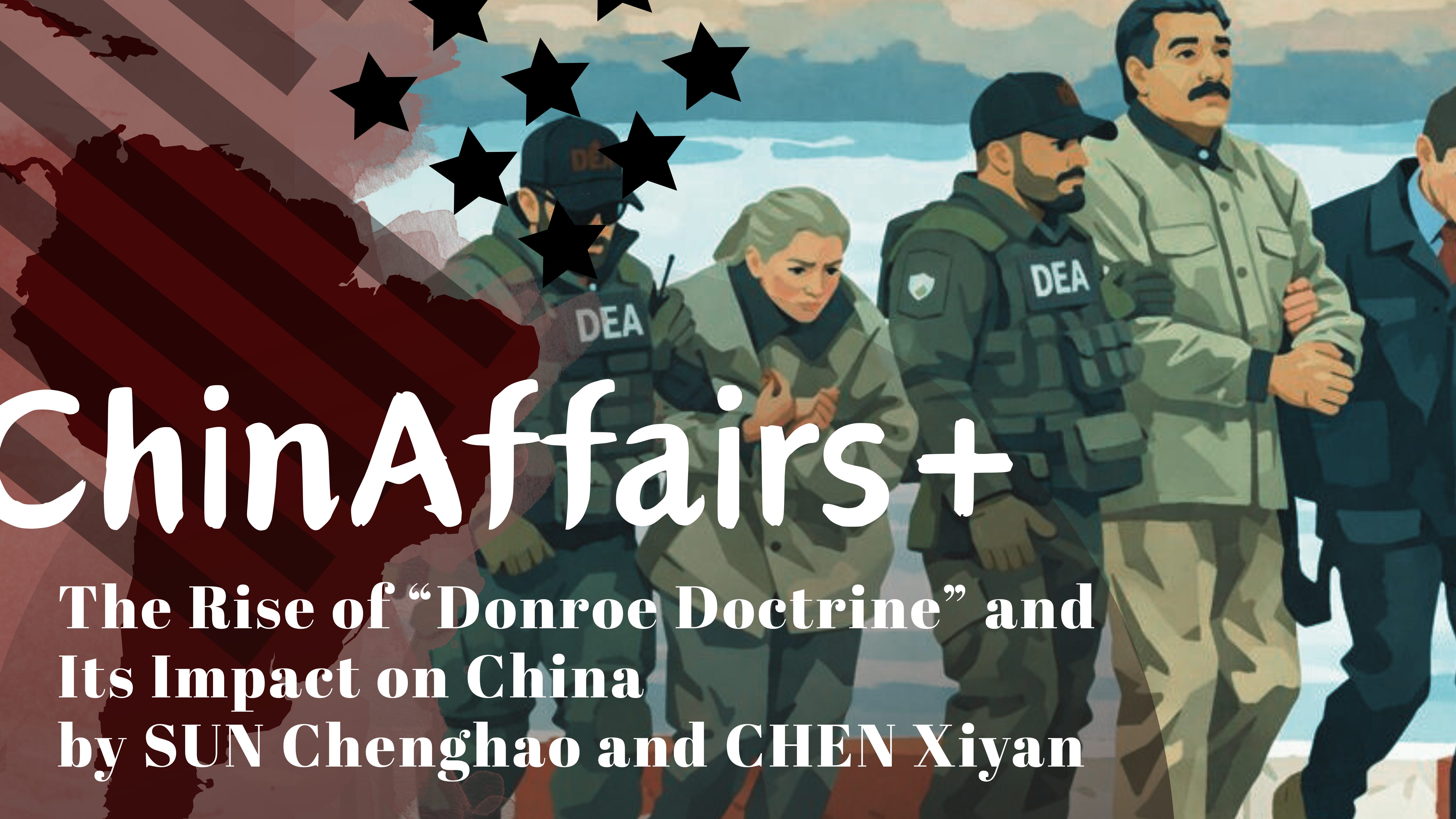
Nicolás Maduro took office as the president of Venezuela in 2013. He continued Chavismo named after his predecessor, Hugo Chávez. Drawing on the political ideas of Venezuelan military leader Simón Bolívar, who championed the independence of Latin American nations from Spanish rule in the nineteenth century, Chávez launched a series of social initiatives aimed at reducing poverty and promoting equality within Venezuela. These initiatives involved expanding state-funded welfare programmes, bringing key industries under state ownership, and challenging what Chávez portrayed as imperialist policies led by countries such as the US.
A March 2013 study by the Washington-based Center for Economic and Policy Research reported that poverty levels in Venezuela fell dramatically following Chávez’s rise to power—declining by almost half, while extreme poverty dropped by over 70 percent. During this period, the nationalisation of the oil sector also contributed to economic growth. However, Venezuela under the rule of Maduro is widely associated with severe economic collapse, hyperinflation, human rights abuses and corruption, leading to mass emigration.
As mentioned above, Venezuelan political ideology, economic policy and the surge of emigration inhibit US pursuit of preeminence in the Western Hemisphere and its implementation of “Donroe Doctrine”. In 1823, the US president James Monroe asserted that efforts by European powers to control or influence sovereign states in the Americas would be viewed as a threat to US security during his seventh annual State of the Union Address to Congress. In 1845, president James K. Polk created the word “Monroe Doctrine” and announced that the principle of the doctrine should be strictly enforced. The Monroe Doctrine established the US objective of constructing a monopolistic regional hegemony in the Western Hemisphere.
On this basis, the 2025 National Security Strategy states that the US wants to prevent and discourage mass migration from other countries in the Western Hemisphere to the US; to cooperate with the Hemisphere’s governments to fight against narco-terrorists, cartels, and other transnational criminal organizations; to control key assets and supports critical supply chains; and to ensure its continued access to key strategic locations. This is described as “Trump Corollary” to the Monroe Doctrine, or the “Donroe Doctrine”. To implement the doctrine, in January 2026, the US Army’s Delta Force, an elite special forces unit, carried out the operation and captured Venezuelan former President Maduro and his wife.
The US Pursuit of Regional Hegemony: A Cost-Benefit Consideration
Trump’s strike in Venezuela is not just for the sake of removing Maduro and controlling assets in Venezuela, but to show US resolve to consolidate hegemony in the Western Hemisphere. Pursuing regional instead of global hegemony is motivated by US cost-benefit consideration.
According to John Mearsheimer, “the best outcome a great power can hope for is to be a regional hegemon.” It is difficult and costly to dominate the entire world. So the US seeks to adopt a focused definition of its national interests and shifts its attention to the Western Hemisphere. It will deny its competitors to position force or to control strategic resources in the Hemisphere.
The request for regional hegemony in the Western Hemisphere will benefit US in several aspects. Trump believes that immigration took a heavy toll on working Americans. Therefore, asserting a dominant role in the hemisphere would allow the US to influence political and economic conditions in its neighboring states, reduce instability, and thereby mitigate inward migration pressure.
More importantly, according to Michael Klare, in the post-Cold War era, international politics is increasingly focused on gaining or maintaining access to and control of valuable natural resources. To invigorate US national power and serve its geopolitical goals, it will seize control of strategic resources in the Western Hemisphere. Although the US is the top oil producer and a net exporter, it still relies on importing heavy crude to meet domestic refining needs and obtain more profits. Canada was the largest source, accounting for 62% of total imports in 2024. But Venezuela’s heavy crude is a potential alternative source, and the US can threat not to purchase Canandian oil, which gives Washington leverage over Ottawa when Trump talks about making Canada the “51st state”. Trump said that US oil companies would be able to invest in Venezuela to fix the badly broken oil infrastructure and start making money for the US. In addition to oil, the US also means to use Latin America’s critical minerals and rare earths to create a new supply chain that cuts out China. This will enable Washington to decouple with and outcompete Beijing.
Pushing out China? The Future of China-Latin America Relationships
China has close ties with Latin American countries. China is the second largest trading partner of Latin America and the Caribbean. According to data from the General Administration of Customs of PRC, in 2024, the total value of goods imports and exports between China and Latin America reached $518.467 billion, a year-on-year increase of 6%. Within this total, imports amounted to $241.466 billion, representing an increase of approximately 46% compared to five years ago. China is also top trading partner for countries such as Brazil, Chile, and Peru.
With the expansion of US influence in Lain America, Chinese presence will be partly influenced, especially in terms of critical infrastructure. In the 2025 National Security Strategy, the White House said it seeks to push out foreign companies that build infrastructure in the region. Actually, the US has already successfully weaken China’s presence. Under US pressure, a Hong Kong company, CK Hutchinson, sold its $22.8 billion ports business in Panama to an investment group led by US giant BlackRock. The US may also target Peru’s Port of Chancay. Trump’s Latin America advisor, Mauricio Claver-Carone, once said, “Any product passing through Chancay or any port owned or controlled by China in the region should be subject to a 60% tariff”.
However, the availability of Chinese consumer goods in everyday life will remain largely unchanged. For instance, according to the Singapore-based market research firm Canalys, Chinese brands now command over 60 percent of the Latin American smartphone market. In Peru, that figure climbs to a staggering 70 percent. Besides, China’s largest carmaker, BYD already leads electric car sales in Brazil, Colombia, Ecuador and Uruguay. Given that Latin American countries struggle to find substitutes for cheap and high-quality Chinese manufactured goods in the short term, the United States is unable to fully exclude China from the Latin American consumer market.
In conclusion, the rise of the “Donroe Doctrine” under Trump reflects the United States’ renewed focus on asserting regional hegemony in the Western Hemisphere to secure economic and political interests. Operations like the strike in Venezuela demonstrate a willingness to manage migration pressures, control critical resources and limit rival influence, particularly from China. However, despite efforts to curb Chinese presence in strategic sectors, everyday life in Latin America continues to be shaped by Chinese consumer goods, like smartphones and electric vehicles. This suggests that US dominance may reshape geopolitics without fully displacing China’s entrenched economic and technological footprint in the region.


We see the sticks that US is offering but I have not seen any carrots...