



Welcome to the 65th edition of our weekly newsletter! I’m SUN Chenghao, a fellow with the Center for International Security and Strategy (CISS) at Tsinghua University, Council Member of The Chinese Association of American Studies and a visiting scholar at the Paul Tsai China Center of Yale Law School (fall 2024).
ChinAffairsplus is a newsletter that shares articles by Chinese academics on topics such as China’s foreign policy, China-U.S. relations, China-Europe relations, and more. This newsletter was co-founded by my research assistant, ZHANG Xueyu, and me.
Through carefully selected Chinese academic articles, we aim to provide you with key insights into the issues that China’s academic and strategic communities are focused on. We will highlight why each article matters and the most important takeaways. Questions and feedback can be addressed to sch0625@gmail.com
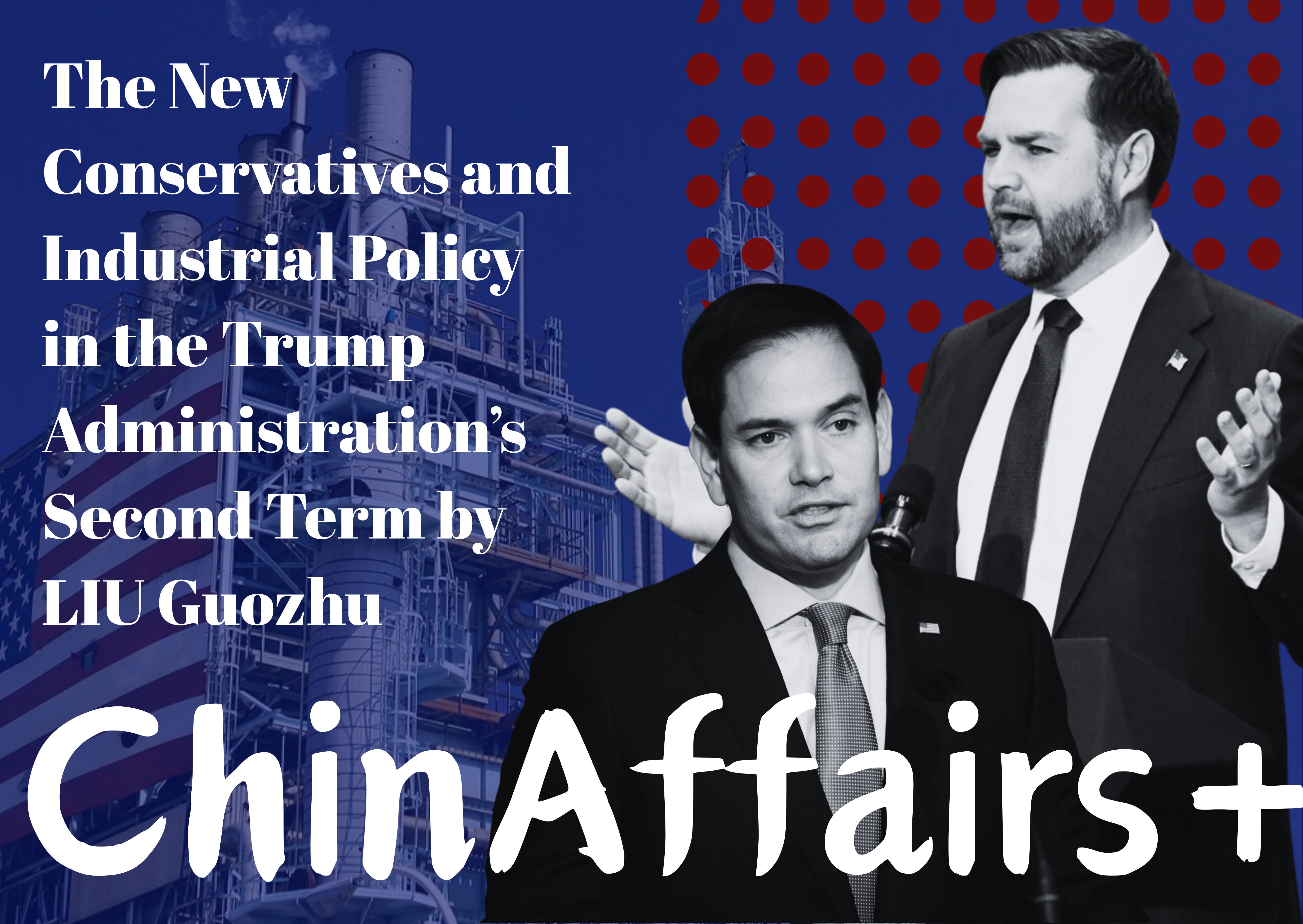
Today, we have selected an article written by Liu Guozhu, which focuses on U. S. Industrial Policy and Supply Chains.

Summary
As the neoliberal paradigm in economic policy reaches its end, different camps in the United States have, in recent years, been exploring a new paradigm to address the threats posed by deindustrialization to America’s economic prosperity and security.
Represented by a new generation of Republican politicians, as well as scholars from think tanks, the new conservatives have put forward concepts such as “Pro-American industrial policy” and “national developmentalism.” They attempt to use federal public policies to promote industrial policy more proactively and on a larger scale, thereby rebuilding America’s manufacturing system. With the new conservatives occupying key decision-making positions within the second Trump Administration and more and more traditional conservatives fading out of mainstream politics, the new conservative industrial policy has not only exerted a significant impact on the industrial policy of the Trump Administration’s second term but has also driven the shift in the industrial policy consensus across the entire conservative camp. Together with liberals, the new conservatives have jointly promoted the formation of America’s new economic policy paradigm.
Why It Matters
The 2011 Occupy Wall Street movement placed the flaws of Neo-liberal economic policies in full view. The transformation of the economic policy paradigm has become a dominant policy consensus gradually formed by the major factions of the two major national political parties. Both parties have successively embarked on the path of exploring a new economic policy paradigm.
While Chinese academic circles have conducted some research into the transformation of the U.S.’ economic strategy and economic policy paradigms, they have overlooked the formation of a neoconservative faction within the conservative camp and its impact on the industrial policy of the Trump administration during its second term. This paper fills this research gap by analyzing the neoconservatives’ industrial policy concepts and the development trend of the Trump administration’s industrial policy in its second term under their influence.
Key Points
Neoconservative Conceptualizations of Industrial Policy
The neoconservative camp consists of two main components: a new generation of Republican politicians such as Marco Rubio and J. D. Vance, and scholars from think tanks like American Compass. Their conceptualizations of industrial policy include the following components.
Rejecting the free-market orthodoxy of the conservative establishment
In a process starting with the presidency of Ronald Reagan, the U.S. conservative camp had almost completely lost the core elements of conservatism, leading to blind faith in the free market. This in turn has resulted in the deindustrialization of American manufacturing and a sharp contraction in the job market, leaving the country’s social fabric eroded, lacking structural stability, and moving toward collapse. Based on this, neoconservatives argue that blind allegiance to the market cannot bring national prosperity, and they have revived the emphasis on the role of government planning.
Constructing a new economic paradigm based on the “American System” and embodying traditional conservative values
To address the current challenges facing the United States, policymakers are adopting the theory of national developmentalism. Since its founding, the United States has relied on national developmentalism to achieve its rise, largely through tariff protectionism, the construction of a financial system, infrastructure investment, and government support for industrial development—historical experience has demonstrated its effectiveness. Specifically, national developmentalism advocates for government policies meticulously formulated and implemented by the state. With growth as the core, it involves designing effective policies targeting productivity, innovation, and competitiveness, cultivating enterprises so that they become strong and dynamic, and achieving synchronous development among freedom, prosperity, and national power.
Building an industrial policy ecosystem
Neoconservatives focus not merely on industrial policy itself, but regard it as part of an integrated whole, seeking to create a healthy ecological environment for U.S. industrial development through federal public policies. From their perspective, the federal government should prioritize the following policy areas: first, expanding protectionist policies to promote the reshoring of manufacturing. Second, promoting large-scale industrial innovation. Third, prioritizing critical industries beyond the national defense industrial system and advanced manufacturing. Fourth, deregulating, particularly in the environmental realm where regulations impose significant constraints on manufacturing development. Fifth, implementing defense-driven industrial policies.
The Neoconservative-Influenced Industrial Policy of the Second Trump Administration
Compared with those in his first administration, the officials in Trump second administration are more aligned with neoconservative ideology. Consequently, the campaign platform of the Trump camp has essentially adopted the neoconservative conceptualization of industrial policy. Since assuming office for the second time, Trump has rolled out a series of manufacturing-related economic policies proposed in his campaign platform. These policies largely reflect the trends in the Trump administration’s conceptualizations industrial policy.
Expanding the implementation of national protectionist measures
Under neoconservative influence, the Trump administration’s second term has significantly strengthened national protectionism, reshaping the U.S. manufacturing base through trade and procurement policies. Specifically, on one hand, it has reinforced the “Buy American” principle, reexamined and potentially adjusted or withdrawn from international procurement and defense agreements that weaken domestic manufacturing preferences, and leveraged the scale of federal procurement to provide stable demand for onshore production and supply chain security. On the other hand, it has raised import barriers through broader and higher-intensity tariff measures, forcing the reshoring of manufacturing. It has also used tariffs as a negotiating tool to urge major trading partners to invest directly in U.S. core industries. This form of protectionism does not merely pursue trade balance; rather, it regards persistent merchandise trade deficits as a record of national capacity failure, and aims to achieve the reshoring of manufacturing and the reconstruction of the U.S. manufacturing system.
Prioritizing technological innovation in emerging industrial sectors
The government has explicitly prioritized support for the two key fields of AI and nuclear technology. It aims to address challenges in the technological domain by accelerating research and development, removing regulatory barriers, strengthening domestic supply chains and manufacturing, stimulating private-sector investment, promoting U.S. companies’ entry into global markets, and establishing new paradigms for research enterprises. In the field of AI, the government emphasizes eliminating administrative regulations that restrict innovation, advancing the coordinated development of research and development, data, applications, and manufacturing, and deeply integrating AI with national defense, manufacturing, and critical infrastructure through national-level action plans and financial investment. In the field of nuclear technology, the government focuses on energy security and strategic competitive needs, promoting the research, development and commercial deployment of next-generation nuclear reactor technologies to provide stable electricity for energy-intensive emerging industries and national security facilities.
Supporting U.S. reindustrialization through defense-driven procurement
Stephen Moore, current Chairman of the Council of Economic Advisers (CEA), states that defense-oriented industrial policies can generate particularly significant positive economic spillover effects in technological progress, research and development, and investment. Furthermore, these policies possess a dual-use nature, capable of advancing both the development of national security and the reindustrialization process simultaneously. Consequently, the government has actively promoted defense-oriented industrial policies, including revitalizing the U.S. maritime industrial base, investing more funds in rebuilding the national defense industrial base, and fostering public-private partnerships between the Department of Defense and selected critical enterprises.
Promoting the development of key industries
Since Trump’s return to the White House, three new industries have been added as federal priority areas. First, the AI industry: the government has launched the Win the Race: U.S. Artificial Intelligence Action Plan to secure U.S. global leadership and reshape related sectors via exporting U.S. AI products, accelerating data center development, promoting tech innovation, and removing restrictive regulations. Second, the unmanned aerial vehicle (UAV) industry: the administration issued an executive order to speed up the safe commercialization and domestic mass production of UAV technology, integrating it fully into the National Airspace System (NAS) to boost productivity in logistics, agriculture, emergency response, and other sectors, as well as create high-skill jobs. Third, the critical minerals industry: to eliminate external reliance and secure supply chains, the government has taken emergency steps, including simplifying mining permits, launching trade investigations, tapping offshore resource potential, easing project financing, and fast-tracking mineral projects, to boost domestic critical minerals production and processing capacity.
Easing the regulations and restrictions that hinder industrial development
The Trump administration views overregulation as a major barrier to stifling innovation, investment, and economic growth. To this end, since its return to the White House, the administration has vigorously pursued regulatory reform: repealing burdensome regulations from the previous administration; removing barriers to development in sectors such as energy, natural resource extraction, AI, and digital assets; scrapping rules that drive up the prices of essential consumer goods; and establishing the “U.S. Investment Accelerator” to rapidly eliminate regulatory barriers for foreign investment. These measures aim to drastically simplify government regulations, reduce corporate compliance costs, and unlock market vitality.
Controversies over Neoconservative Industrial Policies and the Shift in Economic Policies of the Conservative Camp
Controversies over neoconservative industrial policy pre-Trump 2.0
The traditional conservative camp roundly rejected neoconservative industrial policies, arguing that the federal government’s manufacturing policies are ineffective and unnecessary. It questioned Marco Rubio’s so-called “correct industrial policy,” maintaining that it could not solve America’s problems and that replacing China’s central planning with that of the U.S. is unacceptable. The camp accused Rubio’s America-first industrial policy of letting Washington bureaucrats decide what U.S. workers need, then picking winners and losers in the U.S. economy. It urged conservatives to wake up to the fact that the industrial policy pursued by Rubio had failed and would continue to fail. Additionally, the camp attacks neoconservative industrial policies as bearing the mark of progressivism, even embodying the key characteristics of socialist economic policies, and dismisses them as a foolish endeavor.
Controversies surrounding the industrial policies of the Trump Administration’s Second Term
The conservative camp shares roughly the same perspective and degree of concern regarding the Trump administration’s industrial policies, both expressing worry that Trump will expand the implementation of protectionist measures—particularly that indiscriminate tariff wars will harm the development of U.S. advanced manufacturing. It criticizes Trump’s series of industrial policies as a break with traditional American capitalism, which would foster “crony capitalism” and ultimately undermine the global competitiveness of U.S. enterprises. The camp denounces Trump’s industrial policies as “moving toward state capitalism with American characteristics” or “a hybrid of state capitalism and socialism.”
Neoconservatives: drivers of the paradigm shift in the economic policies of the conservative camp
The concepts and practices of neoconservative industrial policies are driving a fundamental paradigm shift in the economic policies of the conservative camp. While drawing criticism from traditional conservatives, the trend has become irreversible. Strengthening intervention in the economy, particularly industrial development, through federal public policies has emerged as a key feature of the Trump’s second administration. Today, Trump enjoys growing support from the increasingly powerful economic forces of the new right, and various policies aimed at rebuilding the U.S. manufacturing system have gained more advocates. Although neoconservatives do not believe they can reshape the Republican Party’s image and policies in the short term, they are convinced that, in time, they can alter the party’s agenda to better align with voters’ interests. Currently, neoconservative economic ideas have made significant headway in Washington. Clearly, under the interaction of internal and external environments, the economic policies of the conservative camp, especially its conceptualization of industrial policy, have been undergoing quiet changes.
Conclusion
The emergence of neoconservatives in U.S. intellectual and political circles coincided almost simultaneously with Trump’s rise in the U.S. political scene. It reflects the social reality that the neoliberal economic policies pursued since President Reagan have reached a dead end, prompting some political forces within the conservative camp to seek a new national governance model. As Trump returns to the political arena, the division within the U.S. conservative camp has further accelerated. Reaganite Republicans are gradually exiting the political stage. Neoconservative industrial policy will become the dominant economic philosophy of the Republican administration at a faster pace than Vance anticipated.
About the Author

Liu Guozhu: Dr. Liu is a professor and researcher at Zhejiang University, and the Director of the Center for American Studies. His main research areas include US foreign relations, international relations, and non-traditional security issues. Liu’s research reports have been collected and reported by the National Development and Reform Commission, the Ministry of Foreign Affairs, and CCTV.
About the Publication
The Chinese version of this article was published in The Chinese Journal of American Studies (《美国研究》) . Founded in 1987, The Chinese Journal of American Studies is an academic journal supervised by the Chinese Academy of Social Sciences (CASS), and co-sponsored by the Institute of American Studies of CASS and the Chinese Association for American Studies (CAAS). It publishes articles by Chinese scholars on various aspects of American society, including U.S. politics, economy, diplomacy, military affairs, science and technology, culture, history, art, ideological trends, and other fields.

