



Welcome to the 83rd edition of our weekly newsletter! I’m Chenghao Sun, a fellow with the Center for International Security and Strategy (CISS) at Tsinghua University, Council Member of The Chinese Association of American Studies and a visiting scholar at the Paul Tsai China Center of Yale Law School (fall 2024).
ChinAffairsplU.S. is a newsletter that shares articles by Chinese academics on topics such as China’s foreign policy, China-U.S. relations, China-Europe relations, and more. This newsletter was co-founded by my research assistant, ZHANG Xueyu, and me.
Through carefully selected Chinese academic articles, we aim to provide you with key insights into the issues that China’s academic and strategic communities are focU.S.ed on. We will highlight why each article matters and the most important takeaways. Questions and feedback can be addressed to sch0625@gmail.com
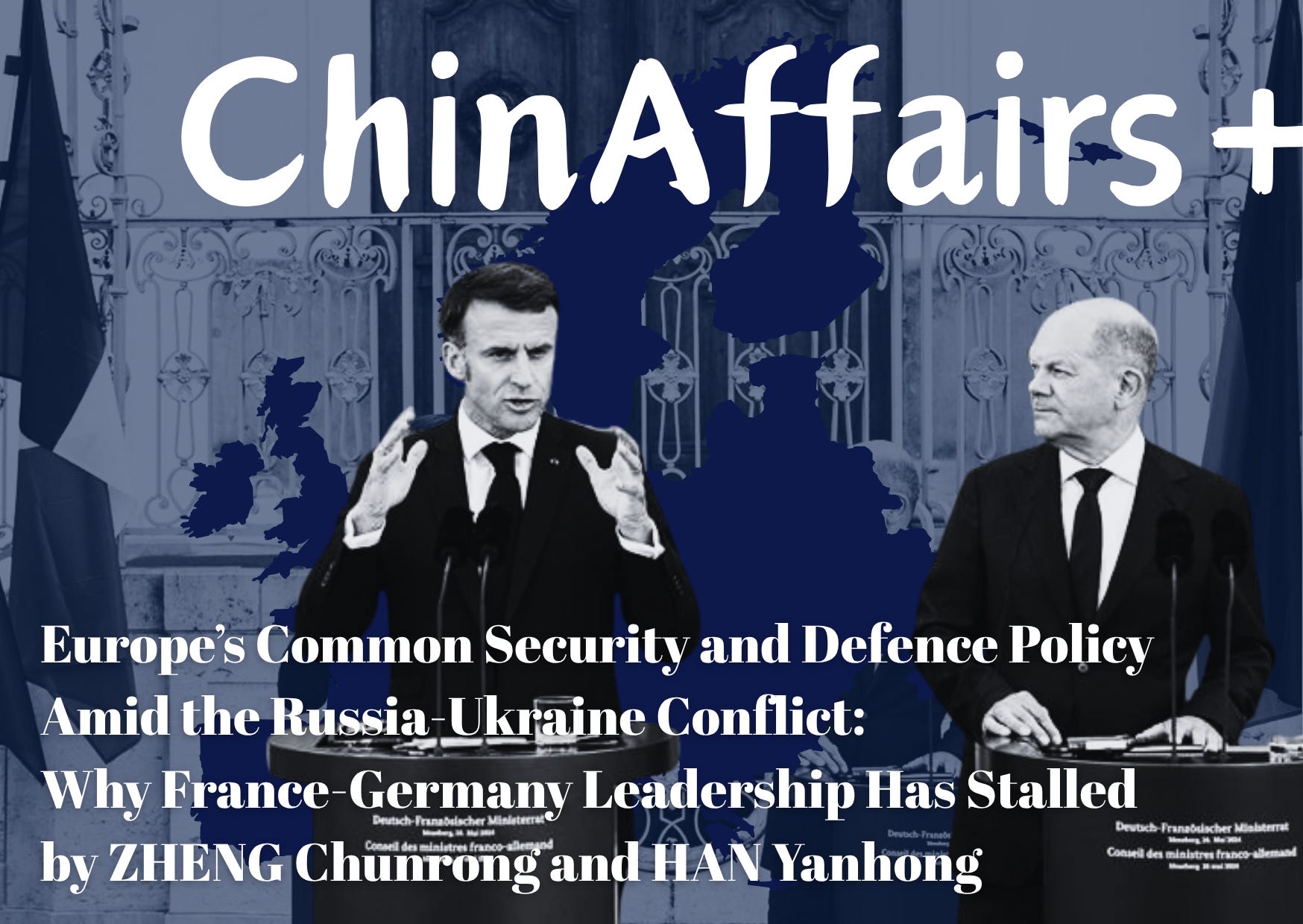
Today, we have selected an article written by Zheng Chunrong and Han Yanhong, which focuses on the Europe’s Common Security and Defence Policy.
Summary
The Russia-Ukraine conflict has triggered an unprecedented defence crisis on the European continent. Against this backdrop, although France and Germany possess both the capacity and the willingness to assume a leadership role in the Common Security and Defence Policy (CSDP), they have found it difficult to form a stable joint force on major security and defence issues, owing to institutional arrangements, divergent interests among member states, and differences in the two countries’ strategic orientations.
These factors have, in turn, hindered the two countries from exercising sustained and effective co-leadership on key CSDP issues. Looking ahead, Franco-German leadership in the CSDP will be shaped primarily by three intersecting variables: the trajectory of France’s domestic politics, the reconfiguration of Germany’s security alliance networks, and the prospects of US-European relations.
Why It Matters
The Common Security and Defence Policy (CSDP) has long been regarded as the weakest link in the process of European integration. Meanwhile, the outbreak of the Russia-Ukraine conflict has drastically reshaped Europe’s security landscape. The return of Donald Trump to office, alongside his sustained rollback of U.S. security guarantees to Europe, has also imposed unprecedented security crises and pressures for defence integration across the continent. In practice, while certain progress has been achieved in defence integration, in-depth cooperation in pivotal domains continues to stall. This article seeks to investigate whether France and Germany have overcome their bilateral divergences and effectively supplied joint security and defence leadership amid the surging demand for deeper European defence integration.
Key Points
1. The Formation and Constraints of Franco-German Leadership within the CSDP
France-Germany leadership in the CSDP is not inherent; instead, it has gradually taken shape and gained momentum under specific security pressures and institutional contexts, but its effectiveness remains constrained by institutional rules, member-state divisions, and strategic differences between France and Germany.
(1) Shared Vulnerabilities Faced by EU Member States
The Russia-Ukraine conflict has laid bare three major shared vulnerabilities of EU member states within the CSDP: heavy reliance on Russian energy, insufficient military capabilities, and inadequate defence budgets.
To begin, Europe was highly dependent on Russian energy supplies. The outbreak of the Russia-Ukraine conflict and subsequent sanctions against Russia drove the EU to largely decouple itself from Russia in the energy sector. The ensuing slowdown in national economic growth and growing pains of the energy transition have further eroded the EU’s economic and industrial foundation for ramping up defence spending.
Second, EU member states generally suffer from insufficient military capabilities. The Russia-Ukraine conflict has highlighted hidden risks stemming from the EU’s chronically insufficient defence investment. States have heavily depleted their domestic arms stockpiles to aid Ukraine, which has, in turn, weakened their own defensive strength. Meanwhile, inconsistent military equipment standards among nations have undermined aid delivery efficiency. Coupled with the EU’s inadequate military transport infrastructure and the absence of a unified cross-border military transit mechanism, the speed of aid to Ukraine has been further slowed.
Lastly, EU member states are generally confronted with fiscal pressures stemming from surging defence expenditures. The outbreak of the Russia-Ukraine conflict has compelled European countries to drastically ramp up military spending, while slowing economic growth has concurrently reduced tax revenues. Such an imbalance between revenue and expenditure forces national governments to make tough trade-offs between defence investment and the security of people’s livelihoods.
(2) EU Member States’ Demand for Leadership from France and Germany
The aforementioned challenges highlight the shared vulnerabilities confronting EU member states in the wake of the Russia-Ukraine conflict, creating an urgent need for robust leadership to boost the EU’s security and defence capabilities. Since France and Germany have occupied central roles in Russia-related diplomacy, including the Normandy Format negotiations dating back to 2014, several European countries naturally looked to France and Germany to spearhead a robust collective security and defence response from the EU following the outbreak of the Russia-Ukraine conflict.
(3) The Willingness of France and Germany to Exercise Leadership
Faced with the regional security crisis triggered by the Russia-Ukraine conflict, France and Germany have demonstrated a strong willingness to take the lead and thus have taken tangible actions. Multiple signs indicate that the leaders of the two countries are ready to proactively cooperate to steer European defence integration forward.
2. The Leadership Effectiveness and Limits of France and Germany in CSDP
(1) Power Resources
In terms of military capacity, France and Germany together account for a substantial share of the EU’s total defence spending, providing critical backing for the EU’s CSDP in armaments, military personnel, and funding.
As for institutional resources, first, France and Germany can fully leverage their core standing within the EU and the rotating presidency framework to translate their own strategic priorities into common EU policies. Second, in respect of decision-making influence, France and Germany benefit from the special weight granted to major powers under the EU’s decision-making mechanisms. Third, when it comes to implementation and delivery, the capacity advantages of France and Germany further strengthen their institutional resources.
Regarding ideational resources, drawing on their unique experience and credibility advantages, France and Germany retain significant influence over EU security affairs.
However, the article stresses that these resources do not automatically translate into effective joint leadership, since leadership outcomes are also shaped by institutional constraints, follower preferences, and the strategies used by France and Germany.
(2) Environmental Constraints
The CSDP preserves substantial autonomy for member states in defence and security affairs. Defence and security matters falling under the scope of the CSDP touch upon the core sovereignty of each member state, and its decision-making mechanism stipulates that unanimous consent from all Council members is required for most major issues. This institutional design grants every member state substantive veto power, creating structural constraints that curb the willingness of individual countries — including France and Germany — to exercise leadership.
The Russia-Ukraine conflict has laid bare stark divergences among EU member states over the CSDP. These disagreements are closely tied to the specific functions and mandates of the CSDP and have grown more pronounced amid the urgency of the conflict. Regarding military assistance and crisis intervention, the EU swiftly delivered military support to Ukraine after the outbreak of the conflict, yet member states held markedly different positions. On the agenda of strategic autonomy, member states led by France, Spain, and Italy advocate bolstering the EU’s defence autonomy and reducing reliance on the United States. By contrast, Germany aligns its stance with Eastern European states and the three Baltic countries, such as Poland, viewing NATO and the United States as the primary bulwark against threats from Russia.
(3) Leadership Strategies
First, following the outbreak of the Russia-Ukraine conflict, France and Germany have taken an active lead in shaping the CSDP agenda. By advancing defence industrial integration, boosting defence spending, and pushing forward the implementation of the “Re-arm Europe” initiative, they have delivered solid backing for the deepening of the EU’s defence policies.
Second, both France and Germany are adept at leveraging coalition strategies to inject momentum into European defence cooperation. Nevertheless, France and Germany each form separate coalitions with other EU member states rather than establishing the much-anticipated bilateral alliance between themselves, which deeply reflects their inherent divergences on defence matters.
Third, France and Germany supply shared knowledge for EU security policies by putting forward new strategic concepts, thereby shaping the security cognitive frameworks of other member states. For France, its most emblematic concept is “European strategic autonomy”, which aims to enable Europe to make independent decisions in key sectors, including defence, and cut reliance on external powers. On Germany’s side, the concept of the “Zeitenwende” (turning point of the era) proposed by Scholz serves as its core principle of shifts in Europe’s security landscape and has exerted far-reaching influence across the EU. Overall, France and Germany have reached growing consensus on addressing “a new era with new challenges” and advancing the vision that “Europe must strengthen its defence and operational capabilities”. However, certain discrepancies persist in their specific interpretations and practical implementation pathways. From France’s perspective, Germany’s Zeitenwende framework remains overly transatlantic-oriented, rather than prioritizing European strategic autonomy as France advocates.
Conclusion
Looking ahead, the leadership of France and Germany within the CSDP will be jointly shaped by three key variables: the trajectory of domestic politics in France, the restructuring of Germany’s security alliance networks, and the outlook for transatlantic relations. Overall, France and Germany are expected to retain their central role in advancing the CSDP in the years to come. Nevertheless, their leadership model will more likely feature consultation, networking, and conditional engagement. While sustaining their resource input and institutional advantages, the two countries will need to better address divergences among member states, institutional constraints, and shifts in the external strategic environment.
About the Author
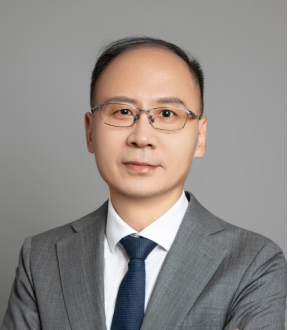
Zheng Chunrong(郑春荣): Dr. Zheng is Professor at Tongji University, Director of the Institute for German Studies, the Institute for European Union Studies, and the German Research Center at Tongji University. He also serves as Executive Director of the Chinese Society for European Studies and Vice President of the Shanghai Society for European Studies. His primary research fields cover German and European politics and diplomacy, China-German and China-EU relations, and the trilateral relations among China, the United States, and Europe.
Han Yanhong(韩彦红) is a student at the School of Foreign Studies, Tongji University.
About the publication
The Chinese version of this article was published in Foreign Theoretical Trends (《国外理论动态》). This journal is a comprehensive theoretical bimonthly journal, listed as a source journal of the Chinese Social Sciences Citation Index (CSSCI) and a national core Chinese journal. It documents emerging developments, issues, and trends in contemporary global economic, political, cultural, and social spheres.

