



Welcome to the special edition of China Scholar Insights!
China Scholar Insights is a feature which aimed at providing you with the latest analysis on issues that Chinese scholars and strategic communities are focusing on. We will carefully select commentary articles and highlight key points. Questions or criticisms can be directed to sch0625@gmail.com
I am SUN Chenghao, a fellow with the Center for International Security and Strategy (CISS) at Tsinghua University. ChinAffairsplus is a newsletter that shares Chinese academic articles focused on topics such as China’s foreign policy, China-U.S. relations, China-European relations, and more. This newsletter was co-founded by me and my research assistant, ZHANG Xueyu.
The New China-EU Trade Consultation Mechanism
Background
On June 29, Chinese Minister of Commerce Wang Wentao and European Commissioner for Trade and Economic Security Maroš Šefčovič held the inaugural meeting of the China-EU Trade and Investment Consultations (TIC) in Brussels and issued a rare joint statement. The two sides agreed to formally establish a new consultation mechanism covering four working areas: trade and investment balancing, export controls, intellectual property rights, and WTO reform. According to the joint statement, China and the EU also agreed to “establish a joint monitoring mechanism to exchange relevant data, monitor trade flows and support technical work with a view to improving transparency, enhancing mutual trust and managing trade frictions.”
The mechanism arrives at a moment when China-EU trade is economically indispensable but increasingly vulnerable to political pressure. Eurostat data shows that the EU’s goods trade deficit with China reached €98 billion in the first quarter of 2026, the highest quarterly level since Q3 2022. In 2025, EU exports to China stood at €199.5 billion, while imports from China reached €559.5 billion, leaving a deficit of €360 billion. These figures have made the trade imbalance one of the most politically salient issues in the relationship. More importantly, the imbalance is increasingly interpreted in Brussels not simply as a trade problem, but as evidence of deeper concerns over industrial competitiveness, overcapacity and economic security.
The new mechanism sends an important signal that neither side wants economic disputes to spiral into a trade war. Šefčovič said the two sides had an ambitious timetable and hoped to achieve tangible results before October. For China, the mechanism offers a channel to address EU restrictive measures through negotiation. For Europe, it provides a way to manage domestic pressure over trade deficits while keeping dialogue with China open. Its significance, therefore, lies less in resolving individual disputes than in creating an institutional framework within which an increasingly contentious economic relationship can be managed.
From Fragmented Disputes to Institutionalized Management
China-EU trade frictions have moved from occasional product disputes to a broader pattern of sectoralized confrontation. Over the past five years, disputes have spread across investment, electric vehicles, medical devices, solar procurement, critical minerals, food products, public procurement, cybersecurity, and industrial policy. Each case has followed its own legal procedure and political rhythm, but together they reveal a relationship increasingly governed by defensive instruments.
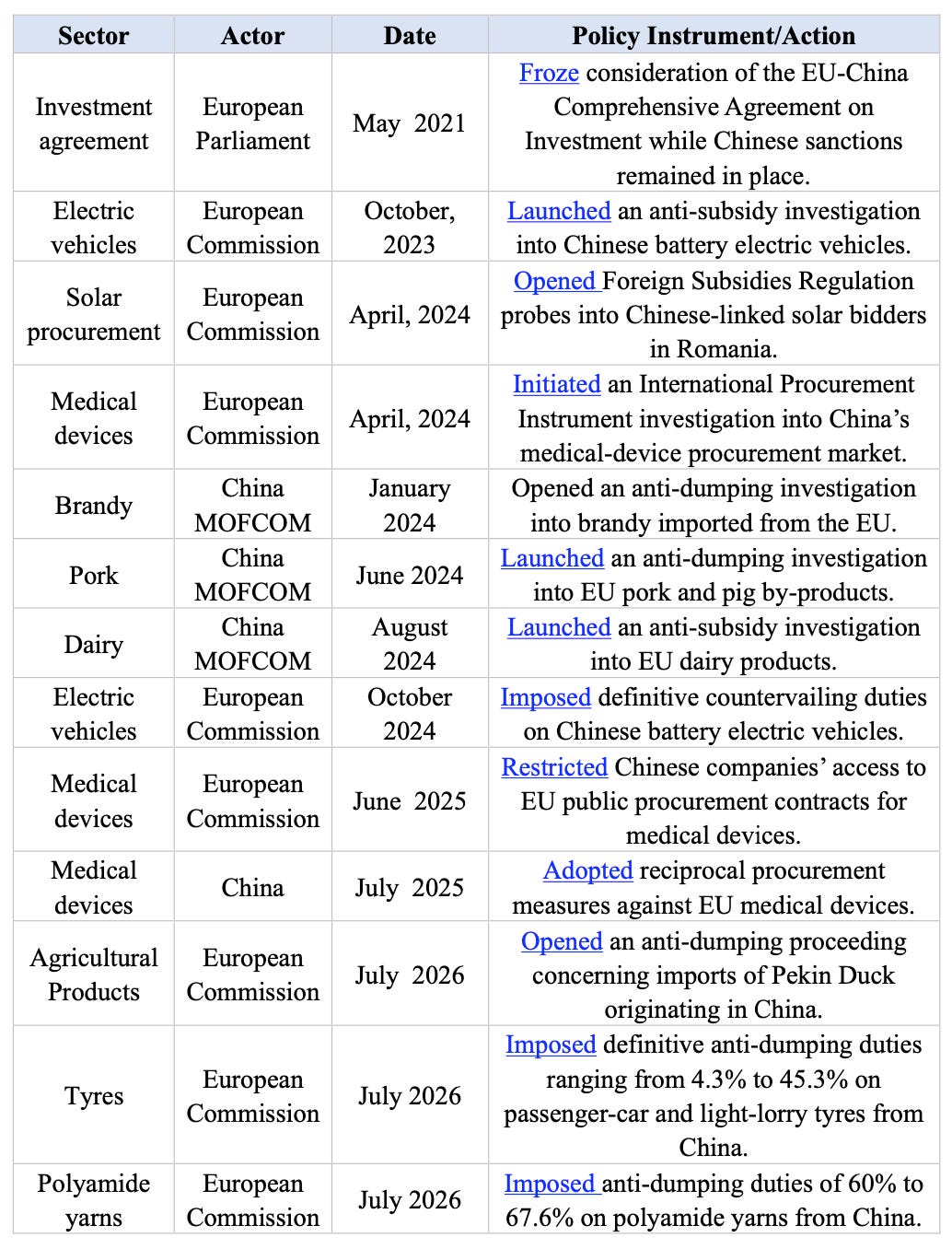
The danger of fragmented dispute management lies in its tendency to turn technical questions into tests of political resolve. As seen in the past years, electric vehicles are framed as the future of European manufacturing, rare earths as a matter of supply-chain security, solar and battery products as a risk of green industrial dependence. Once these cases enter public debate as symbols of strategic competition, technical compromise becomes harder, since governments must answer not only to firms and regulators, but also to public narratives about weakness and resilience. In other words, fragmentation does not merely multiply disputes; it raises the political cost of resolving each one.
The joint monitoring mechanism is therefore the most technically modest and politically valuable part of the new arrangement. Contemporary trade tensions are intensively data-sensitive. For example, a rise in Chinese exports may be read in Brussels as evidence of overcapacity, dumping, or state distortion, while Chinese analysis often points to weak European demand, high energy costs, supply-chain reorganisation, or European firms producing within Chinese manufacturing ecosystems. Shared data will help discipline disagreements by identifying the factual terrain. This common basis for discussing trade flows can help pull certain disputes back from political claims into technical diagnosis, which is easier to manage than generalized accusations.
The mechanism also reflects a recognition in Chinese policy discussions that Europe’s anxiety is partly structural. Some recent Chinese commentaries have described China-EU relations as characterized by “ice and fire”: restrictions and mistrust coexist with strong commercial interdependence and continued demand for cooperation. This framing captures the central contradiction of the relationship. Europe is worried about a new wave of Chinese industrial strength in sectors such as EVs, batteries, solar equipment, machinery, and digital manufacturing, yet these same sectors are also crucial to Europe’s decarbonization and industrial modernization. The mechanism is an attempt to manage that contradiction through procedure rather than escalation.
Rebalancing Through Expansion, With Broader Implications
One of the most consequential ideas emerging from the mechanism is that rebalancing should come through expansion. On July 2, MOFCOM spokesperson He Yadong noted that the two sides “had focused on promoting more balanced growth in bilateral trade rather than reducing trade to achieve balance,” with emphasis on cooperation in artificial intelligence, the green transition, services trade, and market access consultations. China has invited Šefčovič to visit China this autumn for the second ministerial meeting under the mechanism, and the two sides have agreed to hold one or two ministerial-level meetings each year.
This formulation matters because it reframes the trade imbalance as a problem of composition as much as volume. The EU’s goods deficit dominates the political debate, but the broader relationship contains areas where Europe retains considerable advantages. The EU continues to run a services surplus with China, amounting to €21.3 billion in 2025 according to the European Commission. A more balanced relationship could therefore emerge from expanding services trade, improving market access, and encouraging two-way investment instead of compressing goods flows alone.
The mechanism also fits a wider pattern in EU external economic governance. Brussels has long relied on institutionalised platforms to manage relations with major economic partners, such as the EU-US Trade and Technology Council, the EU-India Trade and Technology Council, and trade committees under its agreements with Japan and South Korea. Although these mechanisms differ substantially in purpose and political context, they reflect Brussels’ broader preference for embedding complex economic relationships in standing institutional channels. The China-EU mechanism is distinctive because it is designed less to coordinate policies than to prevent competitive economic policies from becoming unmanageable.
In addition, the focus on WTO reform gives the mechanism a broader multilateral relevance. The joint statement stresses the need to strengthen China-EU cooperation in the WTO and advance substantive progress on reform. This aligns with the EU’s own July 2026 submission of three WTO reform papers, as well as China’s interest in defending a rules-based trading system as stated in its 2026 Position Paper. At a time when unilateral tariffs, economic coercion, industrial subsidies, and weakened dispute settlement are eroding confidence in the global trading system, even limited China-EU cooperation on WTO reform gives the relationship a broader public value.
Challenges: Dialogue Without Suspension of Pressure
The mechanism enters a European political environment already moving on two tracks. Brussels has reopened a channel for negotiation with Beijing, while several member states are pressing the Commission to act more quickly against perceived trade distortions. The tension was visible at the June European Council discussion on “global macroeconomic imbalances.” According to the European Parliamentary Research Service, France proposed a tool similar to the US Section 301 mechanism, which would allow the EU to impose targeted tariffs or import quotas on countries judged to employ unfair trade practices. France also joined Italy, Spain, the Netherlands, and Lithuania in calling for tougher trade measures, while Germany, traditionally more cautious about restrictive action toward China, stated that the EU must protect itself from trade distortions. EU leaders ultimately tasked the Commission with taking a twofold approach: on the one hand pursuing dialogue with Beijing, on the other hand sharpening the EU’s trade-defence toolbox and considering further instruments. The result is a more complicated consensus: dialogue with China remains necessary, while the political threshold for using defensive trade instruments has clearly fallen.
This dual-track logic explains why the launch of the mechanism has not stopped the EU from expanding its economic-security and trade-defence toolkit. In July 2026 alone, the European Commission opened an anti-dumping proceeding concerning Chinese Pekin Duck imports, imposed definitive anti-dumping duties on Chinese passenger-car and light-lorry tyres, upgraded its import monitoring mechanism, opened a consultation on the overall evaluation of the Dual-Use Regulation, and imposed anti-dumping duties of 60 to 67.6 percent on Chinese polyamide yarns. These steps show that dialogue will proceed alongside pressure, and that the mechanism will operate in a policy environment where Brussels remains willing to use unilateral instruments.
European policy debates continue to favour a more assertive response to China’s industrial rise. Recent European analyses emphasize the widening trade deficit, the limits of existing trade-defense tools, and the need for faster responses to import surges and industrial overcapacity. This defensive mood reflects real pressure on European firms, workers, and governments.
From a Chinese perspective, one concern is that some of Europe’s competitiveness challenges may increasingly be attributed to Chinese competition, even though they also reflect domestic constraints such as high energy costs, fragmented capital markets, regulatory burdens and uneven innovation performance. China’s Ministry of Commerce has argued that China is “not the root cause” of Europe’s economic and trade problems, while Chinese policy commentary has pointed to high energy costs, policy volatility, and insufficient innovation momentum as deeper constraints on European competitiveness.
The autumn meeting will therefore provide an early test of whether the TIC can move from political signalling to practical problem-solving. Four indicators will be particularly important: whether the two sides can establish a credible data-sharing process; whether they can create early-warning procedures for sudden trade-flow changes; whether export-control communication becomes more predictable; and whether the exchanged market-access lists produce concrete outcomes.
Conclusion
Chinese official accounts have highlighted a new characterization of China and the EU as “each other’s stable and balanced key trading partners”. Together with the joint statement’s emphasis on stabilizing the relationship and making it more balanced, this language signals an effort to establish a more constructive baseline for economic ties.
The mechanism will not remove the structural pressures behind China-EU trade tensions. Its value lies in making frictions more governable, more transparent, and less vulnerable to political escalation, while preserving the possibility that balance can be achieved through deeper cooperation. Against the backdrop of rising protectionism and unilateralism, the choice of institutionalized dialogue between China and Europe is itself a limited but important signal of stability.
Meili Vergnolle is currently a Ph.D. candidate in International Relations at the School of Social Sciences, Tsinghua University, where her research focuses on science diplomacy, technology and international relations, and China’s foreign policy.
Chenghao Sun is a Senior Fellow and head of U.S.-EU program at Center for International Security and Strategy (CISS), Tsinghua University. He is a member of Munich Young Leaders with Munich Security Conference, visiting scholar at Yale Law School (2024) and fellow at Arms Control Negotiation Academy (2025-2026). His research interests include U.S. domestic and foreign policy, China-U.S. relations, transatlantic relations, AI and International security, etc.


