



Welcome to ChinaVoice, a new podcast series from the ChinaAffairsplus team.
Hosted by SUN Chenghao, we will invite scholars and experts to discuss major international issues from great power relations and global governance to emerging security and diplomatic challenges. Through these conversations, we hope to share diverse perspectives on China’s foreign policy and the evolving international landscape.
Over the past year, European discourse on China has increasingly prioritized concepts such as economic security, de-risking, and industrial resilience, reflecting a significant shift in bilateral dynamics. Since the European Union officially defined China as a partner, competitor and systemic rival in 2019, the relationship has navigated a complex and often turbulent path. What are the structural sources driving current tensions, and how do issues like trade imbalances, investment hesitations, and the Ukraine crisis complicate the landscape? To what extent is Europe’s cautious approach rooted in an over-securitization of economic issues, driven by internal anxieties over sluggish growth and declining industrial competitiveness? As the EU’s 27 member states navigate internal divisions to formulate a cohesive policy, maintaining pragmatic engagement remains crucial.
In this episode of ChinaVoice, we invited LIANG Linlin from the China Chamber of Commerce to the EU (CCCEU), deeply engaged in China-Europe relations, to dissect the realities of European policymaking, the operational environment for Chinese enterprises in Europe, the mechanisms needed to prevent frictions from escalating into strategic confrontation, and the enduring necessity for bilateral cooperation in global governance, green transition, and artificial intelligence.
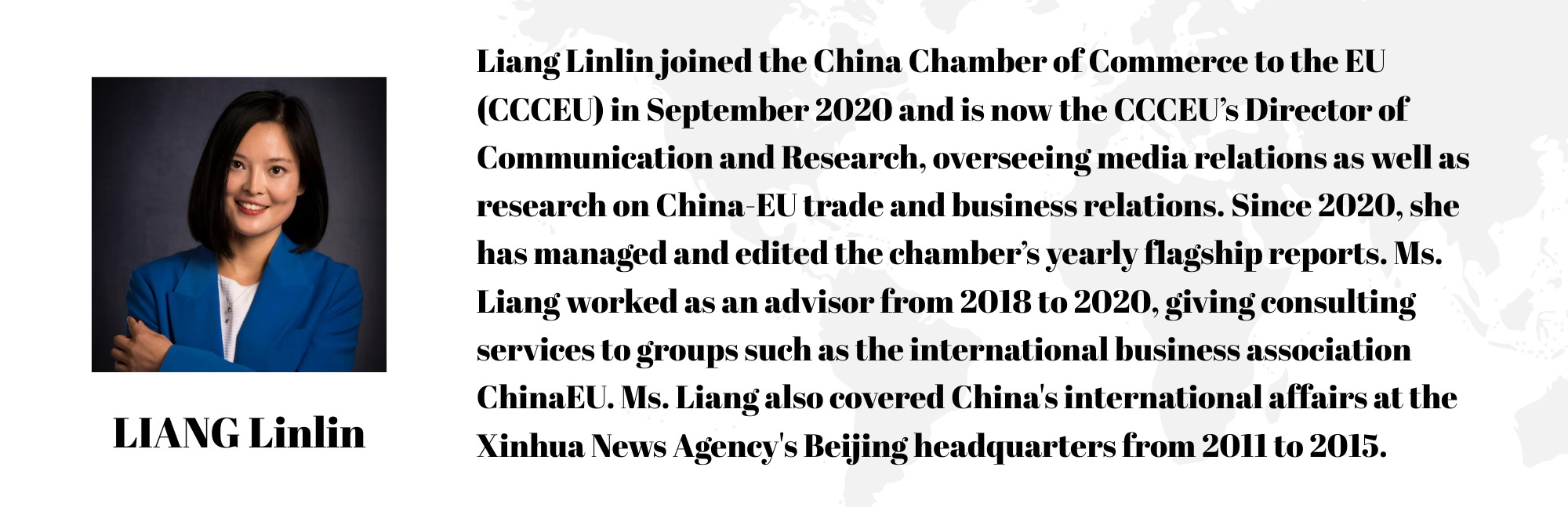
Experts in Today’s Dialogue:

Timestamp:
Key Points:
This episode focuses on the evolving trajectory of China-Europe relations, with SUN Chenghao and LIANG Linlin discussing how both sides should understand rising tensions, manage economic and technological frictions, and identify realistic areas for future cooperation.
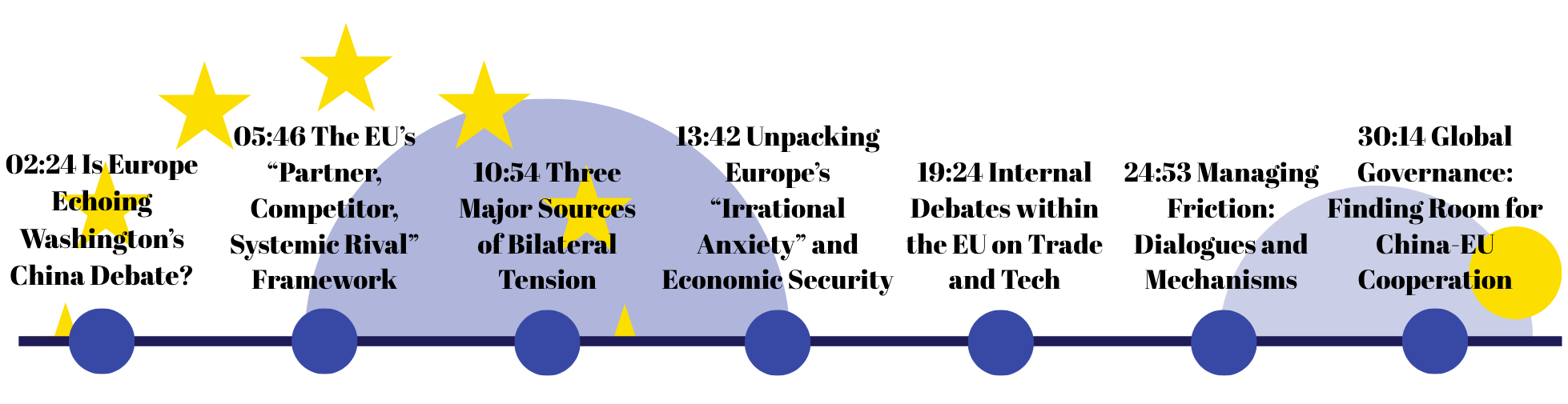
SUN opens the discussion by placing current European debates on China in a broader comparative context. He observes that many conversations now taking place in Europe sound similar to debates in Washington about a decade ago, when U.S. policymakers increasingly concluded that engagement with China had failed and that competition should become the organizing principle of the relationship. In Europe today, he notes, China-related discussions increasingly revolve around economic security, de-risking, industrial resilience, technological sovereignty and the idea of a “China Shock 2.0.” Against this background, he asks whether China-Europe relations have reached a new turning point.
LIANG responds that China-Europe relations have been described as being “at a crossroads” many times in recent years. In her view, however, the more substantial turning point came in 2019, when the European Union redefined China simultaneously as a partner, a competitor, and a systemic rival. Since then, this three-part framework has shaped many policy debates in Brussels and across Europe. She argues that Europe is now once again at a moment of reflection: some policymakers and scholars are debating whether Europe should take a tougher approach toward China, while others are asking whether the EU has overemphasized rivalry and competition at the expense of partnership.
SUN then raises the question of whether Europe has become overly concerned about China. He points out that issues such as economic dependence, industrial competition, critical infrastructure, and national security have become much more prominent in European debates. From the Chinese perspective, some observers worry that Europe is increasingly viewing China through a security lens and may be exaggerating the risks associated with China.
LIANG notes that the EU’s threefold definition of China is difficult to implement in practice because the categories of partner, competitor, and systemic rival can contradict one another. In recent years, Brussels has often stressed the competitor and rival dimensions more than the partner dimension. However, she also observes that not all Europeans see China primarily as a rival. Many are more concerned with China as a powerful economic competitor, especially in manufacturing. She adds that China is not necessarily the central issue in all European political debates; Europe is also preoccupied with energy, defense, migration, and broader economic challenges. There is also a gap between discussions in Brussels and attitudes at the member-state or regional levels.
Turnning to the sources of tension between China and Europe, SUN suggests that current disagreements go beyond individual issues such as electric vehicles, trade disputes, market access, and the Ukraine crisis. They are increasingly connected to broader European concerns about economic security, technological dependence, industrial competitiveness, and Europe’s position in a more competitive international system. LIANG identifies trade and industrial policy, investment, and the Ukraine crisis as three major sources of tension. From Europe’s perspective, trade imbalances, Chinese industrial competitiveness, and market access have become central concerns. From China’s perspective, there is concern that Europe’s de-risking agenda could slide into protectionism or selective decoupling.
On the question of “anxiety” in Europe, LIANG argues that European concerns about China are deeply connected to Europe’s own economic difficulties. Europe is facing sluggish growth, pressure on employment, weakness in parts of its manufacturing sector, high energy prices, rising labor costs, and a complex regulatory environment. In this context, China’s manufacturing capacity can appear overwhelming. Some Europeans worry that China can produce almost everything at competitive prices and increasingly high quality, which raises deeper questions about Europe’s own competitiveness. LIANG believes that some of this anxiety is understandable, but it can become problematic when the concept of security is overstretched. She gives the example of fears that Chinese companies could control infrastructure or access data in unrealistic ways. In her view, such concerns are often not based on facts and reflect a lack of trust.
At the same time, LIANG emphasizes that Europe should not be overly pessimistic about itself. Europe still has a large consumer market, strong innovation capacity, a deep talent pool, and significant power in global standard-setting. For Chinese companies, Europe remains a highly attractive destination, and survey data from the China Chamber of Commerce to the EU suggest that Europe’s importance for Chinese companies’ overseas expansion has continued to rise.
Then, SUN and LIANG also discuss internal divisions within Europe. LIANG explains that the EU is not a single state but a bloc of 27 member states, each with different economic exposure to China, policy traditions, and political preferences. Some countries are more supportive of free trade, while others are more protectionist. Positions also vary between Brussels, national capitals, and regional governments. However, she stresses that EU decision-making mechanisms still matter: even if member states disagree, EU-level rules can still produce collective decisions, especially on trade defense measures.
On managing differences, SUN argues that China and Europe should not allow trade and technology disputes to define the entire relationship. Complete decoupling is neither realistic nor desirable. LIANG agrees and points out that China and the EU already have many dialogue mechanisms, including summits, high-level economic and trade dialogues, digital economy exchanges, climate and environment dialogues, and strategic dialogues. However, she believes that the frequency and effectiveness of communication are still insufficient. She welcomes discussions on a China-EU trade and investment consultation mechanism, which could help address concrete issues such as export controls, the implementation of the EU Foreign Subsidies Regulation, trade defense instruments, and supply-chain-related measures. SUN adds that compared with the frequency of China-U.S. exchanges on trade and investment, China-EU communication still needs to become more regular and institutionalized.
Finally, the discussion turns to global governance. LIANG argues that China and Europe still have meaningful room for cooperation in areas such as energy security, green transition, food security, counterterrorism, climate change, multilateral governance, and third-party market cooperation. She notes that Chinese companies have contributed positively to Europe’s green transition and that there may be potential synergies between the Belt and Road Initiative and the EU’s Global Gateway, particularly in connectivity and third-party markets. However, she stresses that trust must be rebuilt first.
SUN concludes by highlighting artificial intelligence governance as a promising area for future China-Europe cooperation. He suggests that the two sides could explore official or Track 1 dialogues on issues such as the AI-nuclear nexus, the social impact of AI, and preventing the malicious use of AI by non-state actors. Overall, the episode suggests that China-Europe relations are becoming more complicated but also more important. The key question is not whether disagreements exist, but whether both sides can manage them while building more concrete, issue-based, and sustainable cooperation.
Follow ChinaVoice Now!
Apple Podcast
Spotify
RSS Feed
https://rss.com/podcasts/chinavoice/2948104/ (You can also copy this address from your browser’s address bar and paste it into any podcast app that supports RSS.)
Know more about our TEAM!
Executive Producer: SUN Chenghao
Producer: LI Yining, WANG Yinuo
Content Editor: ZHANG Xueyu, LI Yijie, WANG Yexu
Graphics Designer: ZHANG Xueyu
ChinaVoice | Durable Stability or Temporary Easing? Interpreting the China-U.S. Summit

Welcome to ChinaVoice, a new podcast series from the ChinaAffairsplus team.


