



Welcome to the 70th edition of our weekly newsletter! I’m SUN Chenghao,a fellow with the Center for International Security and Strategy (CISS) at Tsinghua University, Council Member of The Chinese Association of American Studies, a visiting scholar at Paul Tsai China Center of Yale Law School in 2024 and Munich Young Leader 2025.
ChinAffairsplus is a newsletter that shares articles by Chinese academics on topics such as China’s foreign policy, China-U.S. relations, China-Europe relations, and more. This newsletter was co-founded by my research assistant, ZHANG Xueyu, and me.
Through carefully selected Chinese academic articles, we aim to provide you with key insights into the issues that China’s academic and strategic communities are focused on. We will highlight why each article matters and the most important takeaways. Questions and feedback can be addressed to sch0625@gmail.com
Today, we have selected an article written by YUE Shengsong on Securitization Expansion in U.S. and European policies toward China.
Summary
The U.S. and European policies toward China are undergoing a profound evolution from traditional “securitization” to “securitization expansion,” wherein non-traditional security issues, such as economy, technology, supply chains, and even people-to-people exchanges, are increasingly incorporated into security considerations. This constitutes a new reality for understanding the interaction and divergence between the two sides.
Based on securitization theory, this study constructs a three-dimensional analytical framework centered on “security reference‑identity framing‑agenda setting” to systematically examine the interactive trajectory of the U.S. and European policies toward China since the 1990s. The research finds that their interaction is essentially an ongoing and expanding collusion: both sides jointly construct China’s development in institutional, economic, technological, and geopolitical dimensions as “systemic challenges”; reinforce the narrative of “othering” China by leveraging the collective identity of the “transatlantic alliance of values”; and subsequently promote the formation of an institutionalized and coordinated agenda covering economic, trade, technological, and geostrategic domains.
However, intrinsic differences in threat perception intensity, prioritization of interests, and strategic culture result in their interaction exhibiting distinct characteristics of “limited coordination” and “instrumentalization.” While this securitization expansion interaction poses systemic regulatory pressure on China in the short term, its inherent limitations also present strategic opportunities. The study argues that China should accurately identify the differences in logic and interests within U.S.-Europe interactions and adopt “resilience-centrism” as a strategic guide. By deepening institutional expansion, constructing a cooperative network within the Global South, and strengthening China’s voice in international affairs, China can effectively counter joint containment and steer major country relations back onto a track of rational competition and necessary cooperation.
Why It Matters
U.S. and European policies toward China have increasingly blurred the lines between economic, technological and security concerns, shaping an international environment where every major policy decision carries geopolitical weight. This shows the trend of securitization expansion, which entails the substitution and suppression of market and cooperation logic by an overarching security logic.
How does securitization logic continue to generate endogenous momentum for U.S. and European policies toward China? What patterns characterize their securitized interactions, and how will these dynamics affect China-U.S.-EU trilateral relations, as well as regional and global orders more broadly?
To address these questions, this article develops a three-dimensional analytical framework centered on “security reference”, “identity framing” and “agenda setting”, revealing the internal mechanisms through which China-related issues are systematically constructed as security threats and translated into coordinated policy agendas.
Key Points
1. Security Reference, Identity Framing and Agenda Setting: An Analytical Framework Based on Securitization Expansion
First, decision makers construct the “existential threat” that policy actions are intended to address. The core of identifying the threat include three aspects, which are simplifying complex realities, linking the reference to core values and interests, amplifying the immediate destructiveness of the threat and emphasizing the urgency of action. The key strategy is to package the subjective perceptions as indisputable “facts”, providing a cognitive basis of legitimacy. Second, identifying threats requires a distinction between “victims” (“self”) and “perpetrators” (“other”).
Identity framing is used to simplify complex international relations through a binary logic, transforming them into a narrative of confrontation between “victims” and “perpetrators”. By mobilizing such narratives, a community of “victims” is constructed, where a hierarchical structure and collective obligation within “partnership” or “alliance” are formed. Third, the agenda is set in three dimensions: constructing a selection of policy toolkits, concentrating particular strategic resources, and ensuring coherence and legitimacy of collective action across alliances. Thus, discursive power is transformed into institutional authority and tangible policy action.
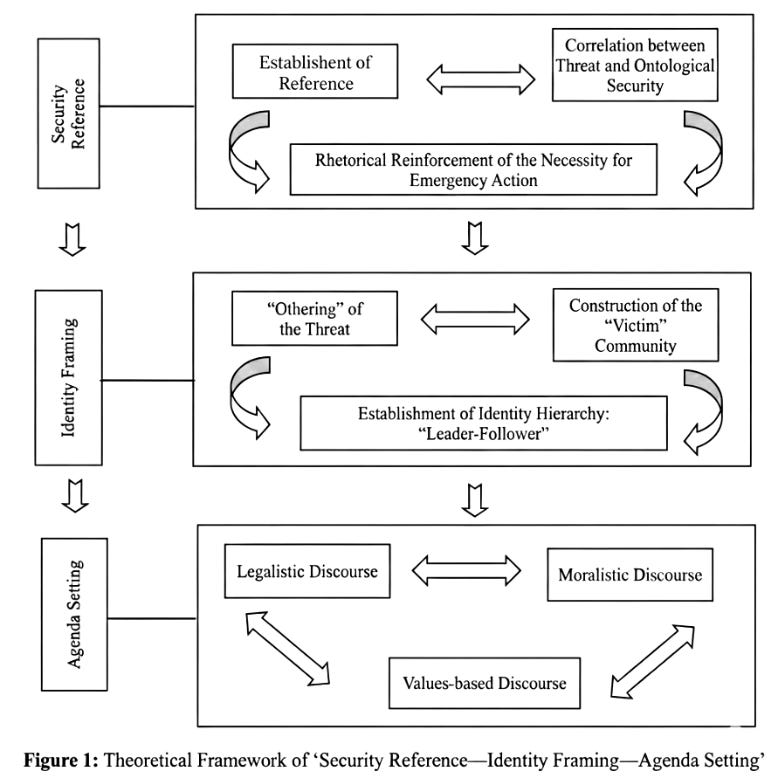
Security reference provides the cognitive preconditions and objects of constructing identity. Identity framing lays the relational foundation and policy orientation for setting agendas. Agenda setting then translates the discursive constructions into policy outcomes, while the feedback from policy reshapes the intensity of perception towards the threat and solidity of identity. This model shows a dynamic logical loop regarding the mechanisms of securitization, and offers a more integrated and explanatory tool for examining securitization.
2. Securitization Expansion Practices in U.S. and European Policies Toward China: Interaction, Divergence, and Evolution
(1) Latent Securitization (1990s-2008): Promoting “Transformation” through Engagement
From the 1900s until the outbreak of the 2008 financial crisis, the U.S. and European policies toward China were characterized by “engagement”, embedded in a core assumption: by incorporating China into a Western-led international system, China could be induced to undergo a “liberalizing” transformation.
During this phase, the security perspective of the U.S. and Europe framed China’s political system and ideology as a long-term, systemic risk to the Western-dominated order. For instance, the Clinton administration linked China’s MFN status to its so-called “human rights conditions”. Additionally, Europe framed EU-China relations with the objective to “support China’s transition to an open society”, listing the promotion of human rights and rule of law as key goals. Based on a shared security reference, the U.S. and Europe displayed a highly coordinated relationship in identity framing. Both sides reinforced their identity as a “transatlantic community” grounded in common values of democracy, freedom and human rights. As a result, the agenda setting of their policies focused strongly on embedding China into international institutions and assimilating China in a normative way. Supporting China’s WTO accession constituted a carefully designed geoeconomic strategy, which aims to shape China’s behavioral norms.
(2) Explicit Securitization (2008-2016): Crisis Catalysis and the Hedging Strategy
The 2008 financial crisis exposed structural flaws in Western governance models and witnessed China’s rapid growth in economic strength and international influence. U.S. and European policies shifted from an emphasis on “engagement” to a strategy of “hedging”, characterized by the coexistence of engagement and containment. Securitization began to expand explicitly into economic and geopolitical domains.
During this phase, the security reference of U.S. and European policies shifted from “value-based threats,” to China’s “existential challenge,” to Western dominance. U.S. official reports began to characterize China’s economic behavior as “unfair competition” and, through the policy of “rebalancing” toward Asia-Pacific, signaled a more critical stance toward China. The EU did not pivot toward geopolitical confrontation as rapidly as the U.S., but its perception of economic threats from China also intensified. In terms of identity framing, the U.S. labeled China as a “competitor” and a potential “rival” capable of challenging U.S. authority. The EU continued to uphold China’s status as a “cooperation partner”, albeit with greater emphasis on China as a “strong economic competitor” and an actor with whom the EU must “defend its interests in negotiations.” U.S. and European agenda setting converged on the objective of “guarding against China,” yet diverged in concrete pathways and policy instruments. U.S. combined geopolitical and economic instruments, reallocating diplomatic, economic and military resources to Asia-Pacific. The EU, by contrast, exhibited a defensive orientation centered on rules and regulatory mechanisms.
(3) Comprehensive Securitization Expansion (2017-present): Competition and Coordination under the Agenda of De-Risking
Since the first Trump administration, security logic has come to dominate trade, technology, supply chains, people-to-people exchanges and other agendas. In terms of security reference, the U.S. positioned China as the “most consequential geopolitical challenge”, while the EU sees China as a partner for cooperation, an economic competitor and a systemic rival, maintaining limited focus on traditional military security.
To mobilize internal consensus and legitimize policy action, both sides reshape a collective identity centered on a “democratic values alliance”. The US-EU Trade and Technology Council (TTC) has emerged as the central mechanism for both sides to coordinate agendas. However, the EU emphasizes “de-risking” instead of the comprehensive “decoupling” favored by the U.S. The EU prefers rule-based and defensive policy tools, while the U.S. rely on unilateral measures such as tariff threats and the Entity List. They jointly engaged in the “Indo-Pacific”, but the EU has stressed that its presence in the region is primarily trade- and rule-based, whereas the U.S. places greater emphasis on military initiatives such as AUKUS and the QUAD. The EU has also shown a strong sense of strategic autonomy and reluctance of becoming merely an instrument of U.S. values-based diplomacy. As a result, both sides display high levels of coordination in low-politics areas, but greater divergences in high-politics issues involving comprehensive trade wars and mandatory sanctions.
3. The Inherent Limitations of U.S. and European Policies Toward China Determined the Limited Cooperation Between the U.S. and Europe
(1) Persistent Divisions and Gradients in Interest Structures within the EU
Western industrial powers like Germany and France prioritize technological sovereignty and market access, while Central and Southern European countries, such as Hungary and Greece, value Chinese investment and infrastructure cooperation and remain geographically dependent on U.S. security guarantees. Diverging interests also appear in the differing willingness to invest in the Indo-Pacific strategy and to share the associated costs. Such heterogeneity significantly weakens the coherence and intensity of transatlantic interactions in China.
(2) Misalignment Between Different Strategic Priorities of U.S. and EU
The U.S. aims to preserve its absolute advantage within the global hegemonic system, pursuing policies with a zero-sum logic. The EU, by contrast, emphasizes maintaining a rules-based multilateral order and safeguarding its prosperity and influence within it. This divergence creates mismatched policy rhythms and instruments: the U.S. favors aggressive pressure and unilateral sanctions, while the EU prefers regulatory tools and multilateral frameworks.
(3) Transactional Shift in Transatlantic Alliances Led by Tensions in Cost-Sharing and Sovereignty
The U.S. expects European allies to unconditionally shoulder greater risks, providing full support in defense spending, technology restrictions on China, and sanctions enforcement, while implicitly accepting U.S. leadership. Europe, however, seeks to cooperate while maximizing economic interests, technological sovereignty, and strategic autonomy. When security imperatives directly conflict with core economic interests, the fragility of the alliance becomes evident.
(4) Three Paradoxes of Security-Centric Narratives Appear in the U.S.-EU Relationship
First, efforts to “decouple” supply chains from China and relocate production offshore raise short-term inflation and fiscal burdens, undermining domestic competitiveness and consumer welfare. Second, pressuring China under the banner of democracy and human rights is weakened by perceived double standards on issues like the Israel-Palestine conflict. Third, weaponizing international rules and standards to exclude China erodes the neutrality, fairness, and stability of the very rules-based order the U.S. claims to defend.
4. The Impacts of U.S. and European Policies Toward China and China’s Strategic Responses
(1) U.S. and European policies Toward China Influenced China, the Trilateral Relationship and the International Order
First, the U.S.-Europe policy interactions toward China seek to impose a systematic framework and regulatory constraints across multiple domains, which shape a more complex and challenging external environment for China. Second, these interactions create a new normal of trilateral relationship dominated by strategic competition, with significantly narrowed space for pragmatic cooperation and highly politicized rules. In such a paradigm defined by the U.S., it’s increasingly difficult to pursue dialogues and cooperation, which presents a difficulty for Europe to seek balance between cooperation and caution. It also carries instability caused by the structural conflicts over economic interests between two sides. Third, such interactions lead to a hierarchized multipolarity and more fragmented governance. Global South countries face the risk of further marginalization or being forced to choose sides. A broader security-driven logic weakens international multilateral institutions, leading to their replacement by exclusive, value-based clubs or technology alliances.
(2) China Should Focus on Proactively Shaping the Environment Based on Precise Strategic Assessment
At a theoretical level, it should establish a strategic philosophy centered on Resilient Centralism: placing its own development at the core, building an internal resilience system capable of withstanding external shocks and possessing strong self-repair capacity, and leveraging the inherent limitations of U.S.-Europe interactions to carry out precise, asymmetric “counter-shaping”.
Based on this strategy, China’s policy toolkit should be more targeted and flexible. In the economic and technological sphere, it should actively explore a path of “relinking” between decoupling and dependence, which means achieving self-reliance and controllability regarding the “high fence”, while deepening connections with the broader global market beyond its “small yard”.
In terms of diplomacy and security, China should distinguish between the U.S.-Europe “value alliances” and its own “development partner network,” building a united front with Global South countries based on shared development interests. China should also leverage U.S.-Europe divergences and support the EU in deepening its practice of strategic autonomy. In the realm of narrative and normative influence, China should actively participate in international discourse competition and enhance its soft power.
On one hand, China should systematically expose how the securitization expansion of the U.S. and Europe raises global costs, undermines international rules, and obstructs human progress. On the other hand, China should go beyond defensive rebuttals to set the agenda proactively, presenting alternative frameworks such as “a community with a shared future for mankind” and “universally beneficial and inclusive economic globalization.”
Conclusion
U.S. and European policies toward China reflect an ongoing and progressively deepening expansion of securitization. A three-dimensional analytical framework-security reference, identity framing, and agenda-setting- provides a systematic examination of the evolution of U.S. and European policies toward China since the 1990s. Yet, this process of securitization expansion is inherently full of tensions and limitations, leaving critical space for China to implement strategic countermeasures.
Looking ahead, the trajectory of China-U.S.-Europe trilateral relations will largely depend on whether China can accurately identify and skillfully exploit the logical fractures within U.S. and European interactions, effectively break containment, and ultimately guide great-power relations back toward rational competition and necessary cooperation.
About the Author

YUE Shengsong 岳圣淞: Associate Professor at the Country and Area Studies Academy, Beijing Foreign Studies University. His main research interests include international political discourse theory and foreign policy analysis, discourse power in international institutions and external communication, asia-pacific international relations and China’s neighborhood strategy.
About the Publication
The Chinese version of the article was published by Northeast Asia Forum (《东北亚论坛》). The journal, managed by the Jilin University, is a comprehensive bimonthly periodical in politics, military, and law. Founded in 1992, the magazine focuses on analyzing the current situation, development strategies, economic cooperation, friendly exchanges and theoretical research in various countries and regions of Northeast Asia. It also evaluates new trends and developments in industry, agriculture, science and technology, finance, commerce, and foreign trade in the Asia Pacific region.

