



Welcome to the 72th edition of our weekly newsletter! I’m SUN Chenghao,a fellow with the Center for International Security and Strategy (CISS) at Tsinghua University, Council Member of The Chinese Association of American Studies, a visiting scholar at Paul Tsai China Center of Yale Law School in 2024 and Munich Young Leader 2025.
ChinAffairsplus is a newsletter that shares articles by Chinese academics on topics such as China’s foreign policy, China-U.S. relations, China-Europe relations, and more. This newsletter was co-founded by my research assistant, ZHANG Xueyu, and me.
Through carefully selected Chinese academic articles, we aim to provide you with key insights into the issues that China’s academic and strategic communities are focused on. We will highlight why each article matters and the most important takeaways. Questions and feedback can be addressed to sch0625@gmail.com
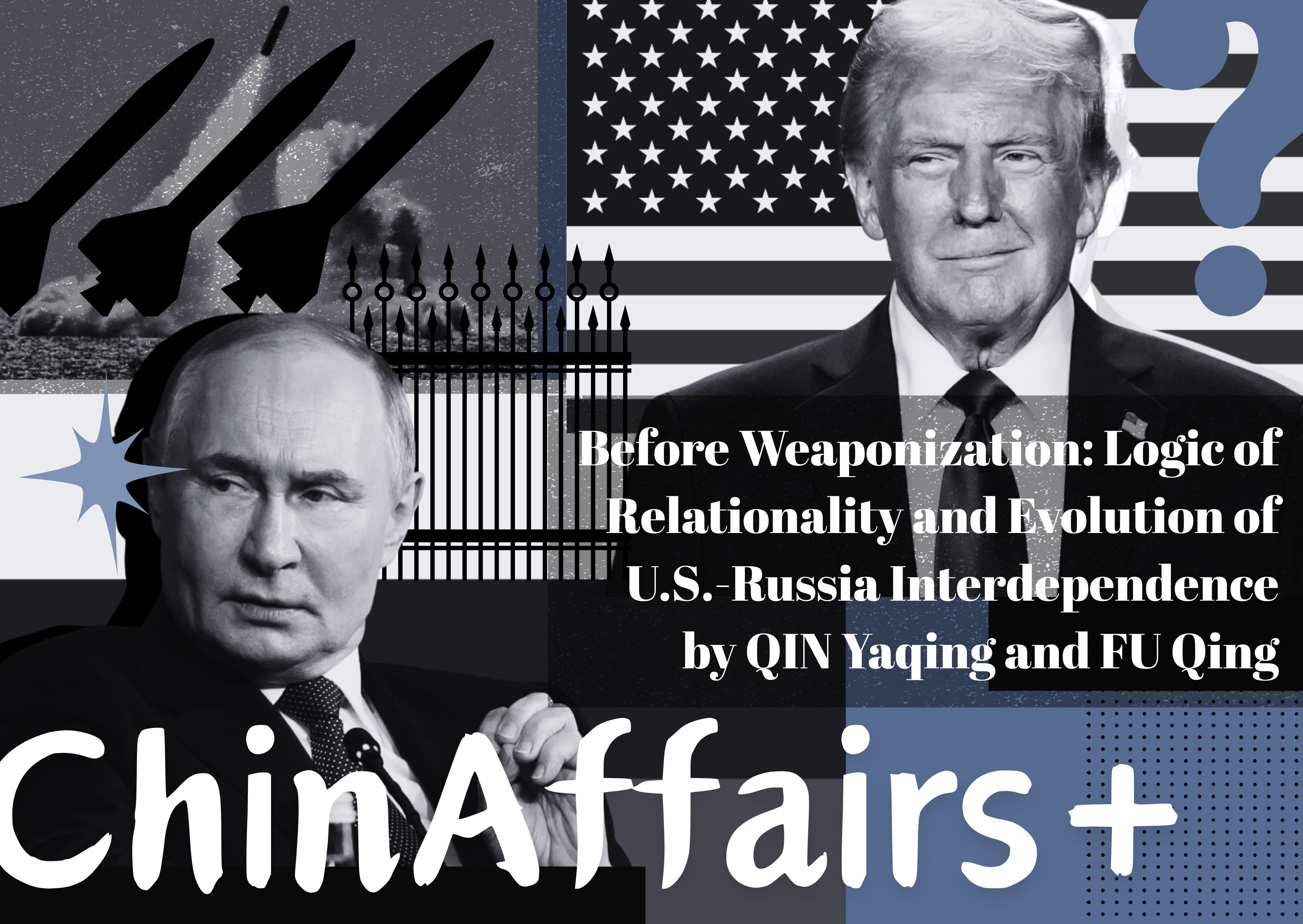
Today, we have selected an article written by QIN Yaqing and FU Qing on logic of relationality and evolution of U.S.-Russia interdependence before weaponization.

Summary
Weaponized interdependence has become a highly salient research issue. However, much existing literature focuses primarily on the outcomes of “weaponized interdependence and its aftermath”, neglecting the pre-weaponization process. Interdependence is an objective fact in international society, which has no inherent tendency towards either weaponization or de-weaponization, and its trajectory is contingent upon the overall relations between states.
The world is shaped by relations. Relations shape state identities, identities define state interests, interests guide state behaviors, and behaviors follow the logic of relationality. When the interstate relationship is characterized by generalized trust, states tend to positively define their mutual identities and interests, thereby facilitating the de-weaponization of interdependence. Conversely, if generalized distrust dominates, states are more likely to negatively define their mutual identities and interests, thereby fostering the weaponization of interdependence. The pre-weaponization process is fundamentally about relations. Interdependence itself is more a permissive mediator than an explanatory variable, capable of evolving towards either weaponization or de-weaponization. Eventually, relations shape state behaviors.
This article empirically tests this proposition by examining the evolution of U.S.-Russia relations and the divergent trajectories of their interdependence from 1991 to 2022, confirming that the pre-weaponization process is fundamentally about relations. Consequently, the fundamental avenues for constraining, managing and resolving the problem of weaponized interdependence lie in improving overall interstate relations and enhancing the level of generalized trust between states.
Why It Matters
In the current international context of intensifying power politics, interdependence is undergoing a profound paradigm shift from a bond of cooperation to a strategic weapon. This weaponized turn has become the core logic for understanding great power competition. The significance of this article lies in the fact that it departs from the limitations of existing research which often treats weaponization as a mere rational choice or a given outcome. By innovatively introducing a relational perspective, it reveals the underlying law that the nature of relations determines the direction of evolution.
Through an in-depth empirical analysis of the three-decade evolution of U.S.-Russia relations, the article demonstrates that interdependence itself is a neutral and irreversible relational fact. Its trajectory towards weaponization or de-weaponization fundamentally depends on the identities and interests defined by the level of generalized trust between states. When the overall relations shift from trust to distrust, originally mutually beneficial economic, trade, and technological networks are rapidly securitized and evolve into tools of suppression for asymmetric power.
This research provides solid academic support for assessing the exercise of networked power in great power competition. It also profoundly points out that the fundamental path to alleviating the dilemma of weaponization lies in improving the overall relationship environment between states rather than restructuring the interdependence itself. Amidst the resurgence of Cold War thinking, this analytical approach starting from the relational origin offers a highly insightful policy perspective for managing great power competition and preventing interdependence from being completely alienated into a bargaining chip for conflict.
Key Points
The Turn Toward Weaponized Interdependence and Empirical Evidence from U.S.-Russia Competition
From Mutually Beneficial Networks to Strategic Tools: In the current context of intensifying power politics, interdependence is undergoing a profound paradigm shift from a bond of cooperation to a strategic weapon. While traditional logic views global integration as a prerequisite for development, the resurgence of geopolitics has prompted dominant states to exploit asymmetric power structures. Consequently, originally mutually beneficial economic or technological networks are being transformed into coercive tools for curbing rivals.
The Representativeness and Research Path of the U.S.-Russia Case: This shift is particularly salient in U.S.-Russia relations, which moved from a post-Cold War honeymoon of de-weaponization to an era of all-encompassing weaponized confrontation. This evolution reveals how interdependence manifests differently across temporal conditions. The core research task is exploring the specific mechanisms that trigger this turn. Specifically, it examines why a party with lower vulnerability chooses to forgo cooperative gains to securitize relational networks as bargaining chips for conflict. By assessing this triggering path, the explanatory power of relational theory regarding networked power in great power competition can be effectively verified.
2. Evolution and Shift in Existing Research Paradigms
Liberal Expectations for Cooperation: Keohane and Nye established the foundation of interdependence theory in Power and Interdependence, arguing that it involves both mutual influence and the incurrence of costs. Under complex interdependence, multi-channel connections reduce the salience of military force and security issues. This paradigm maintains an optimistic outlook on cooperation. For instance, Rosecrance emphasizes that interdependence increases war costs, while Wendt suggests it facilitates collective identities, driving international relations toward de-securitization and de-weaponization.
Realist Payoff Games: In contrast, Waltz offers a realist critique, arguing that in an anarchic system, states must remain vigilant regarding relative gains and the unequal distribution of benefits. Since power is the fundamental means of ensuring security, states seek relative advantages in interactions. Gilpin further reveals that economic ties do not eliminate mistrust and may catalyze competition under certain conditions. Under this logic, interdependence fails to effectively constrain state behavior and may be alienated into a fuse for conflict due to power struggles.
The Weaponized Turn and Research Limitations: As great power competition intensifies, Farrell and Newman introduced the concept of weaponized interdependence, emphasizing that asymmetric, networked characteristics allow states to utilize networked power for strategic coercion. This transforms neutral economic or trade links into strategic instruments. Although research has expanded into various fields, existing literature often treats weaponization as a given outcome or choice. In fact, interdependence serves as a permissive mediator, and its evolution toward weaponization or de-weaponization fundamentally depends on the overall relations between states.
Relational Logic and the Evolution of Interdependence
The Logical Origin of Relationalism
To resolve the differences in strategic attributes exhibited by interdependence, this article introduces a relational perspective exploring the logic that the nature of relations determines the definition of interests. Interdependence is essentially a relational state, and its weaponized trajectory depends on the development of relational processes. Relational networks serve as both the prerequisite for power generation and the physical field for weaponized operations. Since the exercise of power is fundamentally an interaction to adjust mutual relations, differences in relationship types directly determine whether interdependence evolves into weaponized confrontation or de-weaponized cooperation.
The Ontological Turn of Relationalism: Relationalism posits that the world is composed of fluid relations rather than isolated entities, viewing relations as the fundamental units of the world. Unlike mainstream Western theories that treat states as independent entities with pre-existing interests and self-sufficient attributes, relationalism emphasizes that individuals are “relationals” deeply embedded in networks from the beginning. The existence, meaning, and behavior of actors are defined by their relational environment. This perspective shifts the research focus from isolated individual rationality to dynamic relational processes, suggesting that relations provide meaning to an actor’s existence while constantly shaping and constraining choices through the interactive operation of their circles and networks.
Relational Definition of Identity and Interests: In relational theory, an individual’s identity gains substantive meaning only within specific relational scenarios, presenting multiplicity and variability as networks flow and are reconstructed. Because identity determines motivation, interests are not given a priori but are derived from identities defined by relations. This logic explains why the same level of interdependence carries different strategic implications. For example, when interstate relations are friendly, mutual identities are defined as friends and cooperation is the interest. Once relations deteriorate into rivals, curbing the other party becomes a core interest, and originally non-sensitive low-level issues are redefined as high-level security threats.
Actor Agency and Relational Rationality: The actions of actors are rooted in the relational logic of social networks rather than a simple logic of consequences or appropriateness. Although interests drive behavior, their connotations and implementation paths must be defined within specific relational contexts, meaning the essence of rationality manifests as relational rationality. Simultaneously, actors possess significant agency within networks, capable of managing and weaving relational circles to achieve functional goals or adjust the relations themselves. Consequently, an actor's strategic choices are determined not only by objective structures but also by the relational reality perceived through subjective cognition.
Criteria for Determining Generalized Trust
After establishing the ontology of relationalism, trust is introduced as a core variable to transform the abstract relational field into an evaluable analytical tool.
The Dual Connotations of Trust: Trust is a relational concept deeply embedded in social networks, possessing both instrumental rationality and emotional attributes. It involves rational weighing based on cost-benefit analysis alongside emotional expectations of goodwill. These dual attributes collectively constitute positive expectations for mutual behavior, reflecting current interactions while indicating a future vision of shared interests and emotional resonance.
Classification of Trust Relationships: From a relational perspective, interstate relations are classified into two core forms: generalized trust and generalized distrust. This “generalized” nature represents a comprehensive evaluation across all fields rather than a strategic trade-off for a specific event. Generalized trust signifies positive interactions and expectations, whereas generalized distrust reflects negative anticipations based on non-goodwill information and negative emotions, with both dynamically transforming as interactions change
Trust as a Diagnostic Indicator of Identity: Interstate relationship types provide the field for identity generation, and the level of trust directly defines a state’s relational identity. Generalized trust facilitates the identification of “partners or friends,” promoting interest fusion and shared risks. Conversely, generalized distrust defines the other party as a “rival or threat,” leading to security self-help and interest isolation. Consequently, the qualitative descriptions of identity in official state documents serve as key explicit indicators for determining relationship types and predicting policy behavior.
The Direction of Interdependence Evolution
Sources of Power Under Multiple Forms of Dependence: Weaponized interdependence involves an initiating state utilizing relational asymmetries to harm a target. In the contemporary context, state power originates from both networked power based on specific positions and traditional bilateral asymmetric dependence. These forms create a superposition state of interdependence, allowing states to access power tools from multiple channels. Conversely, de-weaponization occurs when a state voluntarily renounces such repressive power to seek conflict reduction and cooperation.
Evolutionary Choices Driven by Relational Rationality: As a relational fact, interdependence possesses no inherent evolutionary tendency. Its transformation depends on the agency of sovereign states following relational rationality, where identities and interests are defined by relations. This means a state’s perception of interests in interdependence is not fixed but deeply embedded in the overall relational context.
Core Hypotheses on Generalized Trust and Evolutionary Direction: The overall relationship is the core variable determining the evolutionary direction of interdependence. Two core hypotheses are proposed:
① Hypothesis 1: In a relationship of generalized trust, states view dependence through absolute gains and promote evolution toward de-weaponization.
② Hypothesis 2: In a relationship of generalized distrust, states view dependence through relative gains and promote evolution toward weaponization.
U.S.-Russia Relations and the Evolution of Interdependence
Based on the relationalism framework, the post-Cold War U.S.-Russia competition illustrates how overall relations define identities and interests, driving interdependence toward weaponization or de-weaponization. As the dominant actor, the United States leveraged asymmetric power to shape the relationship. The 2014 Ukraine crisis marked a watershed, shifting the relationship from generalized trust to generalized distrust. This qualitative change fundamentally transformed their strategic interactions, moving from cooperative integration to the systematic weaponization of interdependence.
1991 - 2013: Generalized Trust and De-weaponization
From the dissolution of the Soviet Union to the 2014 Ukraine crisis, the United States tended to define Russia as a positive partner. Although local frictions existed on issues such as NATO’s eastward expansion and anti-missile systems in Eastern Europe, the overall nature of the bilateral relationship remained within the scope of trust. Under this relationship mode, U.S. behavioral expectations toward Russia remained positive, driving U.S.-Russia interdependence to exhibit significant characteristics of de-weaponization.
De-securitization and the Shift Toward Cooperation in the Security Field: In the relational field of generalized trust, the United States and Russia promoted the evolution of security interdependence toward a positive dimension by de-emphasizing competition and strengthening cooperation. Both sides voluntarily ceased the Cold War-style arms race and successively signed the Strategic Arms Reduction Treaty II (START II) and the New Strategic Arms Reduction Treaty (New START). Through large-scale reductions in strategic nuclear armaments and the establishment of rigorous treaty verification mechanisms, they achieved security risk-sharing based on trust. Regarding sensitive security issues such as NATO’s eastward expansion, both sides consciously managed competition through the establishment of mechanisms like the NATO-Russia Council and engaged in deep collaboration in the field of counter-terrorism, including intelligence sharing, airspace opening, and the signing of military contracts, transforming potential conflict issues into functional cooperation vehicles.
Deep Integration and Institutional Acceptance in Non-security Fields: Guided by generalized trust, Russia began to deeply embed itself into the U.S.-led international economic and trade network, and the level of non-security interdependence between the two sides continued to rise. Through policy tools such as the Freedom Support Act, the United States provided large-scale assistance for Russia’s economic reforms while actively guiding it to establish a market economy system. Both sides established a series of partnerships in the fields of the International Space Station, strategic energy dialogues, and technical investment, and continuously strengthened economic links through bilateral statements. Furthermore, the United States promoted and accepted Russia’s entry into the International Monetary Fund, the G8, and the WTO, transforming international mechanisms from tools of suppression into platforms for multilateral cooperation. During this period, the trust relationship became the core driver of de-weaponization, effectively suppressing the motivation to transform interdependence into strategic chips.
2014 - 2022: Generalized Distrust and the Weaponization of Interdependence
Since 2014, U.S.-Russia relations have deteriorated sharply as the U.S. redefined Russia from a partner to a “rival actor” and “acute threat,” marking an era of generalized distrust. In this field, the United States viewed previously deep interdependence as a security liability and initiated a comprehensive weaponization strategy.
Suspension of Security Cooperation and Competitive Evolution: Under generalized distrust, original cooperation mechanisms collapsed as the security boundary moved forward. Citing Russia’s actions in Ukraine, the United States suspended military cooperation and trade investment dialogues. The 2019 withdrawal from the INF Treaty terminated long-term arms control collaboration. Furthermore, by cutting network security channels and planning cyberattacks, the U.S. shifted security interdependence from positive cooperation to negative competition.
Unilateral Sanctions and the Blockade of Bilateral Dependence: The United States utilized its power advantage to implement weaponized strikes through multiple rounds of unilateral sanctions. This evolved from freezing assets of financial and military entities under the Obama administration to the severe 2017 Countering America’s Adversaries Through Sanctions Act. Following the 2022 conflict, sanctions upgraded to a comprehensive blockade, using administrative and legal means to forcefully obstruct bilateral interdependence.
Multilateral Linkage and the Isolation of Global Dependence: Beyond unilateral strikes, the United States urged allies to join sanctions to decouple Russia from global markets. Targeting Russia’s energy pillar, the U.S. legislated assistance for Central and Eastern Europe to diversify supplies while pressuring countries like the United Kingdom, Japan, and India to reduce Russian imports. This strategy seeks strategic isolation by blocking Russia’s global interdependence paths.
Exclusion from the International System and the Weaponization of Networked Power: Leveraging asymmetric dominance in global networks, the United States systematically excluded Russia from the international system. Measures included suspending Russia from the G8, terminating its OECD accession, and revoking its “most-favored-nation” status. The most severe blow was prohibiting Russian banks from the SWIFT system, effectively weaponizing global financial infrastructure to contain Russia’s development.
Driven by generalized distrust, security became the primary policy consideration. Any cooperation enhancing Russian interests was viewed as a threat, prompting the United States to transform bilateral and global network advantages into weapons of strike, turning interdependence into a breeding ground for suppression.
Conclusion
Through the empirical examination of the historical process of U.S.-Russia competition, this article confirms the decisive role of the nature of overall relations in the evolutionary direction of interdependence. This evolutionary logic profoundly reveals that security and weaponization are, to a large extent, derivatives of relations, rooted in the underlying mechanism where relations define identity and identity defines interests. Interdependence, as a neutral and irreversible relational fact, is not in itself an inevitable incentive for weaponization. The true driving force lies in the overall relations between states. Specifically, generalized trust allows security issues to be processed through de-securitization, while generalized distrust transforms non-security issues into existential threats. Consequently, the fundamental path to resolving the problem of weaponization lies not in changing the structure of dependence but in improving interstate relations and enhancing the level of generalized trust.
About the Author

QIN Yaqing 秦亚青: Dr. QIN Yaqing is former President and Professor of International Studies of China Foreign Affairs University and Chancellor of China Diplomatic Academy. He is Executive Vice President of China National Association for International Studies, Associate Member of the Royal Academy of Belgium, and Global Fellow of Peace Research Institute, Oslo. He was on the resource team for the UN High Panel for Challenges, Threats, and Changes (2003-04) and worked as Special Assistant to the Chinese Eminent Person, China-ASEAN Eminent Persons Group (2005). His main academic interests include international relations theory and global governance. He has published extensively, including Power, Institutions, and Culture (Peking University Press), Relations and Processes (Shanghai People’s Publishing House), and A Relational Theory of World Politics (Cambridge University Press). He got his Ph.D. and M.A. in Political Science at the University of Missouri-Columbia, U.S.
FU Qing付清:PhD Candidate, School of Political Science and Public Management, Shandong University.
About the Publication
The Chinese Version of this article was published on Northeast Asia Forum(《东北亚论坛》). The journal, managed by the Jilin University, is a comprehensive bimonthly periodical in politics, military, and law. Founded in 1992, the magazine focuses on analyzing the current situation, development strategies, economic cooperation, friendly exchanges and theoretical research in various countries and regions of Northeast Asia. It also evaluates new trends and developments in industry, agriculture, science and technology, finance, commerce, and foreign trade in the Asia Pacific region.

