



Welcome to the 7th edition of Ask China! I’m SUN Chenghao, a fellow with the Center for International Security and Strategy (CISS) at Tsinghua University, Council Member of The Chinese Association of American Studies, a visiting scholar at Paul Tsai China Center of Yale Law School in 2024 and Munich Young Leaders 2025.
ChinAffairsplus is a newsletter that shares articles by Chinese academics on topics such as China’s foreign policy, China-U.S. relations, China-Europe relations, and more. This newsletter was co-founded by my research assistant, ZHANG Xueyu, and me. Through carefully selected Chinese academic articles, we aim to provide you with key insights into the issues that China’s academic and strategic communities are focused on. We will highlight why each article matters and the most important takeaways. Questions and feedback can be addressed to sch0625@gmail.com.
In this newsletter, we address concerns about China’s positions through a Q&A format, while also presenting key points of leading Chinese scholars’ commentaries. Through this series, we aim to provide policymakers, think tanks, and strategic communities overseas with access to Chinese scholars’ views, accompanied by curated academic perspectives that help readers better understand the considerations underlying China’s foreign policy choices.
Background
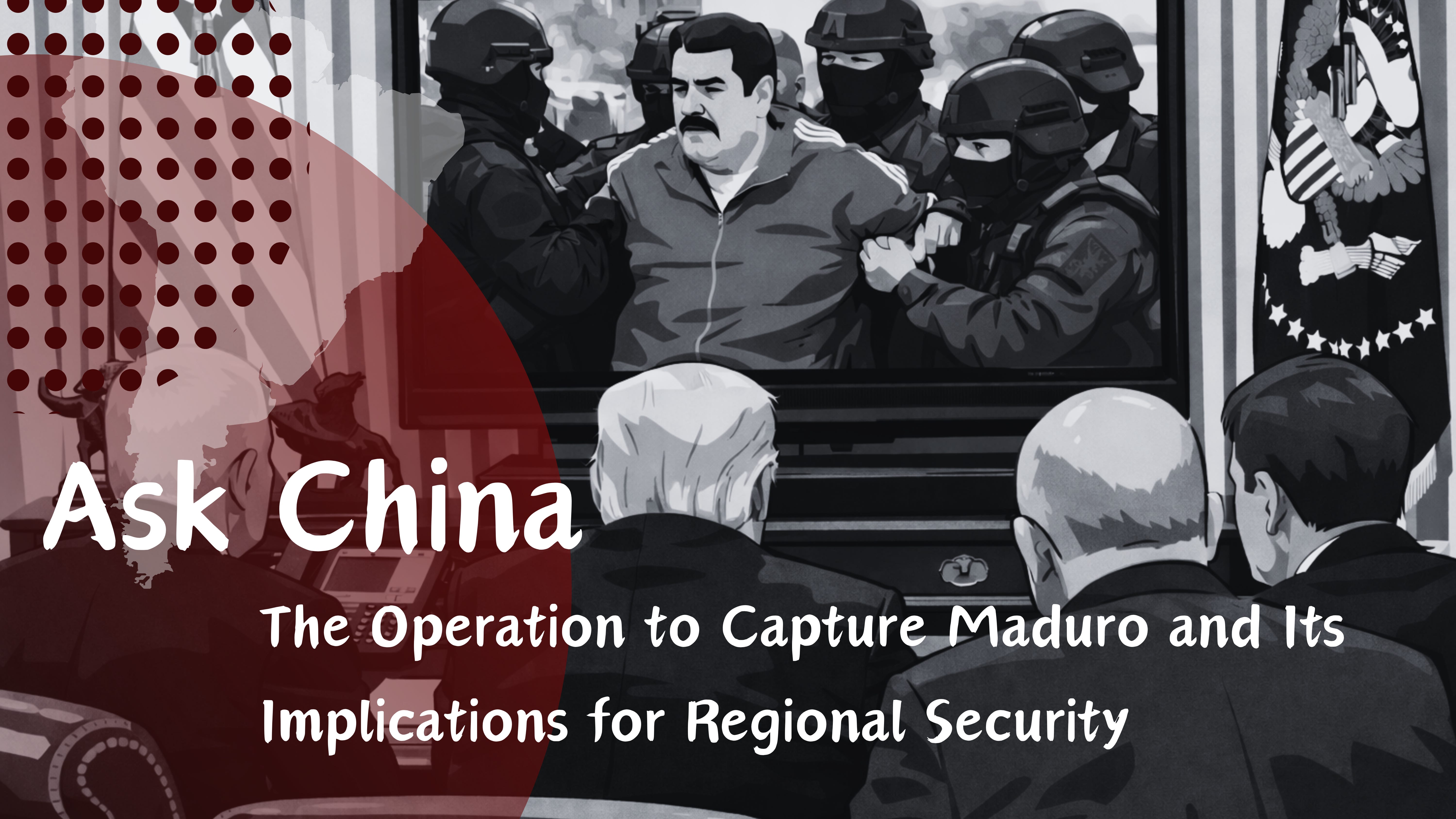
It is widely recognized that U.S.–Venezuela relations have long been tense. Yet although several previous U.S. presidents continuously sought to contain Venezuela, none ultimately chose a direct military invasion. Against this backdrop, the Trump administration’s decision to conduct a military strike and capture President Nicolás Maduro in January 2026 represents a significant departure from previous patterns of U.S. behavior.
In this context, today’s Ask China is based primarily on analyses by Chinese scholars to analyse this issue from three dimensions. First, how should the underlying objectives of the U.S. action be understood—was it driven by immediate tactical considerations, domestic political incentives, or broader strategic signaling? Second, does this shift indicate a deterioration of the international security environment more broadly, suggesting that the constraints imposed by international law and norms on the use of force are further eroding? Finally, does the sudden and decisive U.S. action against Venezuela signal a template that could be replicated elsewhere, raising concerns about whether future U.S.–China competition in other regions might increasingly unfold through similar high-risk, unilateral interventions?

Trump intends to use the counternarcotics narrative to lower political costs. Counternarcotics has been a major policy priority since Trump took office. Through portraying Maduro as a narco-trafficker, Trump turned a counternarcotics crackdown into a signature achievement to build domestic support and strengthen his position ahead of the midterm elections.
The U.S. strike on Venezuela pursued several objectives. From a domestic political standpoint, Trump currently needs a win that is both measurable and highly visible. For him, 2026 brings two immediate tests: the January 20 milestone marking one year in office, and the U.S. midterm election. With unemployment rising at home and his pledge to end the Russia–Ukraine war still unfulfilled, he has strong incentives to pursue an external operation that can deliver clear, demonstrable results and showcase governing competence. Venezuela—repeatedly linked in his rhetoric to illegal immigration and drug trafficking—thus became a plausible target.
From an interest-group perspective, the Venezuela operation reflects substantial incentives for the military–industrial complex. Trump has reasons to appease the defense industry and hawkish domestic constituencies that benefit from sustained military engagement, and these actors can shape electoral outcomes through Super PACs. The U.S. military–industrial complex is deeply embedded in the political system via lobbying, revolving-door networks, and intelligence sharing; over the past eight years, it has donated more than $87 million to members of Congress. The Venezuela campaign, in turn, creates new contracts and market opportunities for defense firms.
From an economic standpoint, Trump’s attack at this time was aimed at obtaining Venezuela’s oil resources. By toppling Venezuela’s government, Washington could seize the opportunity to control oil resources and key ports, securing tangible economic gains. Venezuela holds the world’s largest proven oil reserves—about 303 billion barrels, roughly 17% of global reserves. On the one hand, Trump has sought to bring U.S. oil majors back into Venezuela and commit billions of dollars to rebuilding its oil infrastructure. On the other hand, energy security is a core pillar of the United States’ manufacturing revitalization—especially the electricity demand and supply-security pressures created by AI supercomputing centers. Beyond oil, Venezuela is also a major holder of key minerals, including gold and aluminium. Because emerging critical technologies depend on stable access to such inputs, Venezuela’s energy and mineral endowments have become a prime object of Trump’s strategic-economic interest.
From a strategic perspective, the United States chose to strike Venezuela to preserve its regional hegemony. In the 2025 U.S. National Security Strategy, Trump signaled an intent to return to the Western Hemisphere and advance an America First agenda. The Maduro government in Venezuela embraces an anti-interventionist posture that challenges U.S. primacy in Latin America—something Washington is unwilling to tolerate. At the same time, Venezuela maintains close ties with U.S. strategic competitors such as China and Russia and has leveraged its oil resources to support other actors in the region that have tense relations with the United States. Against this backdrop, military action against Venezuela would reinforce U.S. hegemony in the Western Hemisphere, deter anti-American forces, and provide political backing and security guarantees for pro-U.S. actors in the region.

Venezuela incident should not be seen as an isolated case of crisis management. Instead, it points to a broader change in how the United States conducts external intervention during a period of strategic retrenchment, with clear implications for regional instability.
This incident matters not mainly because of its immediate outcome, but because it helps explain a wider shift in U.S. strategy. The United States has not withdrawn from international affairs. Rather, it is reducing long-term institutional commitments while strengthening direct control over what it sees as core strategic areas and critical assets. Trump’s second term does not mean the end of U.S. hegemony. It reflects a change in how hegemony is exercised, with less reliance on multilateral institutions and long-term order-building, and greater use of lower-cost, more direct, and more coercive tools. In practice, the United States is scaling back its role as a provider of global public goods, while reinforcing exclusive control over the Western Hemisphere, key transport routes, strategic resources, and security depth.
Viewed in this context, the Venezuela case shows how this strategy is applied on the ground. The incident sets a practical precedent by lowering the political and institutional barriers for the United States to use direct force. It was not an accidental action, but part of a broader effort to refocus U.S. attention on the Western Hemisphere and reshape regional order. Unlike earlier approaches based mainly on sanctions or proxy competition, the United States is now combining military action, cross-border law enforcement, and narratives of “political transition”. By applying domestic legal logic to international issues, Washington blurs the line between war and law enforcement, and between sovereignty and jurisdiction. If this approach continues, regional states are likely to feel greater uncertainty about their sovereignty and security, and Venezuela is unlikely to be the last country affected.
The case also highlights the growing importance of resources and geography in triggering direct intervention. U.S. involvement in Venezuela is not only about politics, but also about control over energy resources and regional influence. By moving directly into the oil sector and promoting “transitional management”, the United States is testing a model that combines regime change, economic takeover, and strategic pressure in Latin America. When Venezuela is considered alongside Greenland, a clear pattern emerges. Areas rich in resources, located at strategic nodes, or controlling key routes, are increasingly treated as security issues. This trend pushes affected countries to rethink the stability of their sovereignty and to take more hedging measures in diplomacy, security, and economic policy.
Finally, at the level of global order and major-power relations, this approach leaves little room for ideas such as “great-power co-governance”. By bypassing multilateral institutions, deciding legitimacy on its own, and directly shaping political outcomes, the United States is promoting a more instrumental and exclusive view of international order. This weakens the predictability of international rules and deepens differences between China and the United States over how order should be managed, where intervention should stop, and how responsibility should be shared. As a result, the idea of a “Trump-style G2” lacks a solid foundation.
Accordingly, the Venezuela case should be understood as a signal rather than an exception. As multilateral constraints weaken and power politics return, the United States is more likely to use direct and coercive tools in regions it defines as central to its security. This trend creates long-term pressure for Latin America and may also appear in other strategically sensitive regions.

The U.S. raid on Venezuela and the forcible seizure of President Maduro—widely viewed as a grave violation of sovereignty and international law—cannot be treated as an isolated crisis. For China, relations with Venezuela, Latin America, and the United States must be understood as part of a single strategic environment shaped by Washington’s ongoing reconfiguration of its hegemonic model.
Politically, China must firmly uphold sovereign equality and non-interference, and oppose the U.S. practice of using domestic law and military force to override international law and remove foreign leaders. The Venezuela incident directly damages China’s all-weather strategic partnership with Caracas and reflects a form of new colonialism that exploits Latin America’s long-standing dependency. China should therefore work with regional states to resist the revival of a “new Monroe Doctrine” and to strengthen collective political autonomy through greater regional coordination.
Economically, China must urgently address the systemic risks to its investments and energy security. Venezuela’s core vulnerability lies in assets and jurisdiction, since U.S. courts and the dollar system can be used to strip foreign assets and weaponize finance. Given Venezuela’s vast oil reserves and China’s large-scale loans and investments, Beijing must hedge against legal and political expropriation by diversifying settlement systems, supply chains, and financial exposure, while prioritizing the safety of Chinese personnel and assets.
Regionally, the Venezuela case is accelerating strategic hedging across Latin America. U.S. coercive intervention is pushing regional states to seek greater legal, diplomatic, and economic autonomy. China should respond by embedding itself more deeply in regional development and trade networks, reducing reliance on politically fragile partners and limiting the effectiveness of U.S. point-pressure tactics.
At the global level, the crisis confirms that a “Trump’s G2” lacks foundation. The United States is bypassing multilateral rules and directly reshaping other countries’ politics, reflecting a more exclusive and coercive order fundamentally at odds with China’s emphasis on sovereignty and stability. China should therefore combine firm opposition to hegemonic intervention with pragmatic risk management, avoiding both accommodation and reckless confrontation.
In sum, China’s optimal strategy is to defend international law while restructuring its Latin American engagement in a more diversified, resilient, and institutionalized way, preserving strategic space under conditions of increasingly direct and unpredictable U.S. power.
The U.S. intervention in Venezuela and the forced removal of President Maduro represent more than a regional political upheaval; they constitute a paradigmatic case of contemporary great-power competition conducted through military coercion, financial instruments, and legal mechanisms rather than conventional warfare. As such, this conflict is highly likely to serve as a reference case for future U.S.–China strategic competition in other regions, including the Indo-Pacific, where similar patterns of indirect confrontation, institutional leverage, and economic pressure are already evident.
From the U.S. perspective, the Venezuela operation demonstrates a replicable model of enforcing strategic dominance without prolonged occupation, combining “surgical” military action with the weaponization of financial sanctions, extraterritorial legal jurisdiction, and control over global energy systems. This approach reflects the revival of a sphere-of-influence logic, explicitly articulated in the Trump administration’s embrace of a “new Monroe Doctrine” that defines entire regions as core strategic spaces requiring direct U.S. control or supervision. By reasserting primacy in what it considers its “home region,” the United States signals to both rivals and partners that challenges to its dominance—even when framed as economic or developmental cooperation—may provoke coercive responses beyond diplomatic or economic competition.
The Venezuelan case also illustrates how U.S. domestic law and judicial institutions have become integral tools of foreign policy, enabling the systematic transfer of foreign sovereign assets through American courts without formal annexation or long-term military presence. This fusion of legal authority and geopolitical strategy significantly lowers the threshold for intervention, as it allows the United States to undermine state sovereignty while maintaining a veneer of procedural legality. Such practices erode established norms of international law, particularly the prohibitions on the use of force, non-interference in internal affairs, and the immunity of sitting heads of state.
For China, the Venezuela crisis underscores the structural vulnerabilities inherent in overseas economic engagement when host-country assets, financial flows, and settlement mechanisms remain embedded within U.S.-dominated legal and monetary systems. Despite extensive Chinese investment and long-term energy cooperation with Venezuela, Beijing has been unable to shield its interests from unilateral U.S. actions, revealing the limits of purely economic statecraft in the absence of parallel legal, financial, and security safeguards. This experience is likely to inform China’s strategic calculations in the Indo-Pacific, where similar risks exist for infrastructure projects, energy routes, and financial arrangements involving third countries.
At a broader level, the Venezuela conflict highlights a shift in great-power rivalry away from direct military confrontation toward a form of legal and financial warfare, in which control over rules, institutions, and systems becomes more decisive than battlefield superiority. In the Indo-Pacific context, this suggests that U.S.–China competition will increasingly focus on shaping regional order through alliance structures, monetary systems, technology standards, and legal norms rather than through overt armed conflict. Consequently, third-party states may find their strategic autonomy constrained not by invasion, but by their degree of dependence on external legal jurisdictions, financial infrastructures, and security guarantees.
In conclusion, for both the United States and China, future strategic competition will hinge less on territorial control than on the ability to dominate systems of energy, finance, and international rule-making.

