



Welcome to the 74th edition of our weekly newsletter! I am SUN Chenghao, a senior fellow with the Center for International Security and Strategy (CISS) at Tsinghua University, Council Member of The Chinese Association of American Studies and a visiting scholar at the Paul Tsai China Center of Yale Law School (fall 2024).
ChinAffairsplus shares Chinese academic articles focused on topics such as China’s foreign policy, China-U.S. relations, China-European relations, and more. This newsletter was co-founded by me and my research assistant, ZHANG Xueyu.
Through carefully selected Chinese academic articles, we aim to provide you with key insights into the issues that China’s academic and strategic communities are focused on. We will highlight why each article matters and the most important takeaways. Questions or criticisms may be addressed to sch0625@gmail.com
Today, we have selected an article written by Liao Baizhi, Tang Zhichao, Chen Wenxin, Lu Ruquan, and Chen Qinghong, which focuses on Geopolitical Rivalry in the Middle East and Its Global Impact.

Summary
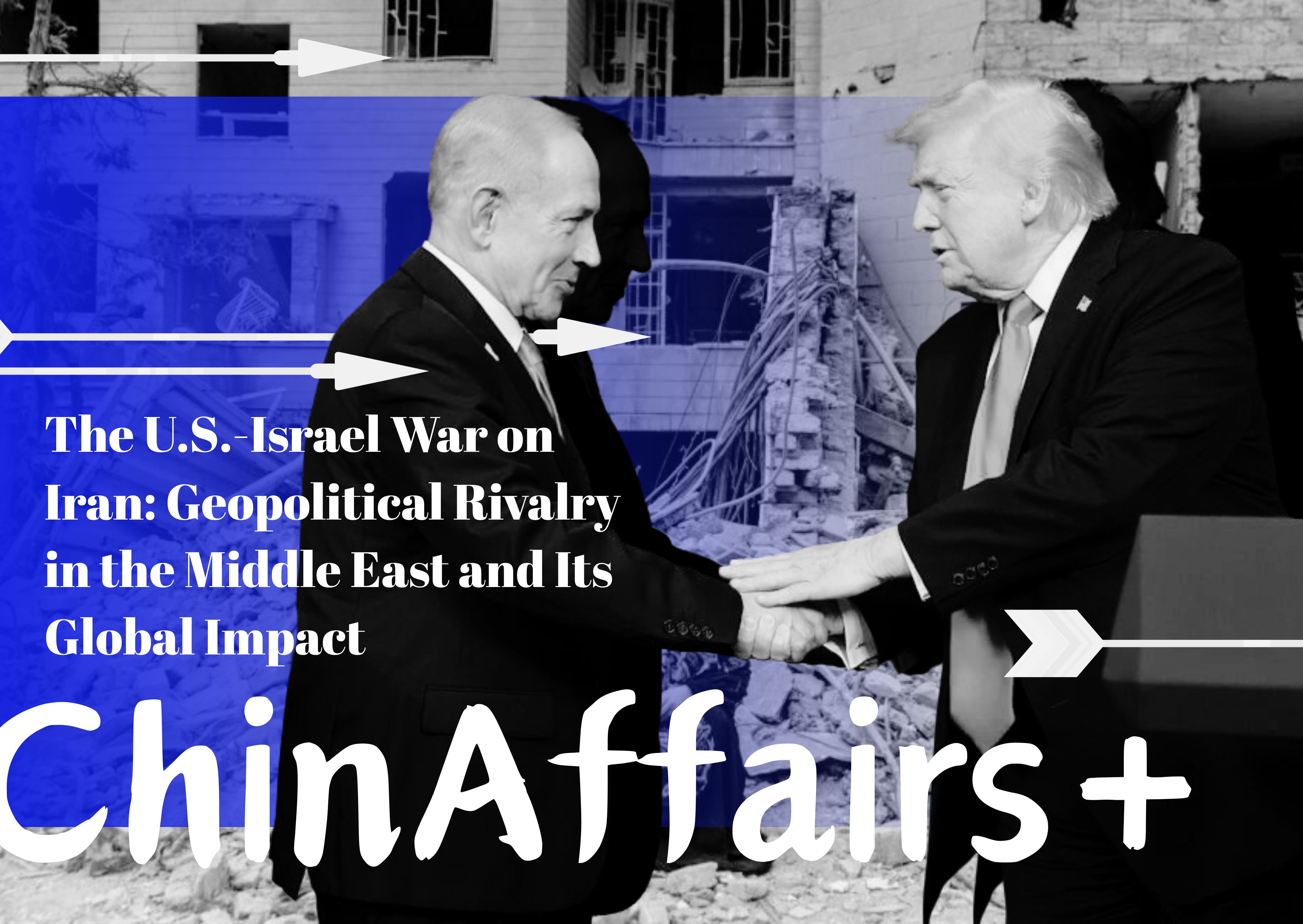
On February 28, 2026, the United States and Israel launched a joint war of aggression against Iran. Currently, the development on the battlefield has far exceeded the control of both nations. The US and Israel have failed in their goal of regime change in Iran. Consequently, Trump’s “Donroe Doctrine” has suffered its first major setback, and the U.S. strategy of low-cost hegemony maintenance has become unsustainable.
The military confrontation between the U.S.-Israeli alliance and Iran has impacted the geopolitical landscape in the Middle East. The U.S.-Israeli military alliance has seen unprecedented strengthening, and Gulf states have drifted back toward confrontation with Iran, while simultaneously recognizing the immense risks of over-reliance on US security guarantees.
The war has rapidly spilled over, triggering a global chain reaction. Security issues regarding strategic corridors have become further pronounced, and global energy and supply chain security face significant challenges. This conflict has delivered a severe shock to the global geopolitical order, exposing what is perceived as the inherent fragility and erratic nature of American hegemony, thereby shattering the myth of U.S. military invincibility.
Furthermore, the war has intensified domestic inflation and fiscal issues within the United States, eroding its economic dominance. It has deepened fractures within the U.S. alliance system, weakened mutual trust between the United States and Europe, and catalyzed new changes in major country relations. By deliberately violating international law and the fundamental norms of international relations, the U.S. has exacerbated the fragmentation of the international order.
Why It Matters
This symposium examines the U.S.-Israel war on Iran through several global shifts: the reordering of the Middle East, changes in U.S. hegemony, disruptions to energy security, and the evolution of global governance. The article shows that this conflict matters far beyond the regional battlefield. Through five interconnected lines of analysis, it explains how the war has reached into global strategic, economic, and institutional domains. Today, this war serves as a key test for U.S. strategic power, the unity of U.S. alliances, the resilience of energy networks, and the future of international norms.
Key Points
The War Is Accelerating the Reconfiguration of Middle Eastern Geopolitics
U.S.-Israel Strategic Overreach in the “New Middle East” Agenda
The United States and Israel have spent recent years trying to shape a “new Middle East.” The campaign against Iran was intended as a decisive step in that agenda. In practice, however, the operation was constrained by poor preparation, weak coordination, and the lack of a credible post-strike plan. As the battlefield moved beyond U.S.and Israeli control, the war exposed the limits of American military power. It also revealed the erosion of U.S. credibility and Washington’s weakening ability to rally allies. In this sense, the conflict may mark the beginning of a more visible “post-American” moment in the Middle East.
Israel’s Military Ascendance and the Risk of Strategic Overstretch
Since the latest round of the Palestine-Israel conflict began, Israel has tried to turn strategic vulnerability into regional initiative by using military force to reshape its security environment. The article suggests that Israel will remain a major driver of geopolitical change in the Middle East, regardless of how the war ends, yet this position still depends heavily on U.S.material and political support. If that support weakens or becomes more contested, Israel may face growing risks of strategic overstretch.
Gulf Security Outsourcing Under Pressure
For Gulf states and other regional actors, the war has blurred the boundary between a “Middle East of war” and a “Middle East of peace.” Countries that had focused on economic diversification and domestic transformation now face renewed exposure to regional conflict. Their model of outsourcing security to the United States is therefore under serious strain. The U.S. security umbrella has become not only a source of protection, but also a channel through which strategic risk is transmitted. Iran, meanwhile, has been weakened militarily but has become more hardline politically. This combination could produce a more unstable regional security environment after the war.
The War Is the Culmination of a Long Structural Confrontation
From the “Twelve-Day War” to Structural Confrontation
The current conflict is not only a continuation of the “Twelve-Day War” of June 2025 but the accumulated result of U.S.-Israeli confrontation with Iran since the 1979 Iranian Revolution. Washington and Tel Aviv have pointed to Iran’s alleged pursuit of nuclear weapons and long-standing “support for terrorism” to justify the war. However, these are proximate justifications rather than root causes. The deeper drivers lie in the contest over the Middle East order, political and ideological antagonism, and a fundamental clash over security concepts and policies.
Two Conflicts Within One Triangle
The U.S.-Iran conflict is different from the Israel-Iran conflict. The former is mainly about Iran’s resistance to U.S. hegemony, external interference, and foreign control in the Middle East. The latter is more directly driven by ideological hostility and mutual threat perceptions. Although both the United States and Israel seek regime change in Iran, their calculations differ.Israel’s objectives are more uncompromising, while the United States remains more opportunistic and conditional, wary of being drawn into another prolonged Middle Eastern war.
Law, Geopolitics, and Ideology
The authors describe the war as aggressive and unjust. Legally, the U.S.-Israeli strikes lacked U.N. Security Council authorization and did not meet the conditions for self-defense under Article 51 of the U.N. Charter. Geopolitically, the war is an attempt to preserve U.S.-Israeli regional hegemony and reshape the Middle East order. Ideologically, it is a confrontation among Trump’s “Donroe Doctrine,” Israel’s right-wing religious Zionism, and Iranian Khomeinism.
The Collapse of Washington’s “Low-Cost” Hegemony
The Logic of Hegemony on a Budget
During his second term, Trump sought to preserve U.S. hegemony through a strategy of domestic renewal, global burden-shedding, and strategic focus. This “low-cost” model emerged in the post-Cold War era as a way for the U.S. to maintain dominance despite its relative decline. The core logic is to maximize strategic gains with minimal direct investment by relying on ally burden-sharing, asymmetric military tools, and financial leverage.
Failure of the “Quick-Win” in Iran
The Trump administration attempted to replicate the “Venezuela model” in Iran, aiming for a rapid, overwhelming operation that would secure regime change without dragging the U.S. into a long war. The plan relied on Israel as the front-line force, while the U.S. provided intelligence, logistics, and air support. They expected limited strikes to dismantle Iran’s nuclear and command structures while avoiding a ground war, but the reality of the conflict quickly shattered these hopes.Asymmetric Drain and Strategic Blowback
Iran’s “mosaic defense” and regional countermeasures trapped Washington in a high-cost, low-return dilemma. High-end U.S.military advantages became fiscal liabilities as expensive defense systems were depleted by low-cost Iranian drones and swarm attacks. The conflict also fractured the alliance system. Most European partners refused to join the strikes, while Gulf states began to view the U.S. security umbrella as a lightning rod for risk rather than a safeguard.America’s “Suez Moment”
The war proves that “low-cost hegemony” is no longer sustainable in a multipolar world. Before the conflict, Washington could still lead by relying on the residual credibility of its power. With that credibility now spent, the cost of maintaining global dominance is set to skyrocket. This failure may be remembered as America’s “Suez moment,” a permanent turning point for U.S. influence in the Middle East.
The War Has Disrupted the Global Energy Order
Hormuz as the Epicenter of the Global Energy Shock
The conflict between the United States, Israel, and Iran has sent severe shockwaves through the global energy order. After the Islamic Revolutionary Guard Corps announced the closure of the Strait of Hormuz, the impact rippled rapidly through the entire oil and gas value chain, spreading from the Middle East to the global market. As the world’s most critical energy chokepoint, the Strait handled approximately 35% of global seaborne crude oil and 20% of the world’s liquefied natural gas (LNG) supply in 2025. This blockade has effectively severed a primary lifeline of the global economy.Supply Paralysis and the Shift to Land Routes
The closure of the Strait has caused the global market to pivot sharply from abundance to extreme supply tightness. With tankers and LNG carriers stranded, major Middle Eastern producers have been forced to slash output as their storage capacity reaches its limits. This crisis has triggered an urgent search for alternative energy routes. Gulf states are now prioritizing overland pipelines that bypass the Strait, as the war has exposed the inherent vulnerability of maritime energy corridors. Over the long term, this shift may drive significant investment into land-based pipeline networks and more diversified transport routes.The “Security Turn” in Asian Energy Policy
The conflict is forcing a radical redesign of energy policies across Asia. Because the vast majority of energy flowing through Hormuz is destined for Asian markets, these importers have been hit the hardest. In the short term, energy security has become the absolute priority for nations dependent on these imports. In the medium and long term, these countries are expected to accelerate supply diversification, expand strategic reserves, and view their energy transitions primarily through a security lens.China’s Resilience and Structural Exposure
For China, the war serves as both a stress test and a stark reminder of its structural vulnerabilities. China has shown strong resilience, supported by coal as a stabilizing base, leadership in renewable energy, and the use of strategic oil and gas reserves. However, its dependence on foreign energy remains high, with a significant share of its imports still relying on the Strait of Hormuz. To mitigate these risks, China should strengthen domestic energy production, enhance its ability to secure allocate global resources, and take a more active role in global energy governance.
The War Reveals Deeper Changes in Global Governance
The Structural Tensions of Governance
The U.S.and Israel war on Iran is more than a high intensity regional conflict. It is a revealing window into the structural tensions of global governance. The war challenges three long standing assumptions: hegemony produces stability, alliances ensure security, and international rules are irrelevant in the face of power politics. A hegemonic power can shift from being the guardian of the international system to its primary disruptor. It also demonstrates how military alliances can become channels for risk transmission and why international rules remain foundational despite repeated violations.The Credibility Crisis of U.S. Hegemony
The war has further eroded the credibility and narrative foundations of U.S.hegemony. While Washington has long positioned itself as the defender of global order and rules, its conduct in this conflict has reinforced perceptions of U.S. power as selective, unilateral, and destabilizing. Launching sudden strikes during a diplomatic window undermined legal legitimacy and destroyed diplomatic trust. Furthermore, the shifting and ambiguous war aims of Washington have left its international credibility in tatters.Alliances as Channels of Risk
The conflict has exposed the inherent dangers of traditional military alliances. Gulf states that relied on U.S. protection found themselves vulnerable to direct retaliation, while European and NATO members showed marked reluctance to get involved. This reflects the classic alliance dilemma of entrapment and abandonment, where states are either dragged into conflicts by their allies or find themselves abandoned when they need support most. In an era of long-range precision strikes and autonomous warfare, these risks have become even more acute.Toward a More Stable International Order
Despite the rise of unilateralism, the war has highlighted the enduring value of international law. The conflict has triggered renewed calls to defend sovereignty and the UN centered international system. The article concludes that the international community must reject hegemonic thinking and bloc confrontation in favor of a more just and practical global governance system. In this context, the Global Governance Initiative proposed by President Xi is presented as a vital framework. Its emphasis on sovereign equality, the rule of law, and multilateralism is seen as a possible pathway toward building a stable and functional international order.
Conclusion
Overall, the U.S.-Israel war on Iran as a significant event in the deepening transformation of the international system. It has accelerated the reconfiguration of Middle Eastern geopolitics and generated systemic shocks for U.S. hegemony, alliance politics, the global energy order, and the international rules system. Washington and Tel Aviv had hoped to use a rapid military campaign to force regime change, reshape the Middle East order, and sustain U.S. hegemony at low cost. Instead, the war has revealed Iran’s resilience, the security concerns of regional states, the fractures within the U.S.-led alliance system,and the vulnerability of global energy markets.
From a longer historical perspective, the significance of the war lies not only in its impact on the Middle Eastern battlefield, but also in its exposure of the deeper contradictions of the existing international order. The sustainability of unipolar hegemony is declining. The security promises of traditional alliance systems are increasingly facing questioning. The vulnerabilities of global energy and supply-chain systems have become more visible.
At the same time, the foundational role of international law and multilateral rules has become more important. The article therefore stresses the need for the international community to oppose hegemonism and power politics while advancing a more equitable, inclusive, and effective global governance system.
About the Author
Liao Baizhi廖百智: Research Professor, Director of the Institute of Middle East Studies, China Institutes of Contemporary International Relations(CICIR).
Tang Zhichao 唐志超: Director of the Department of Political Studies and the Middle East Development and Governance Research Center at the Institute of West Asian and African Studies, Chinese Academy of Social Sciences (CASS).
Chen Wenxin陈文鑫: Fellow and Director of the Institute of American Studies, China Institutes of Contemporary International Relations(CICIR).
Lu Ruquan陆如泉: Senior Economist, President of CNPC Economics & Technology Research Institute.
Chen Qinghong陈庆鸿: Deputy Director and Research Professor of Institute of World Political Studies at China Institutes of Contemporary International Relations(CICIR).
About the Publication
The Chinese version of this article was published in Contemporary International Relations (《现代国际关系》), No.4, 2026. Contemporary International Relations, a policy-oriented research journal, has been published by China Institutes of Contemporary International Relations since 1990. A primary purpose of its journal is to present the views of CICIR researchers on international politics and international relations. The journal’s scope of publication also includes papers by scholars and researchers from other institutes in China and from around the world. It covers analysis of changes in international relations and prominent world events.


