



Welcome to the 73rd edition of our weekly newsletter! I’m SUN Chenghao, a fellow with the Center for International Security and Strategy (CISS) at Tsinghua University, Council Member of The Chinese Association of American Studies and a visiting scholar at the Paul Tsai China Center of Yale Law School (fall 2024).
ChinAffairsplus is a newsletter that shares articles by Chinese academics on topics such as China’s foreign policy, China-U.S. relations, China-Europe relations, and more. This newsletter was co-founded by my research assistant, ZHANG Xueyu, and me.
Through carefully selected Chinese academic articles, we aim to provide you with key insights into the issues that China’s academic and strategic communities are focused on. We will highlight why each article matters and the most important takeaways. Questions and feedback can be addressed to sch0625@gmail.com
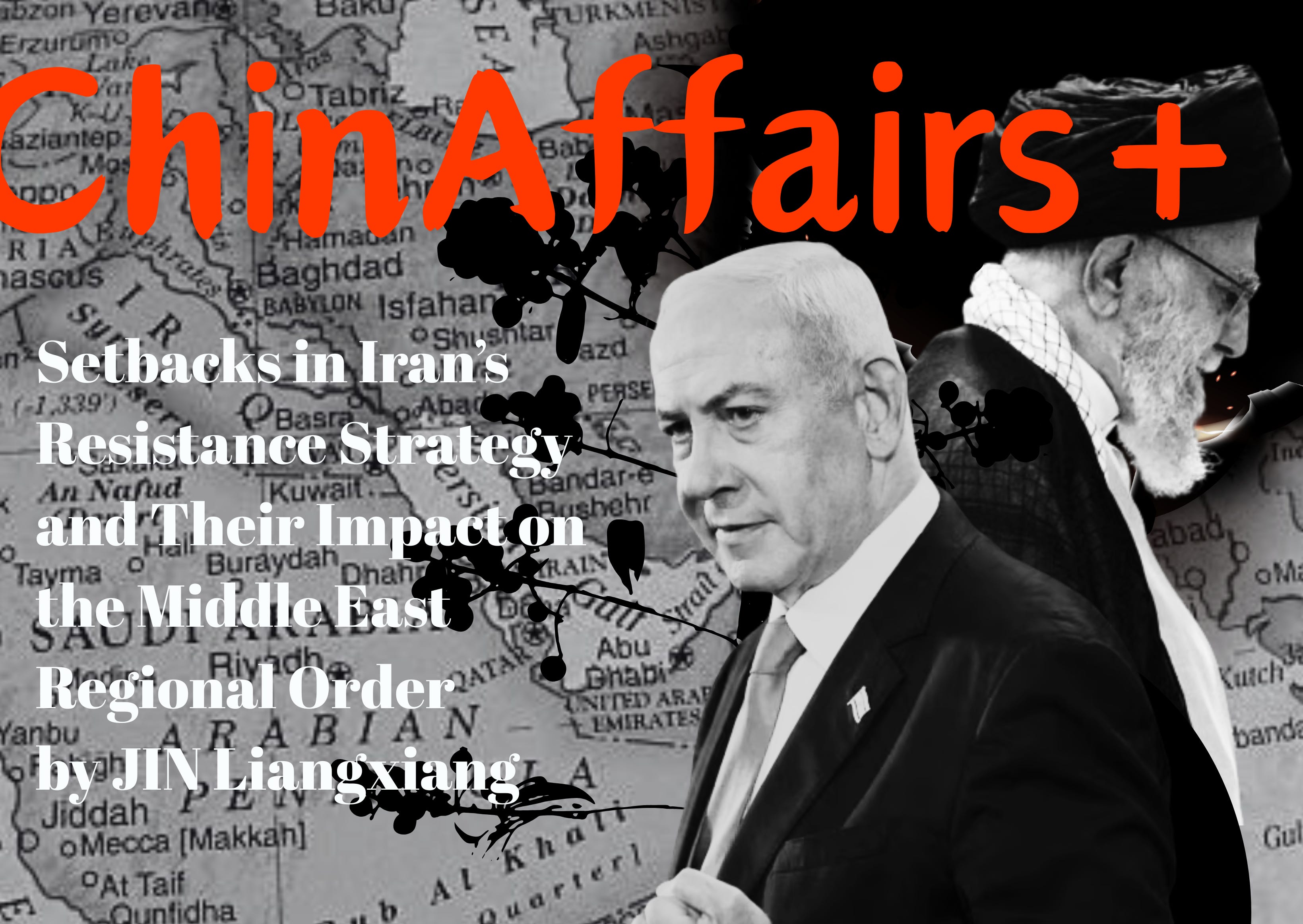
Today, we have selected an article written by Jin Liangxiang, which deals with the unraveling of Iran’s “Resistance Strategy” under U.S. and Israeli pressure.
Summary
The setback in Iran’s resistance strategy is one of the most significant spillover effects of the new round of the Israeli-Palestinian conflict. Iran’s resistance strategy is fundamentally based on maintaining national security rather than exporting revolutionary ideology, adopting a defensive posture rather than offensive stance, using anti - American and anti - Israeli stances as a unifying force, and employing missile deterrence as a key tool. Following the outbreak of the new round of the Israeli - Palestinian conflict in 2023, Iran and its resistance front suffered military strikes from Israel and the United States, resulting in a major setback for its resistance strategy. This was mainly manifested in the severe damage to the resistance network, a significant weakening of its domestic foundation, and a severe compression of its strategic space. The reasons for this setback are threefold: first, Iran’s economic strength is insufficient to support its vast resistance strategic network; second, domestic political maneuvering leads to its wavering between resistance and de - escalation, preventing it from fully implementing its deterrence strategy: and third, the long - term weakening efforts of the US and Israel, along with their repeated breaches of moral boundaries, have given them the upper hand. This setback will have many profound impacts on the regional order: first, it will lead to a new round of regional power fragmentation and reorganization; second, it will further undermine regional rules and norms; and third, the regional agenda structure will undergo new adjustments. The resistance strategy is a crucial component of Iran’s national security strategy, and its setback could intensify to a severe systematic political and security crisis in Iran. If such a scenario occurs, the geopolitical landscape of West Asia and Central Asia could become even more complex.
Why it Matters
On February 28, 2026, the international community was shaken by a coordinated U.S.-–Israeli military operation against Iran known as “Operation Epic Fury.” The strikes targeted Iranian military infrastructure and senior leadership, reportedly killing Supreme Leader Ali Khamenei along with several high-ranking officials and triggering Iranian missile and drone retaliation across the Middle East. This dramatic escalation has pushed the region into one of its most volatile crises in decades and raised urgent questions about the durability of deterrence and the future of Iran’s long-standing strategy of projecting influence through allied networks across the Middle East.
We selected this article because it examines the evolution and apparent decline of Iran’s “Resistance Strategy” from a Chinese academic perspective. Such an approach moves beyond dominant Western narratives that often frame Iran primarily through the lens of proxy warfare, instead situating its strategy within broader questions of state survival, strategic depth, and developmental constraints. Chinese international relations scholars frequently interprets regional conflicts within the broader dynamics of global power transition and the growing political agency of states in the Global South. Within this framework, China increasingly presents itself as a partner to Global South countries seeking greater strategic autonomy in a more multipolar order.
By engaging this perspective, the article sheds light not only on Iran’s strategic predicament but also on how Chinese scholars interpret conflict, sovereignty, and order in an increasingly fragmented international system.
Key Points
1. Tehran’s Strategic Retrenchment: The Eroding “Axis of Resistance”
Following the “Al-Aqsa Flood,” sustained Israeli-U.S. pressure has severely degraded Iran’s “Axis of Resistance” and compromised its domestic deterrence. Originally a reactive formation following the 2002 “Axis of Evil” designation, the “Resistance Front” , has evolved into the cornerstone of Iranian national security, merging the doctrines of “Offensive Defense” and “Forward Defense.”
Iran’s strategy relies on projecting power through non-state actors to neutralize threats before they reach Iranian soil. While Western discourse dismisses these as mere “proxies,” Supreme Leader Khamenei viewed this transnational strategic depth as a vital necessity, often prioritized over domestic concerns. However, the current degradation of this network, coupled with Iran’s late-2025 political crisis, marks a profound failure of its regional architecture. This shift signals a historic inflection point for the Middle Eastern order as Iran’s primary mechanism for regional influence faces unprecedented structural erosion.
2. The Defining Attributes of Iran’s Strategy of Resistance
Iran’s resistance strategy has evolved from revolutionary export into a sophisticated security architecture that leverages “offensive defense,” anti-Western ideology, and missile deterrence to ensure regime survival. Grounded in a unique Shiite strategic culture of defiance, this framework functions simultaneously as a defensive shield against U.S.-Israeli containment and Tehran’s primary mechanism for projecting regional influence.
Driven by National Security, Not Exporting Revolution
Contrary to Western assumptions that frame Iran as an ideological crusade, Tehran’s contemporary “Resistance Strategy” is fundamentally a state-centric security doctrine. Since 1989, regime survival and state-building have eclipsed the export of revolution. The August 2025 reappointment of veteran politician Ali Larijani to the Supreme National Security Council following the “12-Day War” underscores this institutional prioritization. Consequently, Iran’s cultivation of regional non-state actors functions essentially as a “forward defense strategy,” designed to insulate the Iranian homeland from direct conflict.
A Fundamentally Defensive Posture
Despite hostile rhetoric, Iran’s strategic posture is structurally defensive. Proxies like Hezbollah compensate for Iran’s geographic distance and military-technological asymmetry vis-à-vis Israel. Iran’s calibrated retaliatory missile strikes throughout 2024—following the assassinations of key officials and allied leaders—aimed to re-establish deterrence and project strength rather than inflict substantive casualties or provoke uncontrolled escalation.
Bound by Shared Ideology, Not Direct Control
The “Axis of Resistance” is united by a shared anti-U.S. and anti-Israel ideology, reacting directly against perceived regional hegemony and territorial occupation. As Foreign Minister Abbas Araqchi noted in December 2024, these non-state actors–including Hamas, Hezbollah, Iraqi militias, and the Houthis–possess highly developed political autonomy. Iran does not exercise direct control; rather, this anti-hegemonic alignment serves as the network’s connective tissue.
Underpinned by Domestic Missile Deterrence
Iran’s forward defense network is inextricably linked to its domestic missile capabilities. Constrained by sanctions, Tehran systematically prioritized asymmetric missile deterrence at the expense of its conventional air force. While this capability has historically deterred preemptive strikes against Iranian high-value targets, the “12-Day War” exposed critical vulnerabilities in Iran’s air defense architecture, highlighting the structural risks of over-relying on missile deterrence while ceding air superiority.
3. Impact of the Israel-Hamas Conflict on Iran’s Resistance Strategy
By leveraging the Gaza conflict to link Hamas directly to Tehran, Israel is executing a dual strategy to dismantle both the group’s local control and Iran’s regional influence. This concerted military and diplomatic pressure has effectively compromised the “Axis of Resistance,” resulting in a severe degradation of Iran’s strategic depth and its doctrine of forward defense.
Severe Damage to the Regional Axis
The “Axis of Resistance” has suffered major structural setbacks. Israel has systematically dismantled the leadership and military infrastructure of Hamas and Hezbollah. Furthermore, the December 2024 collapse of the Assad regime in Syria–a critical logistical bridge between Iran and Hezbollah–severed the network’s vital supply lines. While localized remnants of these groups survive and reorganize, the overarching network’s operational connectivity and primary nodes have been critically degraded.
Degradation of Domestic Deterrence
Israel strategically escalated from targeting Iranian proxies to dismantling Iran’s domestic military foundation. The unprecedented 12-day Israeli air campaign in June 2025 severely degraded Iran’s air defense systems, radar arrays, and critical missile production and launch facilities. By eliminating key IRGC commanders and stripping Tehran of its airspace control, Israel effectively neutralized the domestic missile deterrence that previously underpinned Iran’s forward defense strategy.
Radical Contraction of Geopolitical Space
Iran’s regional footprint is actively being rolled back. Capitalizing on the weakened Axis, Israel is seizing territory in southern Lebanon and the Golan Heights, while pushing to disarm proxy militias in Lebanon and Iraq. Simultaneously, regional powers like Saudi Arabia and Turkey are moving to fill the power vacuums left in Syria, Lebanon, and Iraq. Consequently, while Iran remains a significant regional power, the geographic depth required to sustain its Resistance Strategy has drastically contracted, diminishing Tehran’s capacity to project power and counter U.S.-Israeli hegemony at historical levels.
4. Causes of the Setbacks to Iran’s Strategy of Resistance
While ostensibly triggered by Israeli military strikes, the unraveling of Iran’s resistance strategy is fundamentally rooted in deep-seated domestic, economic, and structural power constraints–a vulnerability underscored by the post- “12-Day War” overhaul of the Supreme National Security Council–with three key internal drivers warranting closer examination.
Insufficient Economic Foundation to Sustain Resistance
Crippled by structural inefficiencies–such as costly subsidies and military monopolies over resources–and compounded by crushing Western sanctions, Iran’s economy cannot bankroll its expansive regional strategy. The stark economic disparity with Israel, whose 2024 GDP is 1.25 times larger despite having a fraction of the population, severely limits the “Axis of Resistance.” Proxies like Hezbollah, almost entirely dependent on Iranian funding, have struggled to modernize their arsenals since 2006. Similarly, the economic collapse of the Assad regime underscores this systemic fragility. Domestically, financial constraints forced Tehran to over-invest in asymmetric missile deterrence at the expense of conventional air defense, leaving Iranian airspace critically vulnerable to Israeli air superiority during the recent “12-Day War.”
Domestic Political Fissures Undermining Strategic Deterrence
Effective deterrence requires both military capability and the demonstrated political will to inflict unacceptable damage. While Iran possesses the requisite retaliatory capabilities, domestic political fragmentation–specifically the divide between conservatives advocating decisive retaliation and reformists pursuing de-escalation with Washington–has paralyzed its strategic resolve. Operations “True Promise 1” (April 2024) and “True Promise 2” (October 2024) were heavily calibrated to avoid high-value targets and minimize Israeli casualties. Rather than re-establishing deterrence, these restrained, compromise-driven responses exposed Tehran’s lack of resolve. This hesitation effectively punctured Iran’s “deterrence credit bubble,” eroding its credibility and inviting further Israeli escalation.
Long-Term U.S.-Israeli Suppression and Asymmetrical Warfare
Iran’s current setbacks are the culmination of a decades-long U.S.-Israeli grand strategy aimed at systematically dismantling anti-hegemonic regional powers (following the playbook used against Iraq, Libya, and Syria) through relentless economic and military pressure. In the current conflict, this structural pressure is exacerbated by a stark operational asymmetry. While Iran has largely adhered to conventional rules of engagement to avoid massive escalation, Israel and the U.S. have employed unconstrained, boundary-pushing tactics. By utilizing state-sponsored assassinations of Axis leadership and scientists, weaponizing everyday communication devices, and striking IAEA-monitored nuclear facilities during active negotiations, Israel has weaponized unpredictability. This disregard for traditional operational and ethical boundaries has left the Resistance Axis permanently off-balance, unable to anticipate the scope of adversary strikes.
5. The Impact of Iran’s Geopolitical Shifts on the Regional Order
The severe degradation of Iran’s resistance strategy–a fragile counter-hegemonic force that emerged amid U.S. retrenchment–will inevitably restructure Middle Eastern power dynamics, emboldening hegemonic actors and exacerbating regional disorder.
Triggering a New Round of Regional Power Realignment
The dismantling of Iran’s “Axis of Resistance” has ignited a retaliatory scramble among regional powers–namely Saudi Arabia, Turkey, and Israel–to partition Tehran’s former spheres of influence across Syria, Lebanon, and Iraq. However, as the perceived “Iranian threat” recedes, the strategic momentum driving the Abraham Accords will likely stall. Concurrently, Israel’s unchecked military ascendancy and unprecedented reliance on state-sponsored extraterritorial assassinations are generating profound unease across the Middle East. This shifting threat matrix is expected to foster a new, tacit strategic coordination against Israeli hegemony among Arab states, Turkey, and Iran. Consequently, frameworks like the Gulf Cooperation Council (GCC) may find renewed purpose, and the foundational logic of the Saudi-Iranian rapprochement will recalibrate to address the complexities of Israel’s expanded military footprint.
Further Erosion of Fundamental Norms of Regional State Interaction
Historically, Iran’s resistance network provided a fragile check on Israeli overreach, enforcing a tenuous adherence to sovereignty norms in a highly volatile region. With this deterrence heavily degraded, the regional strategic balance has shattered. Israel is now pursuing its objectives with unprecedented impunity, violating international law and sovereignty norms to a degree unseen in modern regional history–evidenced by extrajudicial strikes in Qatar and its active support for separatist movements in Syria and Somaliland. This normalization of state violence will generate a dangerous demonstration effect. As other regional actors inevitably emulate these aggressive, cross-border tactics, the Middle East faces an accelerating trajectory of geopolitical fragmentation and lawlessness.
Catalyzing a Restructuring of Regional Agendas and Renewed Instability
For decades, the U.S. and its allies helped construct the “Iranian Threat” (encompassing nuclear, missile, and proxy agendas) as the Middle East’s paramount security focus, which drew attention to the Palestinian issue. As Iran’s hard power diminishes, this agenda structure may now begin to shift. The Palestinian crisis and the realities of unchecked Israeli military hegemony will reclaim their primacy in regional discourse. Furthermore, the degradation of the Resistance Axis will not pacify the Middle East. Instead of capitulating, non-state actors like Hezbollah, Hamas, and the Houthis will continue to evolve and reorganize under existential pressure. Ultimately, the destruction of the fragile regional balance–which had briefly stabilized following the 2023 diplomatic détentes–guarantees a new phase of heightened fragmentation and instability.
About the Author

Jin Liangxiang金良祥:Dr. Jin Liangxiang serves as Director and Senior Fellow of the Center for Middle East Studies of SIIS. He is also an Executive Council Member of the Chinese Association of Middle East Studies and a Council Member of the Chinese Association of Asian and African Studies. His research focuses on major regional political security issues and current hotspots. Dr. Jin is the author of the book Domestic Sources of Iran’s Foreign Policy, published by World Affairs Press in April 2015. He has published nearly 30 academic articles in leading Chinese journals such as Contemporary International Relations, West Asia and Africa, and Journal of the Arab World Studies. He has also contributed multiple articles to influential international publications.
About the Publication
The Chinese version of the article was published by West Asia and Africa (《西亚非洲》). The academic journal founded in 1980, is published by the Institute of West Asian and African Studies at the Chinese Academy of Social Sciences (CASS). West Asia and Africa emphasizes in-depth exploration of political, economic, international relations, historical, religious, cultural, and social issues related to the regions of West Asia and Africa, balancing foundational theoretical research with major contemporary issues. The journal highlights research that is theoretical, forward-looking, and innovative. It has long been a prestigious academic resource for Chinese scholars in Middle Eastern and African studies and serves as an essential reference for relevant government agencies, institutions of higher learning, and research organizations engaged in international affairs, as well as professionals in foreign trade and market analysis. West Asia and Africa is listed as an A-rated journal in the AMI evaluation of Chinese humanities and social sciences journals, a CSSCI source journal by Nanjing University, and a core journal in Chinese by Peking University.


Iran just forced the US to accept its terms. But this Chinese analyst thinks Iran suffered a set back?