



Welcome to the 85th edition of our weekly newsletter! I’m Chenghao Sun , a fellow with the Center for International Security and Strategy (CISS) at Tsinghua University, Council Member of The Chinese Association of American Studies, a visiting scholar at Paul Tsai China Center of Yale Law School in 2024 and Munich Young Leader 2025.
ChinAffairsplus is a newsletter that shares articles by Chinese academics on topics such as China's foreign policy, China-U.S. relations, China-Europe relations, and more. This newsletter was co-founded by my research assistant, ZHANG Xueyu, and me.
Through carefully selected Chinese academic articles, we aim to provide you with key insights into the issues that China’s academic and strategic communities are focused on. We will highlight why each article matters and the most important takeaways. Questions and feedback can be addressed to sch0625@gmail.com.
Today, we have selected an article written by Sun Chenghao and Ma Songruowen on Leverage-Based Strategies of Middle Powers in Global Artificial Intelligence Governance.
Summary
Against the dual backdrop of intensifying geopolitical rivalry and the rapid advancement of artificial intelligence (AI), the global political and economic order is undergoing profound transformation. In response to the resulting opportunities and challenges, countries have actively participated in AI governance through various means, collectively seeking to promote the orderly development of the global AI ecosystem. As a representative group of states, middle powers warrant closer examination in terms of both their functional roles and strategic choices in contemporary global AI governance.
Drawing on an analytical framework of leverage-based strategies structured around “factor endowments–conversion mechanisms,” this study compares the policy practices of six countries: South Korea, the Netherlands, Canada, the United Arab Emirates (UAE), Japan, and Singapore. It finds that middle powers exhibit varying degrees of agency within the global AI governance framework and pursue different strategic pathways to acquire capabilities and influence. Although middle powers are unlikely to fundamentally alter the distribution of power in global AI governance, they play an indispensable role in addressing deficits in global public goods, facilitating regulatory coordination, and establishing platforms for multilateral dialogue. Examining these issues not only helps identify the limits of middle-power influence and the strategic ingenuity of such states, but also provides further empirical support for understanding interactions among actors operating at multiple levels of global AI governance.
Why It Matters
The global AI governance system is at a formative stage, marked by capability stratification and institutional fragmentation. China and the U.S. lead, but major actors (China, U.S., EU) diverge sharply on ethics, regulation, and principles, resulting in “rule excess but consensus deficit.” Many developing countries lack infrastructure and capacity, leaving them marginalized in rule-making. In this stratified and fragmented landscape, middle powers offer a valuable analytical lens. They merit attention for three reasons: they have moderate material capabilities, occupy strategic positions, and possess sustained governance incentives. Notably, “middle power” in this study is not mutually exclusive with “Global South” or “emerging economy” labels.
Existing scholarship falls into two strands: one focuses on institutional arrangements and major-power dynamics in AI governance, often centering on the U.S., China, the EU, or BRICS; the other examines middle powers in global governance but tends toward capability determinism or role preconfiguration, without adequately explaining how middle powers construct discursive authority in novel issue areas.This article addresses that gap by adopting a middle-power perspective. It analyzes their participation strategies vis-à-vis major-power dominance, compares six middle-power cases, and explores their distinctive influence, aiming to enrich understanding of middle-power behavioral logics in global AI governance.
Key Points
1. Strategic Choices of Middle Powers Participating in Global AI Governance
(1) The Evolution of the Concept of Middle Powers
In recent years, the term “middle power” has been frequently employed by politicians, scholars, and the media. Nevertheless, its meaning remains ambiguous and contested. Debates over the definition and behavioral preferences of middle powers have evolved through approximately three stages.
The first stage focused on so-called “traditional middle powers.” Territorial size, population, level of economic development, military strength, and the maturity of democratic institutions constituted the principal criteria for identifying such states.
The second stage began with the emergence of the concept of “emerging middle powers.” These states tend to advocate reform in global governance, call for economic justice, and actively promote regional integration while playing pivotal roles in that process.
The third stage reflects the profound transformation of the contemporary global political and economic structure. The term “middle power” is now widely used to describe states possessing both material capabilities and regional influence. As a result, it increasingly overlaps with such concepts as “regional powers,” “states with global influence,” “pivotal states,” and “emerging powers.”
In light of the foregoing analysis, this article concurs with scholars such as Jeffrey Robertson and Andrew F. Cooper that research should move beyond the definitional cycle of repeatedly asking, “What exactly is a middle power, and where should the boundaries of this category be drawn?” Instead, a more operational and pragmatic approach should be adopted—one that advances theoretical or empirical inquiry by emphasizing what phenomena the concept can explain within a particular issue area and context.
Accordingly, this article operationally defines “middle powers in global AI governance” as states that do not possess the comprehensive, full-chain capabilities of major powers such as China and the United States and therefore cannot independently determine the overall trajectory of global AI technologies, capital, platforms, and rule systems, but that nevertheless substantially surpass ordinary small states in terms of critical resource endowments, regional or international influence, institutional participation capacity, and strategic nodal value, thereby exerting a sustained influence on global AI governance. Representative middle powers in this field include Singapore, the United Kingdom, South Korea, Israel, Germany, India, Canada, Japan, France, Saudi Arabia, and the Netherlands. These states possess a considerable degree of “embedded agency.”
(2) The Two-Dimensional Interaction Between Factor Endowments and Conversion Mechanisms
Inspired by the economic conception of leverage, whereby limited inputs can be used to generate disproportionately large returns, this article finds that middle powers employ leverage-based participation strategies in global AI governance. More specifically, factor endowments constitute the critical inputs placed at one end of the lever, while conversion mechanisms represent the processes through which leverage is exercised.
Factor endowments
Factor endowments refer to the resource base that a state can mobilize and allocate during a particular period. Drawing on classical scholarship and contemporary developments in AI, this article focuses on three types of factor endowments: technological, capital, and institutional endowments. Together, these three types constitute the foundational conditions for a state’s participation in international AI competition and governance. They determine both its position within the global AI landscape and its potential to shape the international governance system.
* a. Technological endowments comprise the material and technological conditions that a state possesses in such areas as algorithm research and development, chip design, data resources, and digital infrastructure. They form the hard-power foundation of national innovation and productive capacity.
* b. Capital endowments refer to the capacity of a state’s economic and financial system to mobilize resources, including sovereign wealth funds, cross-border investment networks, technology investment platforms, and merger-and-acquisition instruments. Such resources allow states to compensate for technological deficiencies and to embed themselves in—and potentially shape—global governance networks through capital-based activities.
* c. Institutional endowments refer to a state’s capabilities in AI rule-making, standards coordination, institutional innovation, and agenda construction. They reflect the normative resources and institutional influence available to that state.
Conversion mechanisms
Conversion mechanisms explain how states transform their factor endowments into foundations of power and sources of influence within the global AI governance system. These mechanisms can be divided into two categories.
* a. Endogenous-capability-led mechanisms. These mechanisms emphasize a logic of power generation centered on the accumulation of endogenous capabilities. Through sustained investment in and intensive development of a particular factor endowment, a state gradually establishes a relatively autonomous capability system. Once this accumulated capability develops into a comparatively stable structural advantage within a particular domain, it may spill over into the international sphere and enhance the state’s relative influence in global AI governance.
* b. Nodal-position-led mechanisms. These mechanisms suggest that state influence does not arise primarily from the gradual accumulation of domestic capabilities. More importantly, it derives from the strategic positions that states occupy within international production networks, critical supply chains, transnational systems of flows, or regional institutional arrangements. By controlling scarce and relatively irreplaceable nodes, these states can combine their limited domestic capabilities with favorable external structural conditions, thereby amplifying their influence.
Strategic Types
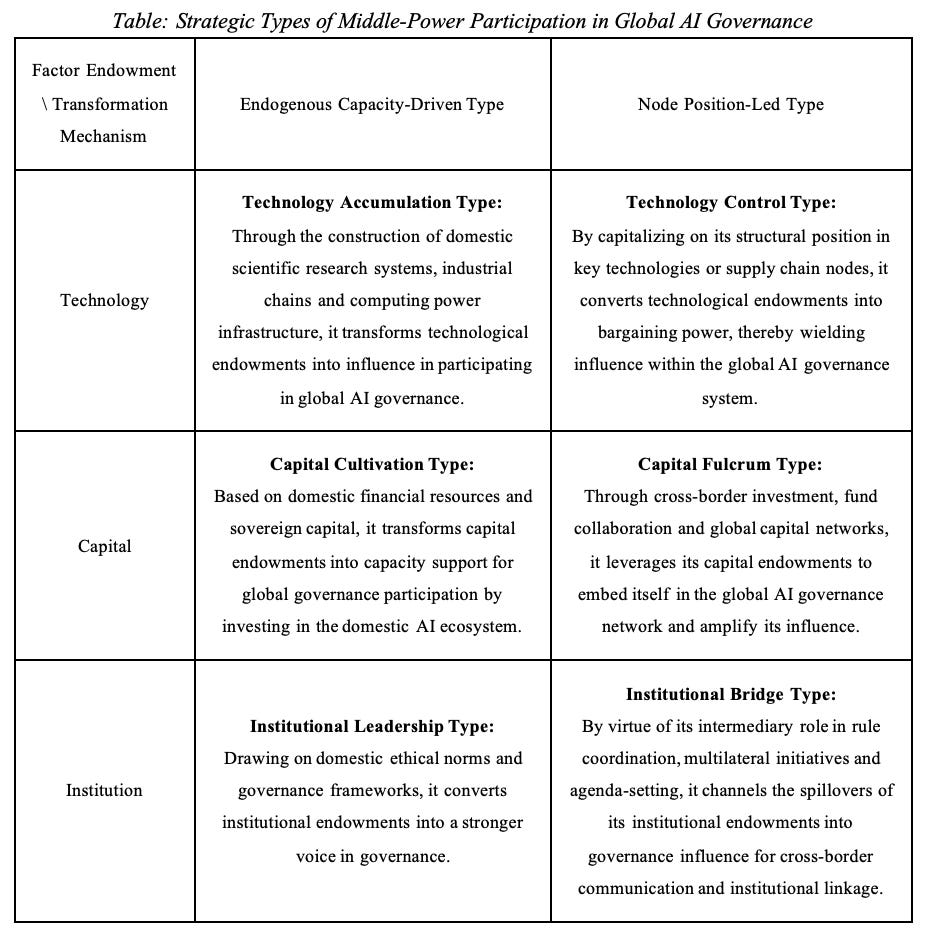
Given their geopolitical standing and extensive resource endowments, major powers can generally establish comprehensive, coordinated strategies across multiple dimensions of global AI governance. Other states, constrained by limited material resources and high barriers to participation, often find it difficult to establish stable fulcrums of leverage. In this sense, leverage-based participation constitutes a distinctive pattern through which middle powers engage in global AI governance. As shown in the table below, different combinations of factor endowments and conversion mechanisms produce six strategic types through which middle powers acquire participatory capabilities and influence in global AI governance.
2. Case Studies of Middle-Power Participation in Global AI Governance
This article selects South Korea, the Netherlands, Canada, the UAE, Japan, and Singapore as representative cases of particular strategic types. In practice, the strategies of middle powers are often multidimensional: a single country may possess several types of factor endowments or pursue multiple conversion pathways simultaneously. These countries were selected because their characteristics in the corresponding dimensions are particularly pronounced, giving them considerable analytical representativeness, cross-national comparability, and empirical distinctiveness. Their selection does not imply that each country’s practices are confined to a single strategic model.
(1) South Korea: A Representative Technological-Accumulation Strategy
South Korea is a middle power with substantial technological endowments. It possesses internationally competitive advantages in semiconductor design and manufacturing and in the development of AI models, while accumulating domestic capabilities through state-led industrial integration and technological diffusion. According to South Korea’s Ministry of Science and ICT, the country is seeking to maximize its strengths in information and communications technology, semiconductors, and the manufacture of electronic components, with the objective of elevating its AI competitiveness to the highest level globally.
South Korea has launched initiatives including the Disruptive Technology Initiative and its sovereign AI program. Benefiting from government support, successive technological innovation, and industrial expansion, South Korea is emerging as one of the world’s leading AI powers. It also plays an important role in advancing international cooperation and shaping the global AI agenda, having repeatedly served as the chair or convener of global and regional AI governance mechanisms. Through the large-scale domestic development and application of AI, South Korea has become both an “early responder” to AI-related technological risks and governance challenges and a “provider of practical experience.” This position has, in turn, created opportunities for the country to participate in and coordinate global AI governance.
(2) The Netherlands: A Representative Technological-Control Strategy
Like South Korea, the Netherlands is a middle power with significant technological advantages in the AI sector. However, it tends to acquire structural power by occupying critical positions within the global AI industrial chain. As the only country capable of supplying advanced extreme ultraviolet lithography equipment, the Netherlands holds a monopoly over the world’s most advanced lithography technology and controls a strategic component of the computing supply chain. These technological endowments provide it with greater bargaining space and influence in global AI governance.
The Dutch government has repeatedly leveraged issues of technological security to participate in negotiations concerning international AI ethics and governance rules for AI supply chains. In September 2024, the Dutch government announced that exports of relatively advanced lithography equipment and related technologies to destinations outside the European Union would require special authorization from the Netherlands. This demonstrates how the Netherlands, by controlling an irreplaceable technological node in the global industrial chain, exercises asymmetric influence over technological flows and regulatory negotiations. In doing so, it has reshaped the issue structure and distribution of bargaining power within global AI governance and has consequently become an important participant in the global governance process.
(3) Canada: A Representative Capital-Cultivation Strategy
AI development is highly dependent on capital, giving actors with substantial capital endowments a comparative advantage in global AI governance. Canada is a representative middle power in this category. Its national AI policy has been at the forefront internationally, characterized by forward-looking assessments and planning, clearly defined and pragmatic objectives, and sustained public financial support.
Through strategic capital investment, Canada has cultivated fundamental AI research and a robust talent ecosystem. It has subsequently translated its research outputs into normative concepts and assessment tools capable of international adoption, thereby supplying the knowledge resources required for global AI governance. This has enabled Canada to establish a crucial pathway connecting domestic capabilities with participation in global AI governance.
For example, in 2018, Ann Cavoukian proposed the seven foundational principles of “Privacy by Design.” This concept was subsequently incorporated into the European Union’s General Data Protection Regulation (GDPR), becoming an important institutional foundation of European AI governance. Projects conducted by the Vector Institute and the Quebec Artificial Intelligence Institute have made significant contributions to global research on AI ethics and the development of tools for assessing algorithmic fairness. These achievements have further strengthened Canada’s image as a “responsible leader” in AI governance.
(4) The United Arab Emirates: A Representative Capital-Leverage Strategy
The UAE regards AI as a strategic priority for national development. Its government has invested substantial financial resources in an effort to secure a leading position both regionally and globally. The UAE’s capital-driven participation in global AI governance is primarily manifested in three respects.
First, it exchanges “capital for access” by participating in the development of global AI infrastructure. MGX, a UAE state-backed investment platform, joined the U.S. government in investing in the Stargate Project, an initiative launched by leading AI companies including OpenAI, Oracle, Microsoft, and Nvidia. This investment not only connects the UAE to the construction of global AI infrastructure through capital participation, but also creates opportunities for the development of its domestic AI sector.
Second, the UAE exchanges “capital for technology” by embedding itself in global networks of core AI technologies. In 2025, MGX acquired a majority stake in Altera and stated that it would help the company become a truly global leader in the AI era.
Third, the UAE exchanges “capital for influence,” thereby acquiring discursive resources for shaping the global AI agenda and narratives of AI development. In November 2025, the UAE proposed an “AI for Development Initiative” at the Group of Twenty (G20) Leaders’ Summit. This initiative created an opportunity for the country to shift from being an “external observer” of international governance debates to an “internal participant.”
(5) Japan: A Representative Institution-Leading Strategy
The institutional architecture of AI governance is currently taking shape, while international norms remain unsettled and important regulatory gaps persist. Japan has sought to assume the role of an institutional “architect” and “leader” by introducing legislation at an early stage and developing innovative, forward-looking policies, thereby attempting to guide the development of global AI governance.
Through a series of policy documents, including the Social Principles of Human-Centric AI and the AI Guidelines for Business, the Japanese government has gradually constructed a domestic AI governance philosophy and institutional system. Japan has subsequently sought to internationalize its domestic governance concepts through multilateral diplomacy, identifying cooperation with friendly countries and the United Nations, the establishment of an AI governance framework, and the exercise of Japanese leadership as important policy objectives. During its presidency of the Group of Seven (G7), for example, Japan promoted the Hiroshima AI Process as a rule-setting platform for international AI governance.
(6) Singapore: A Representative Institution-Bridging Strategy
In recent years, Singapore has actively participated in agenda-setting, principle formulation, and standards coordination in global AI governance. Unlike Japan’s strategy, which primarily emphasizes the international diffusion of domestic norms, Singapore places greater emphasis on its functional role as a “regulatory hub” and “platform intermediary.” By connecting different governance systems and institutional arenas, it seeks to increase its discursive authority and influence in global AI governance.
At the international level, Singapore has pursued two principal approaches. First, it has sought to translate abstract governance principles into operational transnational technological instruments. It launched the AI Verify testing framework to facilitate mutual recognition and interoperability among different governance frameworks at the practical level. Second, Singapore has actively established issue frameworks for global AI governance. It issued the Singapore Consensus on Global AI Safety Research Priorities, providing direction for subsequent global dialogue.
At the regional level, Singapore spearheaded the formulation of the ASEAN Guide on AI Governance and Ethics, thereby promoting greater coordination and consistency among ASEAN member states in the field of AI. Singapore has also led regional cooperation with dialogue partners including the United States, China, and the European Union, helping align ASEAN standards with international standards.
3. Assessing the Impact of Middle Powers on Global AI Governance
(1) Constructive Role
Providing Gap-Filling Instruments When Major-Power Competition Creates Governance Vacuums
Global AI governance continues to face numerous problems, including inadequate technological assessment tools, weak mechanisms for cross-border cooperation, ambiguous boundaries between rights and responsibilities, and insufficient representation. Although major powers possess greater technological and material capabilities, their governance initiatives inevitably reflect the logic of strategic competition, industrial protection, normative projection, and bloc formation. The products they provide are therefore not necessarily neutral global public goods. The participation of middle powers can help address these deficiencies to a certain extent.
At the institutional level, instruments such as the Netherlands’ Artificial Intelligence Impact Assessment, Japan’s AI Governance Guidelines, and Canada’s Algorithmic Impact Assessment framework provide other countries with diverse forms of knowledge and practical tools from which they may draw. At the technological level, the UAE and Saudi Arabia have successively released open AI models focused on the Arabic language and local cultures. These initiatives can help bridge the digital divide, enable users from a broader range of linguistic and religious communities to benefit from AI technologies, and advance AI development in the Gulf region.
Amplifying Normative Influence in Areas More Conducive to International Consensus
Most middle powers cannot surpass major AI powers in terms of hard capabilities. They therefore tend to use issues such as safety, fairness, standards, and transparency as points of entry through which to acquire soft power. To some extent, these efforts have heightened and reinforced international attention to the public interest, indirectly reminding and constraining major powers while supporting the sound and orderly development of the global AI sector.
The Dutch government, for example, attaches considerable importance to ethical and trust-related issues arising from AI development. It has organized multiple domestic institutions to study the social implications of AI while advocating greater transparency and accountability for AI systems at the international level.
Maintaining Essential Cross-Border Coordination and Institutional Connections Within a Fragmented Governance Structure
Against the backdrop of intensifying geopolitical conflict, declining political trust, and resurgent nationalism, middle powers provide limited but essential institutional cohesion. Their participation helps slow the fragmentation and bloc formation of the global AI governance system while preserving a minimum level of pragmatic cooperation among different countries and regions.
For example, the UAE has hosted the Dubai AI Assembly as a platform for cross-regional cooperation. South Korea and the United Kingdom jointly convened the ministerial session of the AI Seoul Summit, creating conditions for international dialogue on AI safety, innovation, and inclusive development.
(2) Functional Limits
First, their domain-specific advantages do not automatically translate into structural power. Compared with major AI powers, middle powers generally cannot establish comprehensive and controllable capability systems encompassing capital provision, industrial ecosystems, infrastructure, core technologies, and institutional rules. The factor endowments on which their influence depends may also lack stability and remain vulnerable to economic cycles, policy adjustments, market volatility, and technological change.
Second, the effectiveness of their governance efforts is highly conditional and susceptible to the intensity of major-power competition. The influence of middle powers in global AI governance often rests on their ability to maneuver flexibly among different platforms and groups. As geopolitical pressure increases and AI issues become progressively securitized and aligned with competing blocs, however, their room for maneuver contracts. Their policy choices consequently become increasingly constrained by external alliance structures and institutional fragmentation.
Conclusion
This article applies a “factor endowment–conversion mechanisms” framework to examine the differentiated strategies of six middle powers (South Korea, the Netherlands, Canada, the UAE, Japan, and Singapore). The findings show that middle powers do not passively adapt to the major-power-dominated structure; instead, they selectively amplify their endowments in technology, capital, or institutions and match endogenous or nodal-position-led pathways, adopting a “leveraging” strategy to gain discourse power and influence beyond their material strength. The six strategies vary in emphasis. Their governance effects include filling gaps, amplifying norms, and providing institutional cohesion, but their impact is constrained by external shocks and the intensity of great-power competition.
For China, middle powers are not passive balancers but active shapers, and their logic aligns well with the principle of extensive consultation, joint contribution, and shared benefits. China should pay greater attention to this group, encourage their roles in agenda coordination and regulatory interoperability, and use cooperation with middle powers to expand ties with smaller states, thereby building an AI cooperation network that extends from bilateral to multilateral levels, thus advancing a global community with a shared future in artificial intelligence.
About the Author
SUN Chenghao孙成昊:Fellow with the Center for International Security and Strategy (CISS) at Tsinghua University, Council Member of The Chinese Association of American Studies and a visiting scholar at the Paul Tsai China Center of Yale Law School (fall 2024). Professor Sun’s research interests mainly include: American politics and diplomacy, China-U.S. relations, U.S.-Europe relations, U.S.-Russia relations, AI and international security governance.
Ma Songruowen马宋若文:PhD student, Oxford Department of International Development.
About the Publication
The Chinese version of this article was published in Forum of World Economics & Politics(《世界经济与政治论坛》).It is an academic journal sponsored by the Jiangsu ProvinceAcademy of Social Sciences, which mainly publishes original research papers, reviews, and commentaries. The journal was founded in 1981, enjoying a high reputation and influence in the academic community.


