



Welcome to the 84th edition of our weekly newsletter! I’m Chenghao Sun, a fellow with the Center for International Security and Strategy (CISS) at Tsinghua University, Council Member of The Chinese Association of American Studies and a visiting scholar at the Paul Tsai China Center of Yale Law School (fall 2024).
As the anticipated China–U.S. leaders’ meeting approaches, attention is turning to its agenda and the prospects for stabilizing bilateral relations. Meanwhile, recent developments in AI, including renewed warnings from industry leaders such as Dario Amodei about the risks of frontier models, have raised questions about how safety concerns might shape cooperation between the two countries.
Can the meeting bring greater predictability to China–U.S. relations? Will calls for stronger AI safeguards create opportunities for cooperation, or deepen disagreements over technological competition? Drawing on Professor Sun Chenghao’s recent interviews with the Associated Press, CNN, the South China Morning Post, Agence France-Presse and the China Review News Agency, this edition explores the meeting’s potential agenda and the prospects for bilateral AI dialogue.
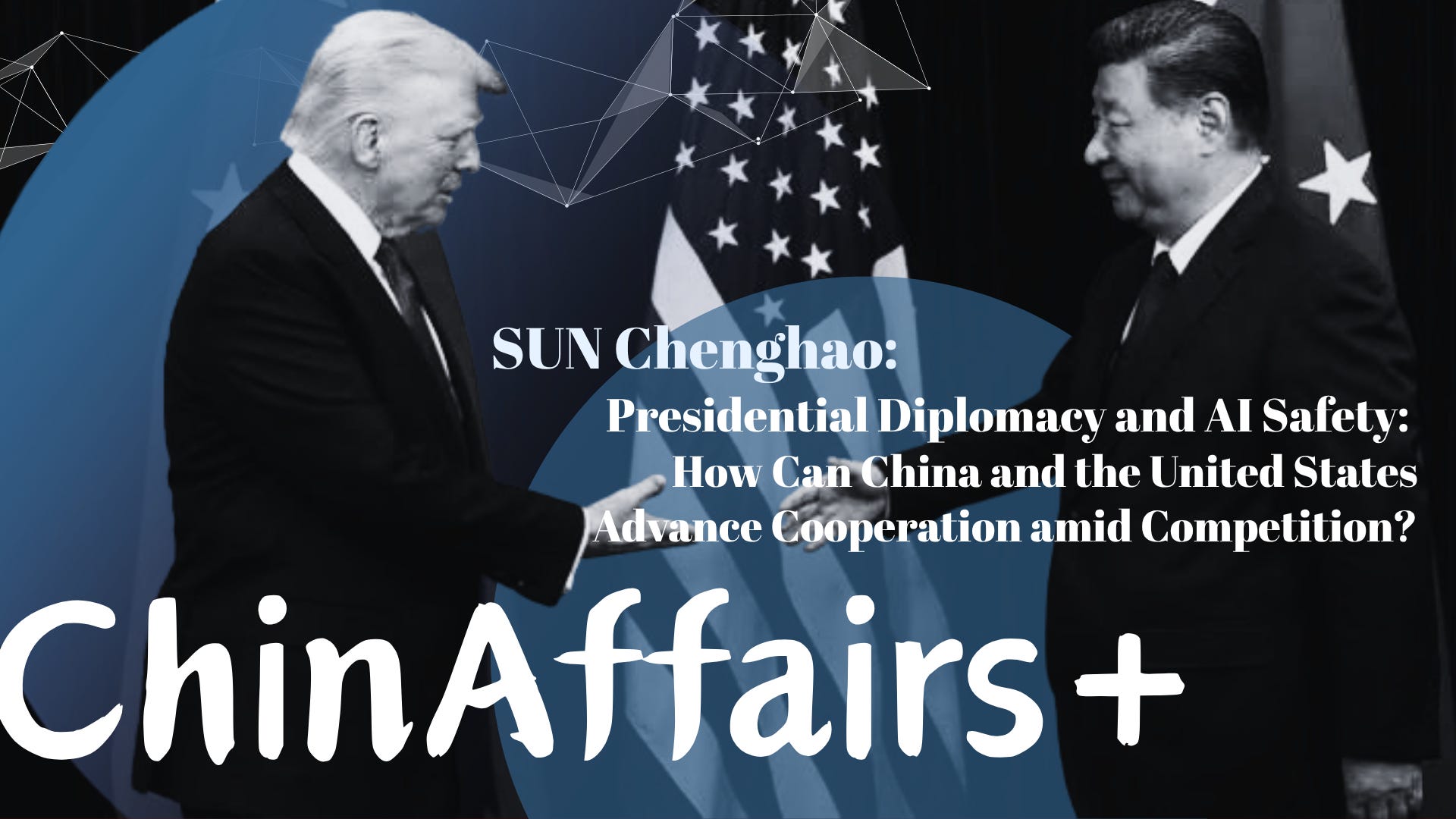

SUN Chenghao: If the visit proceeds as planned, I believe the priority will be to consolidate the stabilization in relations since the leaders’ meeting in May, rather than pursue an all-encompassing “grand bargain.” The aim would be to translate the leaders’ consensus on a “constructive China–U.S. relationship of strategic stability” into more sustainable policy arrangements. The concept itself recognizes that neither side expects competition to disappear. Instead, both hope to sustain cooperation, keep competition within bounds, and manage differences, avoiding a return to a cycle of escalation and retaliation.
I see at least four groups of issues on the agenda. The first is trade and economic relations, including how to extend the existing trade truce, whether tariffs can be reduced further, and how to address export controls on rare earths and other critical minerals alongside U.S. technology restrictions. This is the area most likely to produce tangible results and an important test of whether a temporary truce can provide more stable expectations. The second is Taiwan, the most sensitive political and security issue. Beijing will pay particular attention to whether Washington avoids sending provocative new signals through arms sales and interactions with Taiwan. The third is AI and technology. Competition over chips will be difficult to resolve in the short term, but limited common interests have emerged around AI safety and cyber risks. The fourth is international and regional issues, including the Middle East.
What matters most is whether the meeting can help establish a pattern of interaction in which competition persists, but individual disputes no longer repeatedly escalate into crises affecting the entire relationship.

SUN Chenghao: “Constructive strategic stability” should not be understood as a comprehensive thaw or reconciliation. Differences over trade, technology, Taiwan, and regional security remain, and there is still a strong consensus in Washington on competing with China. Tough statements from individual officials or new disputes do not, by themselves, mean that strategic stability has failed. The key question is whether these disputes can be contained or will continue spilling over into other areas.
One prominent challenge is the tension between the leaders’ desire for stability and the competitive impulses within government departments. Whether political consensus can become policy boundaries respected across departments will determine whether stability lasts beyond one or two successful meetings.
I would watch three indicators: whether the two sides reduce sudden escalations in tariffs, export controls, and sanctions; whether major disruptions involving Taiwan and other sensitive issues can be avoided; and whether positive agendas—including trade, AI risk management, and people-to-people exchanges—continue to advance. Ultimately, strategic stability must be judged by whether the two countries can prevent specific disputes from developing into comprehensive confrontation.

SUN Chenghao: Taiwan may not be the issue most likely to yield an announced “deliverable,” but it could be the most important issue for risk management. Beijing has long regarded Taiwan as the most important and sensitive issue in China–U.S. relations. At the leaders’ meeting in May, the Chinese side explicitly linked Taiwan to the stability of the broader relationship. This time, Beijing is therefore likely to emphasize the need for Washington to avoid actions that cross established policy boundaries, particularly by making its approach to arms sales, interactions with Taiwan, and “Taiwan independence” more predictable.
The Trump administration presents a complicated picture. On the one hand, U.S. policy toward Taiwan has considerable institutional continuity, underpinned by the Taiwan Relations Act, bipartisan support in Congress, and the executive branch’s security policy apparatus. These will not fundamentally change because of a single leaders’ meeting. On the other hand, Trump’s approach is more transactional and personalized than that of more conventional U.S. administrations. He often weighs the costs and benefits of individual issues within the broader China–U.S. relationship. This means the White House, Congress, and national security agencies may not always move in step on specific Taiwan-related decisions.
The most realistic objective is therefore to place Taiwan within the broader framework for managing bilateral risks. Resolving the issue or expecting a fundamental change in U.S. policy is unlikely. Clearer communication about red lines and restraint around major actions that could trigger miscalculation would themselves help reduce the likelihood of a crisis. Taiwan is, in this sense, one of the most important stress tests for “constructive strategic stability.”
Regarding arms sales, Beijing has not publicly announced an explicit condition that any new U.S. arms sale to Taiwan would lead to the meeting’s cancellation. Its public statements over the past few months nevertheless suggest that, if Washington hopes to stabilize relations through presidential diplomacy, it needs to create a political atmosphere on Taiwan consistent with that objective.
The issue is not simply whether an arms sale occurs, but also its scale, timing, and the capabilities involved. U.S. arms sales to Taiwan have continued for decades, and China has consistently opposed them. A particularly large, militarily significant, or politically symbolic sale immediately before an important leaders’ meeting would be more likely to be interpreted by Beijing as a strategic signal than as a routine continuation of existing policy. That would create an obvious tension between commitments to stability at the highest level and major actions on the relationship’s most sensitive issue.
Recent congressional visits to Taiwan and proposals for arms sales form part of the backdrop, but a direct causal link should not be assumed. U.S. Taiwan policy has long been shaped by the executive branch, Congress, and the national security establishment, and congressional efforts to strengthen security support for Taiwan are not new. From Beijing’s perspective, the more important question is whether the White House can maintain the overall direction of its China policy under domestic political pressure. For “constructive strategic stability” to be credible, it must be reflected in concrete policy decisions as well as statements at leaders’ meetings. This helps explain why Taiwan arms sales are particularly sensitive at this moment.

SUN Chenghao: I think we need to distinguish technological competition from the governance of technology-related risks. Advanced chips, computing power, model capabilities, and export controls directly affect how both countries assess their future technological advantages. They are unlikely to become areas of substantial cooperation in the near term.
Recent U.S. debates about AI illustrate this tension. Some business leaders are increasingly concerned about loss of control, cyberattacks, and biological risks associated with frontier AI, while policymakers worry that slowing development could weaken the United States’ competitive position against China. AI is simultaneously a matter of safety governance and geopolitical competition.
Even so, AI safety could provide a limited opening for common ground. Both countries increasingly recognize that some AI risks are transnational and will not stop at national borders simply because the two countries are strategic competitors. These include large-scale AI-enabled cyberattacks, the malicious use of advanced models in biological applications, uncontrollable behavior by AI agents, and the need for timely communication after major AI incidents. Addressing these issues does not require prior agreement on chip controls or technological leadership.
If the leaders’ meeting makes progress, the most realistic outcome would be clear political authorization for continued AI safety dialogue, rather than a comprehensive governance agreement. This could support regular communication among officials, technical experts, and companies, gradually building shared terminology, risk classifications, and procedures for reporting major incidents. Verification, evaluation standards, and even some military AI risks could be discussed later, if trust and technical conditions permit. Technology is unlikely to become an opening for broad bilateral cooperation, but AI safety could be one of the few areas where limited common rules are possible amid intense competition.

SUN Chenghao: I think they have narrowed the political space for cooperation, but have not eliminated it. From a Chinese perspective, the main problem with Amodei’s essay is that it combines two different agendas: managing genuine AI safety risks and preserving a U.S. technological lead over China. His proposals for tighter chip controls, restrictions on access to advanced compute, and a crackdown on alleged model distillation reinforce Beijing’s concern that “AI safety” could become another instrument of technological containment.
At the same time, it would be a mistake to dismiss the entire safety debate as geopolitical competition. China itself is paying growing attention to loss-of-control risks, malicious use, cyber threats, and the safety of AI agents. The Foreign Ministry has recently reiterated that China gives equal weight to AI development and security and takes both inherent and secondary risks seriously.
The key question is whether the two countries can create some separation between competition over capabilities and cooperation on risks. If Washington defines AI safety primarily through the goal of slowing China down, Beijing’s confidence in such cooperation will inevitably decline. But if the agenda focuses on risks that could harm both countries—such as AI-enabled cyberattacks, biological misuse, major model failures, or loss of control—meaningful room for cooperation remains. Amodei himself acknowledges the need for international coordination, including with China. The space is narrower, but it is still there.

SUN Chenghao: At this stage, I would not begin by seeking an ambitious, comprehensive bilateral AI governance agreement. A more realistic approach would start with high-consequence risks that neither country wants to see and that have cross-border implications. These include AI-enabled cyberattacks, biological risks, major model failures or loss of control, abnormal behavior by AI agents, and communication following serious AI safety incidents. Such issues offer a relatively clear basis for identifying minimum shared interests.
The next step would be to develop a common vocabulary: how to define a “high-risk model,” which capabilities should trigger more rigorous evaluation, and what kinds of incidents require notification. Discussions on evaluation methods, verification mechanisms, and more sensitive military applications could follow.
Above all, the two countries need mechanisms that can function even when strategic trust is limited, including regular intergovernmental communication, exchanges among technical experts, and channels for discussing major incidents. China and the United States do not need to resolve their broader AI competition before they begin reducing risks that neither side wants to bear.


