



Welcome to ChinaVoice, a new podcast series from the ChinaAffairsplus team.
Hosted by Chenghao Sun , we will invite scholars and experts to discuss major international issues from great power relations and global governance to emerging security and diplomatic challenges. Through these conversations, we hope to share diverse perspectives on China’s foreign policy and the evolving international landscape.
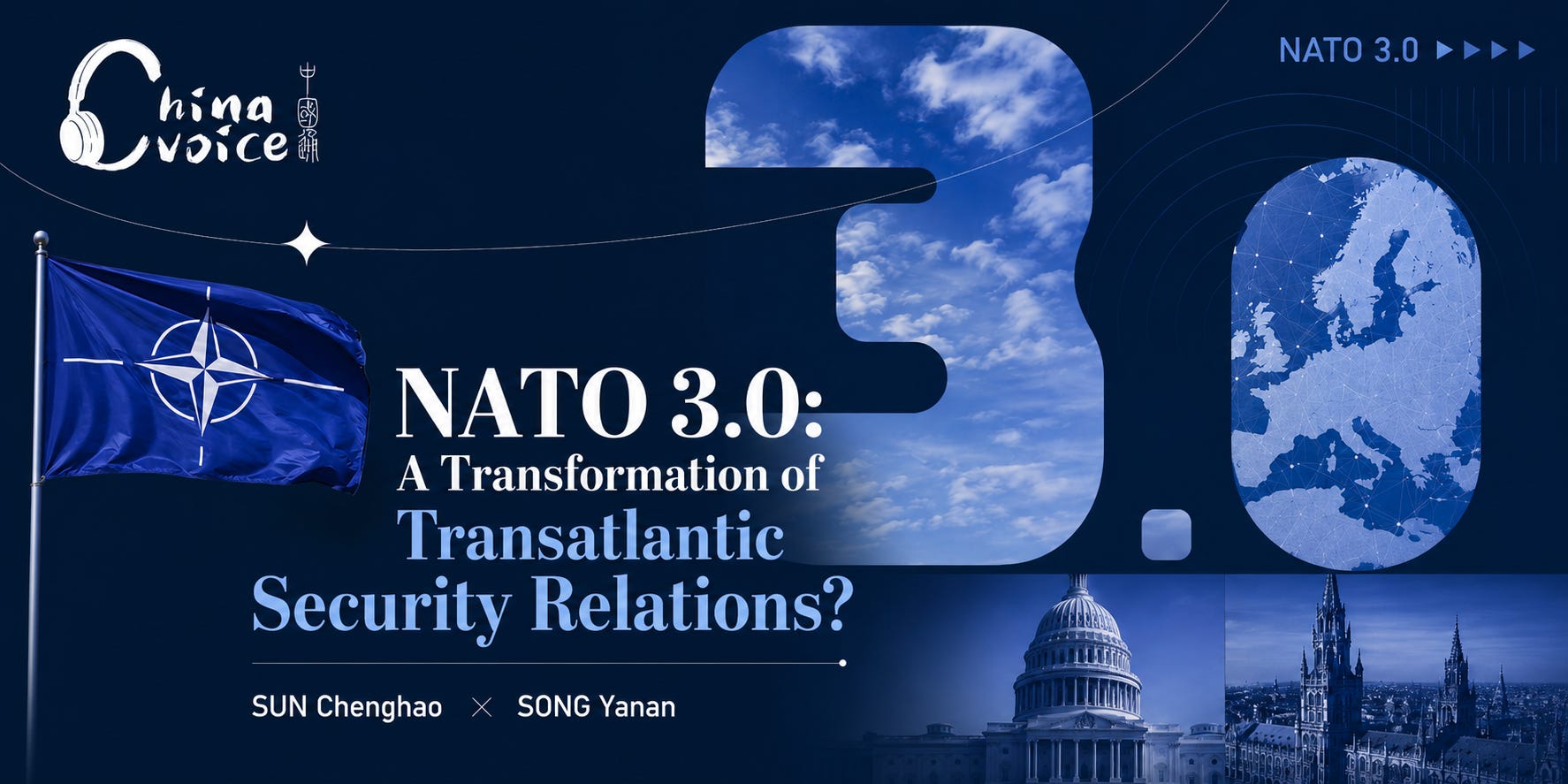
The recently concluded Ankara Summit may not have been the most dramatic NATO summit in recent years, but it could well prove to be the one that most clearly reflects the Alliance’s evolving nature. Previous summits largely revolved around questions such as whether the war in Ukraine would reinvigorate NATO, when Ukraine might join the Alliance, and whether President Trump would weaken the United States’ security commitments to Europe. By contrast, the Ankara Summit confronted a more fundamental and practical question: how NATO will continue to function as the United States expects Europe to shoulder greater responsibility while the European security environment continues to deteriorate.
NATO Secretary General Mark Rutte described this transformation as “NATO 3.0.” At its core, the concept envisions a rebalancing of security responsibilities within the Alliance, with European allies and Canada increasing defense spending, expanding defense industrial production, and assuming a greater share of collective defense.
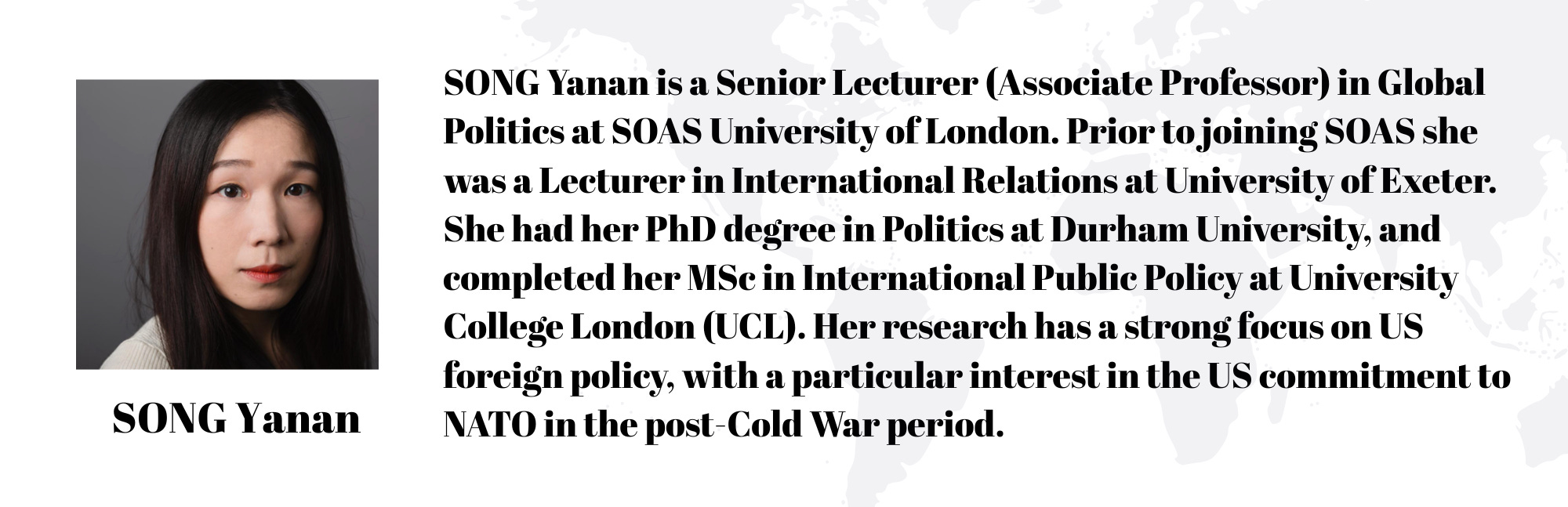
To explore the implications of NATO 3.0 and what this latest summit reveals about the Alliance’s future trajectory, we are delighted to welcome Professor Yanan Song of SOAS University of London. In this dialogue, we discuss the meaning and defining features of NATO 3.0, assess its prospects and potential challenges, and examine the strategic choices that are likely to confront Europe as it navigates a rapidly evolving transatlantic security landscape.
Experts in Today’s Dialogue:

Key Points:
Ankala Summit and the NATO’s Current Operational State
Prof. SONG positions the 2025 Ankara Summit not as a dramatic turning point for NATO, but as an important step in NATO’s long-running evolution. She defines its core character as strategic rebalancing: the 32-member bloc is adjusting internal responsibility allocation to adapt to a shifting global strategic landscape, while preserving cross-alliance unity amid evident internal political differences.
The summit delivers dual-layer outcomes: in the short term, it locks in immediate political reassurances including reaffirmation of Article 5 collective defense commitments and sustained collective support for Ukraine to solidify alliance cohesion. In the long term, it formally kickstarts the long-debated gradual transformation of NATO’s internal division of labor, rather than marking the end of that decades-long policy discussion. Notably, a clear implementation gap persists between the summit’s political pledges and tangible execution: adjustments to defense capacity building, cross-national industrial alignment and domestic political consensus take years of continuous investment to deliver, and cannot be measured only by public headline announcements.
NATO 3.0 and Redefinition of Tranatlantic Responsibility Division
Two experts agree that NATO 3.0 does not signal a weakoned alliance or U.S. withdrawal from European security, but instead refers to an attempt to build a far more sustainable transatlantic security architecture via balanced responsibility sharing. Europe will take primary charge of core conventional deterrence against Russia, military readiness improvement, cross-national defense industrial capacity building and sustained follow-up support for Ukraine, to free up U.S. resources for its long-term strategic priority of Indo-Pacific competition. And the U.S. will remain the irreplaceable core provider of nuclear deterrence, global intelligence sharing, strategic airlift, theater missile defense and unified alliance command and control systems for the foreseeable future, capabilities that cannot be easily transferred to European allies. For the Europe, although there is a growing recognition that it needs to take a greater responsibility for its own security, its defense capacity building still face many chanllenges. Increased defense budgets do not automatically translate to actual military capability, due to fragmented European defense industry and long production lead times for key equipment.
The two discussants also point out that people often overemphasize Trump’s personal role in pushing Europe to take more security responsibilities, and tend to ignore the broader underlying strategic trends. Prof. SONG notes the root of this adjustment lies in consensus in the U.S. over the past decade to devote more attention and resource to the strategic competition with China, which is an inevitable structural shift of US grand strategy rather than a reflection of a single president’s personal personality.
Future Trajectory of NATO and Transatlantic Relations
The two speakers confirmed that the transatlantic defense relationship has entered a more complex new phase, where cooperation and competition coexist as the new normal, rather than a binary choice between the two. While the two sides will remain close security allies, they are also becoming competitors in certain areas of defnese, technology and industry policy.
Looking ahead, NATO will gradually evolve into a more balanced, more Europe-centered but still fundamentally transatlantic alliance. Issue linkage, ad-hoc coalitions of willing allies and expanded loyalty tests covering broader strategic domains beyond traditional defense will become increasingly common features, as reaching full consensus across 32 members on every single agenda item grows progressively difficult.
At the end of this episode, Prof. SUN raises a question about China, asking how the new division of labor between the US and Europe may shape Europe’s future China policies. Prof. SONG argues that Europe will maintain close coordination with the U.S. on security and critical technology issues, but retain independent operational flexibility in its bilateral economic relations with China, rather than carrying out full alignment with Washington’s policy stances.
Follow ChinaVoice Now
Apple Podcast
Spotify
RSS Feed
https://rss.com/podcasts/chinavoice/3022810/(You can also copy this address from your browser’s address bar and paste it into any podcast app that supports RSS.)
Team
Producer: Chenghao Sun
Podcast Editor: Yinuo Wang, Yining Li
Content Editor: Yexu (Jasmine) Wang, Xueyu Zhang, Yijie Li
Graphics Designer: Xueyu Zhang


