



Welcome to the 92nd edition of our weekly newsletter! I’m SUN Chenghao, a fellow with the Center for International Security and Strategy (CISS) at Tsinghua University, Council Member of The Chinese Association of American Studies and a visiting scholar at the Paul Tsai China Center of Yale Law School (fall 2024).
ChinAffairsplus is a newsletter that shares articles by Chinese academics on topics such as China’s foreign policy, China-U.S. relations, China-Europe relations, and more. This newsletter was co-founded by my research assistant, ZHANG Xueyu, and me.
Through carefully selected Chinese academic articles, we aim to provide you with key insights into the issues that China’s academic and strategic communities are focused on. We will highlight why each article matters and the most important takeaways. Questions and feedback can be addressed to sch0625@gmail.com
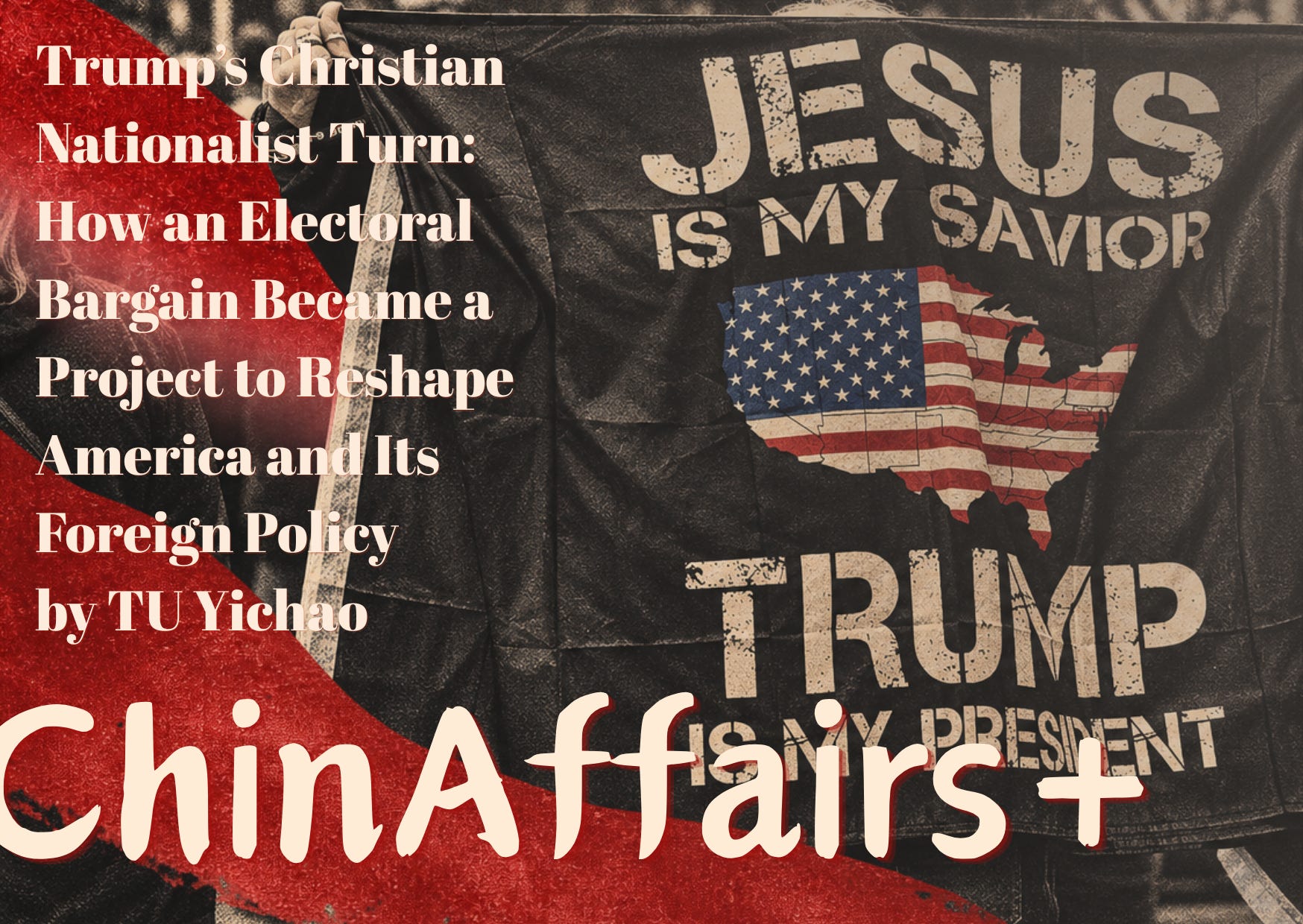
Today, we have selected an article examining how Christian nationalism has reshaped U.S. domestic and foreign policy during the Trump administrations.

Summary
The relationship between the Trump administrations and the religious right has undergone a profound transformation, shifting from a transactional alliance to an ideological fusion. During the first term, the relationship was defined by a mutually dependent exchange: evangelical voters provided political support in return for concrete policy outcomes-most notably conservative judicial appointments, anti-abortion executive orders, and a Middle East policy driven by Christian Zionism. The successes and limitations of the first term’s policies catalyzed a radicalization of this relationship heading into the second term.
Guided by“Project 2025”- a blueprint for Christian nationalism, the relationship in the second term is characterized by ideological convergence, with the “allies” of the first term evolving into the architects and administrators of the second. Rather than merely replicating past policies, the second term represents a systematic radicalization of the initial agenda; it aims to reshape the state apparatus, dismantle institutional checks and balances, and institutionalize Christian nationalist ideology as a core principle of governance. This trajectory poses profound challenges to America’s tradition of the separation of church and state, as well as to its pluralistic democratic values and norms, while simultaneously intensifying tensions with multilateralism on the global stage.
Why it matters
At the Pentagon’s 9/11 memorial in September 2026, President Donald Trump and Defense Secretary Pete Hegseth linked the ongoing war with Iran to America’s broader struggle against terrorism. The moment illustrates why religion, nationalism, and foreign policy can no longer be treated as separate issues in U.S. politics.
Today, we have selected an article examining how Christian nationalism has reshaped U.S. domestic and foreign policy during the Trump administrations. Its key contribution is to trace a shift from a first-term transactional alliance, in which religious conservatives supported Trump in exchange for judicial appointments, anti-abortion policies, and a pro-Israel Middle East agenda, to a second-term ideological fusion that seeks to embed Christian nationalist ideas into the state apparatus.
A Chinese perspective is especially important because U.S. domestic ideological changes directly affect Washington’s approach to human rights, immigration, Israel-Palestine, Iran, alliances, and multilateralism. Understanding these internal drivers helps international readers better assess how U.S. leaders justify policy choices and define America’s global role. The article should, however, be read with caution. Christian nationalism is a powerful lens, but it should not be treated as the only explanation for U.S. policy. Strategic interests, partisan incentives, institutional constraints, and personal political calculation also remain essential.
Key Points
1. Christian Nationalism: Concept and Definition
The major shift in domestic and foreign policies under the Trump administration is a result of profound changes in the population and social as well as economic structures of the United States.
Demographic Anxiety and the Rise of “Extra-Democratic” Approaches
The decline in white Christians’ share of the U.S. population, from 54% in 2008 to 41% in 2024, has fueled fears of cultural displacement and Christian nationalism. The movement seeks to preserve white Christian dominance through “extra-democratic” strategies targeting the Senate and federal judiciary, while framing immigration as a cultural threat.
Geo-economic Restructuring Under the Impact of Globalization
Import competition weakened manufacturing unions and their ties to the Democratic Party, leaving an organizational vacuum that conservative churches filled. This shift drew white working-class voters toward Republican religious conservatism, strengthening support for Trump’s cultural protectionism and religious agenda.
The Evolving Definition of Christian Nationalism
Unlike Christian realism, civil religion, or civic republicanism, Christian nationalism seeks institutional privilege for conservative Christianity, accommodating other religious conservatives while excluding liberalism and secularism. Its apocalyptic worldview frames foreign affairs as a struggle between good and evil. Common good constitutionalism provides an allied legal rationale for using expansive executive power and judicial transformation to impose conservative moral values, underpinning efforts to reshape the state during Trump’s second term.
2. The Religious Agenda of Trump’s First Term: Impact and Limitations
A transactional alliance defined Trump’s first term: the religious right supplied crucial electoral support in exchange for conservative judicial appointments, anti-abortion measures, restrictions on LGBTQ+ rights, and pro-Israel policies.
Domestic Policy: Delivering on the Promise of “Religious Freedom”
At home, the administration advanced the religious right’s priorities through judicial restructuring, executive action against abortion, and the weaponization of “religious freedom” in culture wars.
(1) Reshaping Justice: The Core Deal
Conservative judicial appointments formed the core bargain with evangelical voters. Trump appointed more than 200 federal judges, including three Supreme Court justices, while framing religious freedom as a key criterion. This agenda favored conservative Christian claims over those of other faiths, reflecting “Christian privilege” and using the judiciary to constrain progressive policies.
(2) Using Executive Power to Advance a Conservative Agenda
Trump used executive authority to expand religious exemptions, restrict abortion funding, weaken LGBTQ+ protections, and ease constraints on churches’ political activity. These measures rewarded the religious right while recasting “religious freedom”as a tool for advancing conservative Christian values through state power.
Foreign Policy: Projecting the Christian Right’s Worldview
Abroad, the influence of the domestic religious coalition was channeled chiefly through Mike Pence, Mike Pompeo, and evangelical advisers.
(1) High-Profile Promotion of the “International Religious Freedom” Agenda
International religious freedom became an institutionalized foreign-policy priority through ministerial summits, a dedicated international alliance, and an executive order, with religious-right leader Sam Brownback appointed to spearhead the agenda.
(2) Advancing a Pro-Israel Christian Zionist Agenda on Middle East Issues
Trump’s pro-Israel policies satisfied Christian Zionist constituencies, who interpreted recognition of Jerusalem and Arab–Israeli normalization through biblical narratives. This alignment marginalized Palestinian claims, including those of Palestinian Christians, and undermined U.S. credibility as a mediator.
(3) A Rightward Shift in Stance on Global Governance Issues
Religious conservatism extended domestic culture wars into global governance through expanded abortion-related aid restrictions, conservative coalitions opposing reproductive and LGBTQ+ rights, and efforts to prioritize religious freedom and property rights in U.S. human rights diplomacy.
(4) Intensive Long-Arm Jurisdiction over Religious Human Rights Targeting Specific Countries
First-term diplomacy combined transactional “America First” priorities with religious-right demands, but establishment resistance and institutional checks constrained implementation. These limits convinced Christian conservatives that executive orders and judicial appointments alone were insufficient, fueling the second term’s more radical agenda.
3. Trump’s Second Term: The Institutionalization and Radicalization of Christian Nationalism
The second term shifts toward institutionalizing Christian nationalism through federal personnel restructuring, religious oversight bodies, and nationwide mobilization. This fusion of ideology and state power also shapes foreign policy, casting the U.S.–Iran war in apocalyptic, “crusading” terms.
l Reshaping Domestic Governance: The Implicit “Establishment” of Christianity and Institutional “Purges”
Civil-service restructuring, new religious oversight bodies, and national prayer campaigns embed Christian nationalism within federal governance. Restrictions on abortion and transgender rights advance this agenda, while immigration enforcement at places of worship exposes its selective protection of religious freedom. These measures face sustained legal challenges from civil-rights and interfaith coalitions.
l Recasting Foreign Policy: The Ideologization of Geopolitics and the Decline of Multilateralism
The Trump administration’s second-term foreign policy casts geopolitical competition as a Christian nationalist struggle between good and evil, deepening international divisions while consolidating domestic support.
(1) Implementation of “Project Esther” and the Instrumentalization of Antisemitism
Project Esther frames pro-Palestinian activism as a terrorist support network, conflating anti-Zionism with antisemitism. Its agenda aligns with visa revocations and threats to university funding, turning antisemitism prevention into a tool for suppressing dissent and embedding Christian Zionist priorities in national security policy.
(2) Value-Based Pressure: “Civilizational Admonishment” of European Allies
America’s relations with European allies are increasingly framed around Christian civilizational identity, recasting transatlantic cooperation as a conservative alliance against globalism and multiculturalism. This approach resonates with parts of the Central and Eastern European right while alienating Western European mainstreams, deepening divisions within the West.
(3) The “Sacralization” of Geopolitical Conflict: The Dual Logic of the 2026 U.S.-Iran War
Apocalyptic rhetoric casts the U.S.-Iran war as a divinely sanctioned struggle, seeking to sustain its legitimacy despite public opposition. Hegseth’s integration of evangelical messaging into military institutions reinforces this framing, while reported complaints from service members highlight religious coercion and divisions within the ranks.
(4) The Gaza Peace Plan: Tension Between Realism and Eschatological Theology
Postwar Gaza diplomacy of the U.S. exposes tensions between religious-nationalist demands for Israeli territorial expansion and transactional efforts to secure Arab-Israeli normalization. Pro-Israel donors and ideological intermediaries reinforce annexationist pressures, while commercial and diplomatic priorities favor accommodation with Arab partners, leaving regional strategy caught between domestic coalition demands and geopolitical bargaining.
Religious Backlash and Coalition Fractures: The Spring 2026 Crisis in Religious Public Opinion
Religious war rhetoric, clashes with the pope, and Trump’s self-deification intensified the backlash in spring 2026, extending opposition beyond liberal and minority constituencies and fracturing his conservative base.
(1) A Historic Clash Between the White House and the Vatican
Clashes with Pope Leo XIV over the Iran war expose a fundamental tension between “America First” Christian nationalism and Catholic commitments to peace and universal concern, with Trump and Vance rejecting papal criticism as interference in U.S. policymaking.
(2)The “AI Jesus” Incident: Crossing the Bottom Line of Conservative Theology
An AI-generated image portraying Trump as a Christ-like healer provoked accusations of blasphemy from conservative allies, exposing tensions between personal loyalty and religious conviction. Continued support from evangelical leaders and parts of the broader religious right underscored the coalition’s uneven response.
(3)Religious Support Erodes in Spring 2026, yet Institutional Backing Holds
Religious support weakened by spring 2026: Catholic approval stood at 48%, while white evangelical confidence in Trump’s moral fitness fell from 55% to 40%. Opposition to the Iran war crossed denominational lines, exposing tensions between religious ethics and political loyalty. Yet much of the religious right remained supportive, and conservative judicial appointments provided durable institutional backing for the administration’s agenda.
Conclusion
The relationship between the Trump administration and the Christian right has moved from a transactional alliance in his first term to a deeper ideological fusion in his second. What began as an electoral bargain has evolved into an effort to embed religious conservatism within the machinery of the state, from bureaucratic restructuring and judicial politics to foreign policy. Christian nationalism is no longer merely a mobilizing tool; it has become one of the organizing logics of governance.
Across both terms, Trump’s religious agenda has remained consistent: defending “religious freedom,” opposing abortion and progressive social values, supporting Israel, and promoting traditional values abroad. Yet the second term marks a qualitative shift. Religious policy has moved from symbolic gestures to institutional reconstruction, challenging the principle of church-state separation more openly and linking domestic politics with diplomacy.
This fusion creates a self-reinforcing political cycle. Domestic religious constituencies shape foreign-policy priorities, while values-based diplomacy consolidates Trump’s support at home. The result is a more ideological administrative state, one that seeks to defend Christian privilege while weakening pluralist and legal constraints. Its consequences will extend beyond U.S. politics, affecting America’s credibility and the future of global religious governance.
About the Author

Dr. TU Yichao is an associate professor at Center for American Studies, Fudan University. She did research work at the CUHK in 2006, and at Wheaton College sponsored by Billy Graham Evangelical Association and East Gates International in 2007. Now she is an invited fellow in the 2008 program of Asian Christian Higher Education sponsored by the United Board for Christian Higher Education in Asia.
Dr. Tu is the author of American Evangelicals and International Relations (Shanghai People’s Publishing House, Shanghai, forthcoming), as well as several articles and papers on religion and international Relations, religion and politics in the US, and history of Christianity in China.
About the Publication
The Chinese version of the article was published by The Chinese Journal of American Studies (《美国研究》). Founded in 1987 as a quarterly, This Journal has been published every two months since 2014. Jointly sponsored by the Institute of American Studies at the Chinese Academy of Social Sciences and the Chinese Association for American Studies, the journal features Chinese scholars’ research on diverse aspects of American society, including politics, economics, foreign policy, military affairs, science and technology, culture, history, the arts, and intellectual currents. It serves as a shared academic forum for China’s American studies community, fostering scholarly exchange and a deeper understanding of the United States.

