



Welcome to the 78th edition of our weekly newsletter! I’m SUN Chenghao, a fellow with the Center for International Security and Strategy (CISS) at Tsinghua University, Council Member of The Chinese Association of American Studies and a visiting scholar at the Paul Tsai China Center of Yale Law School (fall 2024).
ChinAffairsplus is a newsletter that shares articles by Chinese academics on topics such as China’s foreign policy, China-U.S. relations, China-Europe relations, and more. This newsletter was co-founded by my research assistant, ZHANG Xueyu, and me.
Through carefully selected Chinese academic articles, we aim to provide you with key insights into the issues that China’s academic and strategic communities are focused on. We will highlight why each article matters and the most important takeaways. Questions and feedback can be addressed to sch0625@gmail.com
Today, we present a collection curated by LI Yining and LI Yijie, Chinese Perspectives on the 250th Anniversary of the US, on how leading Chinese scholars evaluate America’s structural transition, its severe domestic polarization, and the enduring resilience of its institutions and technology.
Summary
This collection brings together four distinct Chinese assessments of America’s 250th anniversary. Zhang Tengjun describes the moment as a “historical halftime,” while the other contributors emphasize prolonged adjustment, institutional resilience, or the uncertain relationship between declining hegemony and national power.
Despite maintaining global leadership in technology and economics, the U.S. is plagued by structural dilemmas. The authors highlight a fractured national consensus fueled by severe political polarization, widening inequality, and intense culture wars over identity and historical narratives. The traditional “progressive narrative” is facing unprecedented internal challenges.
However, the essays caution against simplistic predictions of American collapse. Zhu Zhaoyi emphasizes the resilience and adaptive capacity of U.S. institutions. Da Wei, by contrast, questions whether the conventional idea of American “self-correction” adequately explains the country’s historical development. Meanwhile, the U.S.-led order commonly associated with “Pax Americana” is visibly eroding—often dismantled by the U.S. itself due to domestic constraints—while America’s technological frontier remains a possible engine for national renewal.
Taken together, the four essays portray a contested American transition. Their authors share concerns about polarization and structural strain, while differing over the resilience of U.S. institutions, the prospects for national renewal, and the future of American global leadership.
Why It Matters
As the United States approaches its 250th anniversary, understanding how several Chinese scholars assess America’s trajectory is useful. This collection moves beyond simplistic narratives of “American decline.” Instead, the selected authors offer a nuanced assessment, acknowledging both America’s severe internal fractures and its continuing institutional and technological strengths.
For global policymakers, businesses, and analysts, these insights are useful. They reveal how these authors interpret U.S. domestic polarization, shifting foreign policies, and the erosion of “Pax Americana.” This selection represents a cross-section of Chinese scholarly debate and carries no claim to official status.
Key Points
1. CICIR Institute of American Studies Research Group: The United States at 250: How Did It Get Here, and Where Is It Headed?
Beneath the clamor of the celebrations marking the 250th anniversary of American independence on July 4, 2026, the two parties’ dispute over “what exactly should be celebrated” deepens public division. National pride has fallen to a 25-year low. Mainstream media and think tanks clash over core questions such as “What is America?” This prompts deep reflection on how the United States arrived at this point and where it is headed.
The Development Course of the United States and the Evolution and Predicament of American-style Capitalism
From independence to the late 19th century, American laissez-faire capitalism developed gradually. From the late 19th century to the 1930s, it developed into monopoly capitalism. From the 1930s to the late Cold War, it moved from general monopoly capitalism toward state monopoly capitalism, with international hegemony fully taking shape. From the late Cold War to the first decade of the 21st century, state monopoly capitalism became rigid, and waves of privatization, marketization, and liberalization pushed the United States toward international financial monopoly capitalism.
U.S. Structural Problems Keep Emerging, but Its Global Lead Is Hard to Overturn in the Short Term
The United States still leads globally in the economic, technological, security, and global governance spheres, but widening wealth gaps, erosion of the manufacturing base, a long-term decline in manufacturing employment, slowing marginal growth, and waning national identity are undermining its hegemony. The report argues that checks and balances have become increasingly dysfunctional, contributing to political gridlock. Ideological polarization deepens the dispute over “What is America?” With global leadership in decline, American hegemony is hard to sustain.
Looking Ahead, the United States Will Enter a Prolonged Period of Adjustment Marked by Both Restructuring and Division
The relative decline of hegemony does not mean national power will collapse overnight, and some strength may be restored, but a return to the “golden age” is extremely difficult. Financial monopoly capital squeezes the real economy, entrenching industrial hollowing out. The tech-right and financial oligarchs are deeply embedded in politics, exacerbating polarization and K-shaped growth while the public grows disillusioned. The right wing is internally divided, and the two parties battle over major issues, with the public interest reduced to a casualty. These fundamental problems mean the United States can hardly replicate its past “greatness.”
2. ZHANG Tengjun: America at 250: Halftime of History
The U.S. marks its 250th anniversary amid mixed feelings. Zhang argues that a question long posed by Black Americans and other minority groups—“What does it mean to love a country that does not love you?”—is now confronting the broader American public.
Two Bodies Vie for Control of the Celebrations, and Two Narratives Tear Apart National Consensus
In 2016, Congress created the “U.S. Semiquincentennial Commission” for the celebrations. In January 2025, Trump established Task Force 250 by executive order. Later that year, following a cooperative agreement with the National Park Service, the National Park Foundation created Freedom 250 LLC to help organize anniversary events. Zhang argues that the creation of the parallel structure shifted control over the celebrations and directed a larger share of federal funding toward Freedom 250. The competing arrangements push rival narratives: one of diversity and historical reflection, the other of national glory and “greatness again.” Polls show record-low national pride and deep pessimism about the “American Dream” and the country’s future. In 1976, similar difficulties helped forge national healing; today, grander celebrations expose a shattered basic consensus.
An Inherent Contradiction Ignites a Culture War on Two Fronts: Identity Politics and Historical Narrative
The Declaration of Independence proclaimed that "all men are created equal" while slavery persisted, an inherent contradiction from America's very birth that comes into sharp focus on the 250th anniversary. For a long time, the "progressive narrative" could still be maintained — yet today it has become untenable. The culture wars unfold along two fronts: one is the battle over identity politics, with the two sides mirroring each other through "anti-wokeness" versus diversity and inclusion, squeezing the middle ground; the other is the clash over historical narratives, from the "1619 Project" to book bans and the removal of statues, where even the path of looking back at history has split in two.
Ideological Divisions Spill into the Economic and Diplomatic Spheres, Driving a Transformation of American Power
Ideological divisions are now spilling over into the economic and diplomatic spheres: macro data is strong, yet public sentiment has hit rock bottom, and “affordability” has become the top concern. On the economic front, bipartisan consensus is driving manufacturing reshoring and supply chain security, a course correction from neoliberalism, but in the short term tariffs raise consumer prices, while fiscal subsidies add to federal debt pressures, with long-term competitiveness still in doubt. On the diplomatic front, the Monroe Doctrine is reviving, the Western Hemisphere is once again a priority, and allies face transactional pressure. The Economist argues that domestic polarization is being transmitted into foreign policy volatility, adding to global uncertainty.
Pessimism and Optimism Coexist, and the "Republican Experiment" Stumbles Forward Through Detours and Corrections
Looking back from the 250th anniversary, pessimism and optimism coexist. The pessimistic case lies in political dysfunction, collapsed social trust, and generational value divides. The optimistic case rests on foundational innovation, demographic and immigrant vitality, and local civic energy that still fuel national self-renewal. The “republican experiment” launched 250 years ago has no destined endpoint and is bound to cycle through detours and corrections. This anniversary is merely a historical halftime. America will neither easily disintegrate nor swiftly become “great again,” but will keep stumbling forward in the tension between its ideals and reality. For the world, more meaningful than pronouncing its rise or fall is to soberly prepare for a more uncertain future.
3. ZHU Zhaoyi: America at 250: Roots, Institutions, and Fractures
Philadelphia is revisiting the founding history of 1776, while the San Francisco Bay Area is chasing technology and the future—the same country split by two different themes. But the reason the United States has not followed the historical trajectory of great powers from rise to decline after 250 years lies in an institutional root system that can self-correct, self-restructure, and continuously absorb new elements amid its fractures.
The Span of Growth: Paradigm Shifts Every Half-Century to a Century and an Unfinished Project in the Public Mind
With roughly 4% of the world’s population, the United States accounts for 26% of global GDP. Over the past 25 years, it has received more than 60% of global venture-capital investment, and more than half of the world’s most important AI models have been developed there. Among countries with populations above 10 million, none has a higher GDP per capita. What truly sets it apart is that, despite repeated crises throughout its history, it has never been locked into decline. The key lies in the fact that its growth has never been dependent on a single industry; roughly every half-century to a century, it restructures its growth paradigm, replacing old engines with new ones. Majorities of Republicans, Democrats, and independents say the American Dream remains a work in progress. Zhu interprets this finding as evidence that many Americans still view the national project as unfinished, and this collective mindset is precisely the evidence that it continues to grow.
Institutions Are the Primary Productive Force: Self-Correction, Restructuring, and Absorption That Keep Recombining Factors of Production
The foundation of America's long-cycle resilience lies in its institutions. Its political institutions disperse power through checks and balances, reduce the risk of systemic collapse, and provide room for error correction in times of crisis. Its economic institutions, built on property rights protection, contract enforcement, and deep capital markets, form the incentive foundation for long-term investment and innovation. Its social institutions, particularly an immigration system that attracts global talent and top-tier universities backed by substantial research funding, convert human capital into continuous innovative output. Together, these three layers endow American institutions with three rare qualities: the capacity to self-correct, to restructure, and to absorb. Land, capital, and technology are all factors of production, but the institution that enables the continuous recombination of these factors is the primary productive force.
The Price of Hegemony: How Global Dominance Breeds Inequality, Partisan Rupture, and a Nation Divided Between Optimism and Despair
Zhu argues that America’s geographic security buffer has facilitated extensive overseas intervention while limiting the direct military risks to its homeland. Such interventions can still impose heavy fiscal, military, and political costs. He identifies the dollar system as a durable instrument of U.S. power. At home, the unequal distribution of globalization’s gains has intensified political and social divisions. In his assessment, these forces make the United States both a highly dynamic testing ground and a potentially dangerous source of instability.
Zhu Argues That China Has Benefited from the Existing Order and Seeks a Greater Voice Within It
Zhu argues that China has been a major beneficiary of the U.S.-led international order and seeks greater institutional influence within that order. The core insight from America’s 250-year experience is that institutional resilience lies in maintaining the capacity for self-correction and continuous absorption. Zhu concludes that most states will continue to operate largely within the existing system, while the United States itself lacks the capacity to construct an entirely new international order.
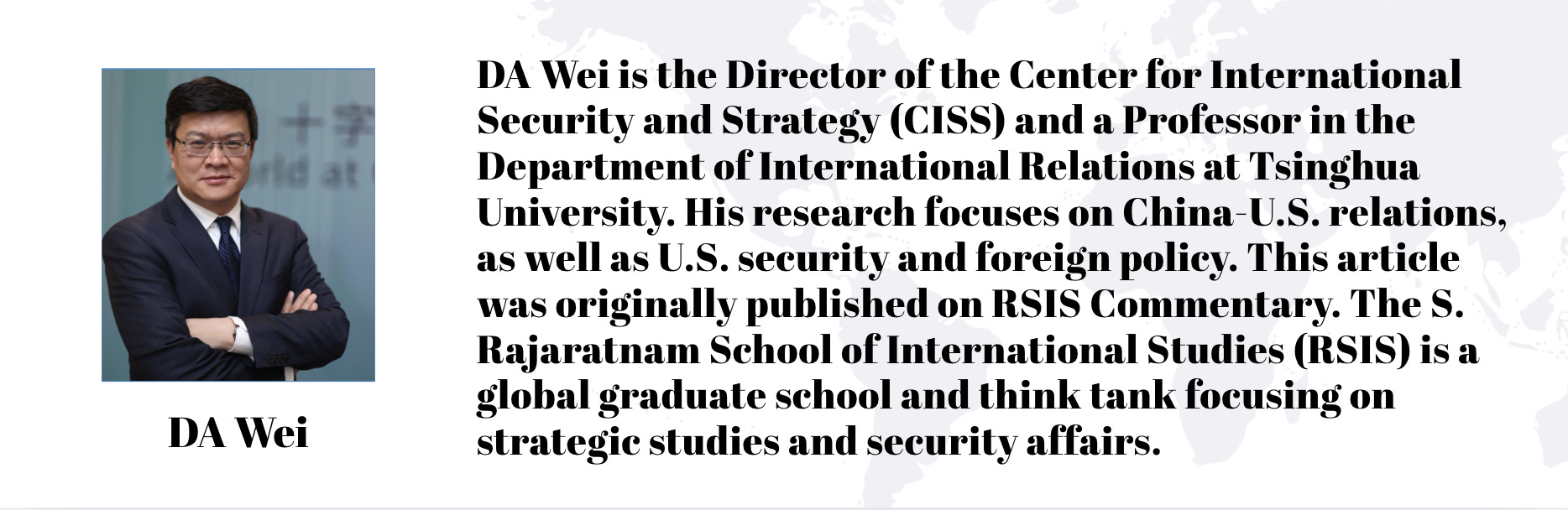
4. DA Wei: The End of Hegemony and the Rebirth of Power: America on Its 250th Anniversary
The United States is in an interregnum marked by the end of the old "Pax Americana" order, uncertainty over the trajectory of its power, and a still-blurry new world of the "Post-American Era."
The Rise and Fall of American Hegemony: How Two Traditions Pulled America from Dominance to Self-Dismantlement
Two traditions have always pulled at American foreign policy—the self-preserving republican tradition and the expansionist imperial tradition—driving its trajectory from a great power to a hegemon in a pattern of “two steps forward, one step back.” After World War II, the United States built an institutional order centered on the United Nations and a network of international institutions. During the Cold War, this order operated primarily within the Western bloc; after the Cold War, it expanded globally under U.S. unipolarity. Yet hegemony itself sows the seeds of decline; internal contradictions such as industrial hollowing out and strategic overreach erupted after 2008, giving rise to Trump’s “table-flipping” foreign policy. Today, the United States is ending its hegemony in a rare way—not by external defeat, but by actively dismantling the system it built, trapped in the core dilemma of being unwilling to bear the costs and constraints of liberal internationalist hegemony while still wanting to enjoy its benefits.
The Rise and Fall of American Power: The Technological Frontier as the Most Realistic Remaining Path to Renewed Power, but Institutional Hegemony Hard to Rebuild
America’s leaps in national power have relied on geographical, institutional, and technological frontiers. The first two avenues are increasingly constrained, making the technological frontier the most realistic path to reviving its strength. Yet even if technological change grows the “pie,” it may fail to improve distribution and could intensify the concentration of wealth and power. America’s much-vaunted “capacity for self-correction” is in essence a reinterpretation of its founding ideals in different historical contexts; past success offers no guarantee of future victory. American power may rise again, but a “Pax Americana”-style institutional hegemony is now difficult to rebuild, owing to the absence of the overwhelming material advantage, international prestige, and domestic consensus that the United States possessed in 1945 or at the end of the Cold War.
Conclusion
Taken together, the four articles portray America at 250 as a formidable power navigating a painful, long-term transition rather than a failing state. They share concerns about domestic contradictions, partisan gridlock, and cultural fractures, but they differ over the resilience of U.S. institutions, the prospects for national renewal, and the future of American global leadership. The era of unquestioned “Pax Americana” is fading, yet America’s future trajectory remains contested rather than predetermined. As the U.S. stumbles forward as an “unfinished project,” it will continue to wrestle with the gap between its founding ideals and reality. For the rest of the world, the focus must shift from predicting America’s collapse to adapting to a more complex, uncertain international landscape defined by this ongoing transformation.


